. 2023 Sep 5;13(1):14659.
doi: 10.1038/s41598-023-41801-2.

Function of a mutant ryanodine receptor (T4709M) linked to congenital myopathy

Affiliations

Function of a mutant ryanodine receptor (T4709M) linked to congenital myopathy

Zsuzsanna É Magyar et al. Sci Rep. .

Abstract

Physiological muscle contraction requires an intact ligand gating mechanism of the ryanodine receptor 1 (RyR1), the Ca2+-release channel of the sarcoplasmic reticulum. Some mutations impair the gating and thus cause muscle disease. The RyR1 mutation T4706M is linked to a myopathy characterized by muscle weakness. Although, low expression of the T4706M RyR1 protein can explain in part the symptoms, little is known about the function RyR1 channels with this mutation. In order to learn whether this mutation alters channel function in a manner that can account for the observed symptoms, we examined RyR1 channels isolated from mice homozygous for the T4709M (TM) mutation at the single channel level. Ligands, including Ca2+, ATP, Mg2+ and the RyR inhibitor dantrolene were tested. The full conductance of the TM channel was the same as that of wild type (wt) channels and a population of partial open (subconductive) states were not observed. However, two unique sub-populations of TM RyRs were identified. One half of the TM channels exhibited high open probability at low (100 nM) and high (50 μM) cytoplasmic [Ca2+], resulting in Ca2+-insensitive, constitutively high Po channels. The rest of the TM channels exhibited significantly lower activity within the physiologically relevant range of cytoplasmic [Ca2+], compared to wt. TM channels retained normal Mg2+ block, modulation by ATP, and inhibition by dantrolene. Together, these results suggest that the TM mutation results in a combination of primary and secondary RyR1 dysfunctions that contribute to disease pathogenesis.


Conflict of interest statement

The authors declare no competing interests.

Figures
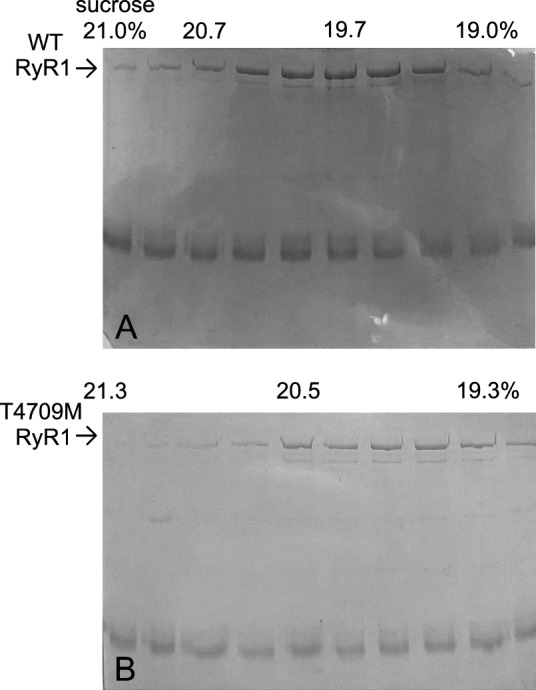
Figure 1
Figure 1
SDS-PAGE of RyR1 samples purified from skeletal muscle tissue. (A) Samples of different sucrose gradient fractions of a RyR1 preparation from wt mice. The arrow indicates the band of the RyR1 protein. Sucrose concentrations (%) were as indicated. (B) Samples of a RyR1 preparation as in (A) from a homozygous T4709M RyR1 mice.
Figure 2
Figure 2
Biophysical properties of RyR1 channel currents. (A) Current–voltage relationships of wt and T4709M single RyR1s. Average (± SE) wt and T4709M RyR1 channel slope-conductances are indicated in the right corner. (B) Representative amplitude histograms at -60 mV of wt and T4709M RyR1s.
Figure 3
Figure 3
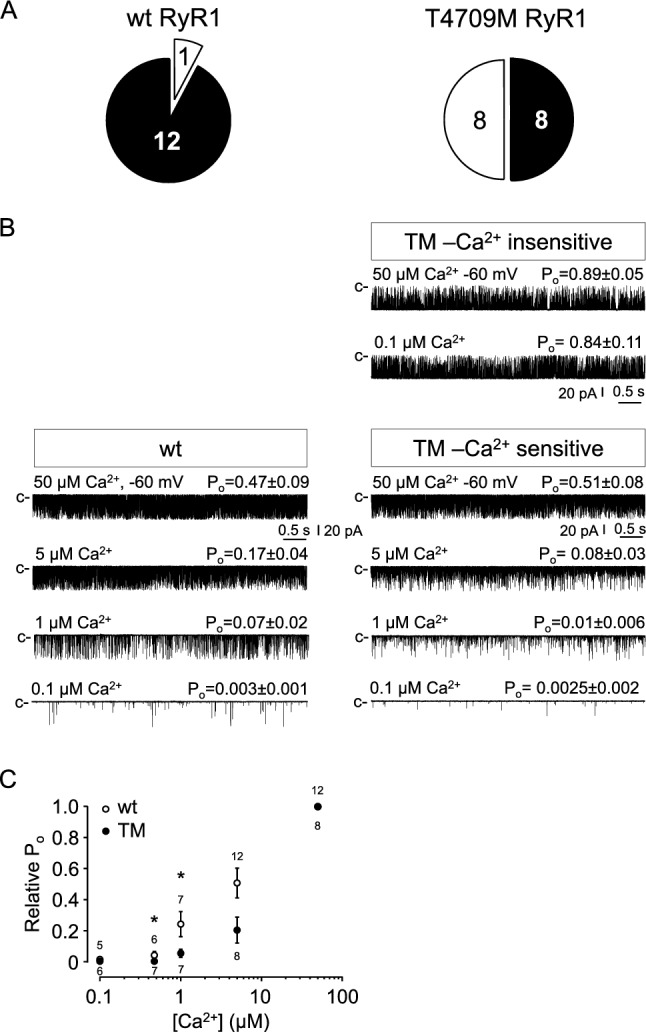
Ca2+ dependence of wt and T4709M RyR1 channel activity. (A) Pie charts summarizing the proportion of wt (left) and T4709M (right) RyR channels that responded to changes in cytosolic [Ca2+] (black). (B) Representative single channel current traces of wt and T4709M RyR1 channels at high (50 μM) and low (100 nM) cytosolic [Ca2+]. The closed state of the channel is marked by `c`. Downward deflections correspond to channel openings. Average open probabilities (Po) ± SE are indicated above each trace. (C) Relative RyR1 channel open probabilities (Po) (mean ± SE) plotted as a function of cytosolic [Ca2+]. Pos are expressed relative to control, recorded at 50 μM Ca2+.
Figure 4
Figure 4
The effect of Mg2+- and ATP on the activity of wt and T4709M RyR1 channels. (A) Mean ± SE of Po of wt and T4709M RyR1 channels (50 μM cytosolic Ca2+) at different cytosolic Mg2+ concentrations normalized to control Po obtained at 0 μM Mg2+. (B) Mean ± SE of Po of wt and T4709M RyR1 channels (0 mM cytosolic Mg2+ and 100 nM cytosolic Ca2+) at different ATP concentrations normalized to control Po obtained at 0 μM ATP.
Figure 5
Figure 5
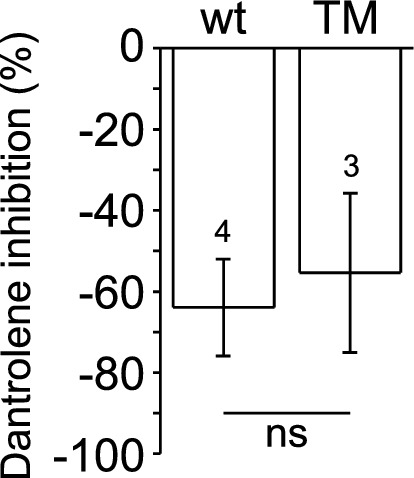
The effect of dantrolene on wt and T4709M RyR1 channels. Control single channel currents of wt and T4709M RyR1 channels were recorded in the presence of 50 μM Ca2+, 1 mM ATP and 3 mM Mg2+. The channels were then treated with 10 μM dantrolene. Data are expressed as [(Po dantrolene/Po control) − 1] × 100.

References

    1. Fill M, Copello JA. Ryanodine receptor calcium release channels. Physiol. Rev. 2002;82:893–922. - PubMed
    1. Calderón JC, Bolaños P, Caputo C. The excitation–contraction coupling mechanism in skeletal muscle. Biophys. Rev. 2014;6:133–160. - PMC - PubMed
    1. Smith JS, Coronado R, Meissner G. Sarcoplasmic reticulum contains adenine nucleotide-activated calcium channels. Nature. 1985;316:446–449. - PubMed
    1. Smith JS, Coronado R, Meissner G. Single channel measurements of the calcium release channel from skeletal muscle sarcoplasmic reticulum. Activation by Ca2+ and ATP and modulation by Mg2+ J. Gen. Physiol. 1986;88:573–588. - PMC - PubMed
    1. Smith JS, Imagawa T, Ma J, Fill M, Campbell KP, Coronado R. Purified ryanodine receptor from rabbit skeletal muscle is the calcium-release channel of sarcoplasmic reticulum. J. Gen. Physiol. 1988;92:1–26. - PMC - PubMed

Publication types

Substances