Observational Study
. 2023 Nov;280(11):5115-5128.
doi: 10.1007/s00405-023-08163-x. Epub 2023 Sep 5.

Distinct smell and taste disorder phenotype of post-acute COVID-19 sequelae

Affiliations
Observational Study

Distinct smell and taste disorder phenotype of post-acute COVID-19 sequelae

Verena Rass et al. Eur Arch Otorhinolaryngol. 2023 Nov.

Abstract

Purpose: Olfactory dysfunction (OD) commonly accompanies coronavirus disease 2019 (COVID-19). We investigated the kinetics of OD resolution following SARS-CoV-2 infection (wild-type and alpha variant) and its impact on quality of life, physical and mental health.

Methods: OD prevalence was assessed in an ambulatory COVID-19 survey (n = 906, ≥ 90 days follow-up) and an observational cohort of ambulatory and hospitalized individuals (n = 108, 360 days follow-up). Co-occurrence of OD with other symptoms and effects on quality of life, physical and mental health were analyzed by multi-dimensional scaling, association rule mining and semi-supervised clustering.

Results: Both in the ambulatory COVID-19 survey study (72%) and the observational ambulatory and hospitalized cohort (41%) self-reported OD was frequent during acute COVID-19. Recovery from self-reported OD was slow (survey: median 28 days, observational cohort: 90 days). By clustering of the survey data, we identified a predominantly young, female, comorbidity-free group of convalescents with persistent OD and taste disorders (median recovery: 90 days) but low frequency of post-acute fatigue, respiratory or neurocognitive symptoms. This smell and taste disorder cluster was characterized by a high rating of physical performance, mental health, and quality of life as compared with convalescents affected by prolonged fatigue or neurocognitive complaints.

Conclusion: Our results underline the heterogeneity of post-acute COVID-19 sequelae calling for tailored management strategies. The persistent smell and taste disorder phenotype is characterized by good clinical, physical, and mental recovery and may pose a minor challenge for public health.

Study registration: ClinicalTrials.gov: NCT04661462 (survey study), NCT04416100 (observational cohort).

Keywords: Long COVID; Mental health; Olfactory dysfunction; Post-COVID-19 condition; Quality of life; Smell and taste disorder.


Conflict of interest statement

No support from any organization for the submitted work; PT owns a data science enterprise, Data Analytics as a Service Tirol, and has received an honorarium for statistical data analysis and scientific writing of the manuscript; no other relationships or activities that could appear to have influenced the submitted work.

Figures
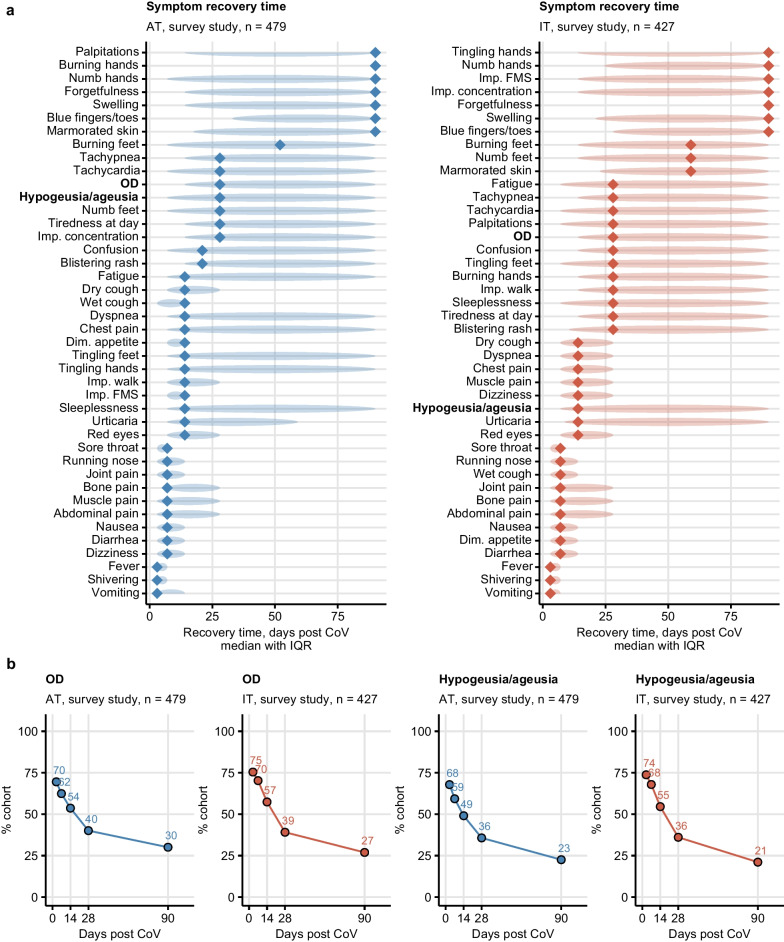
Fig. 1
Fig. 1
Symptom-specific recovery times in the ambulatory COVID-19 survey study. Symptom-specific recovery times were calculated for each participant of the survey study cohorts (Austria: AT, Italy: IT). a Distribution of the recovery times in the individuals with the indicated symptoms present during acute COVID-19 (first 14 days after clinical onset). Diamonds represent median recovery times, tinted ellipses code for interquartile ranges. Numbers of complete observations are indicated in the plot captions. b Percentages of individuals with self-reported olfactory dysfunction and taste disorders in the AT and IT survey study cohorts at particular time points after clinical onset. Numbers of complete observations are indicated under the plots. OD self-reported olfactory dysfunction, Imp. concentration impaired concentration, Dim. appetite diminished appetite, Imp. walk impaired walk, Imp. FMS impaired fine-motor skills
Fig. 2
Fig. 2
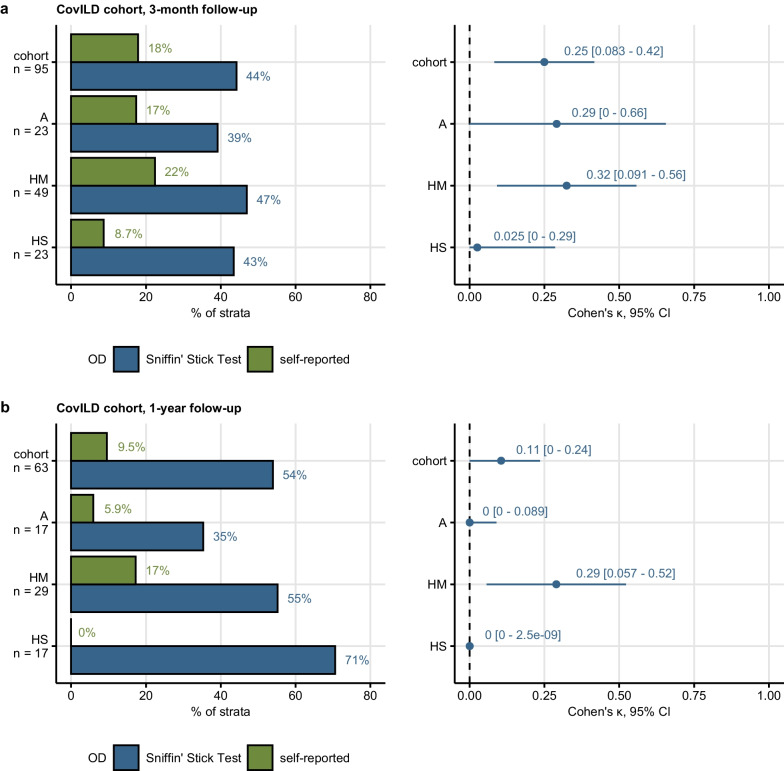
Rates of subjective and objective hyposmia in the CovILD cohort two months and one year after COVID-19. Objective olfactory dysfunction (OD) was diagnosed in CovILD study participants with < 13 correctly identified odorants in the 16-item Sniffin’ Sticks Identification Test. Frequencies of objective and self-reported olfactory dysfunction were compared at the 3-month (a) and 1-year follow-up (b) after COVID-19 in the entire cohort and the ambulatory (A), hospitalized moderate COVID-19 (HM) and hospitalized severe COVID-19 (HS) subset of the cohort. Concordance between the self-reported and objective olfactory dysfunction was assessed by Cohen’s κ inter-rater reliability statistic. Percentages of individuals with self-reported and objective hyposmia within the cohort or COVID-19 severity strata are presented in bar plots. Cohen’s κ with 95% confidence intervals (CI) are displayed in Forest plots
Fig. 3
Fig. 3
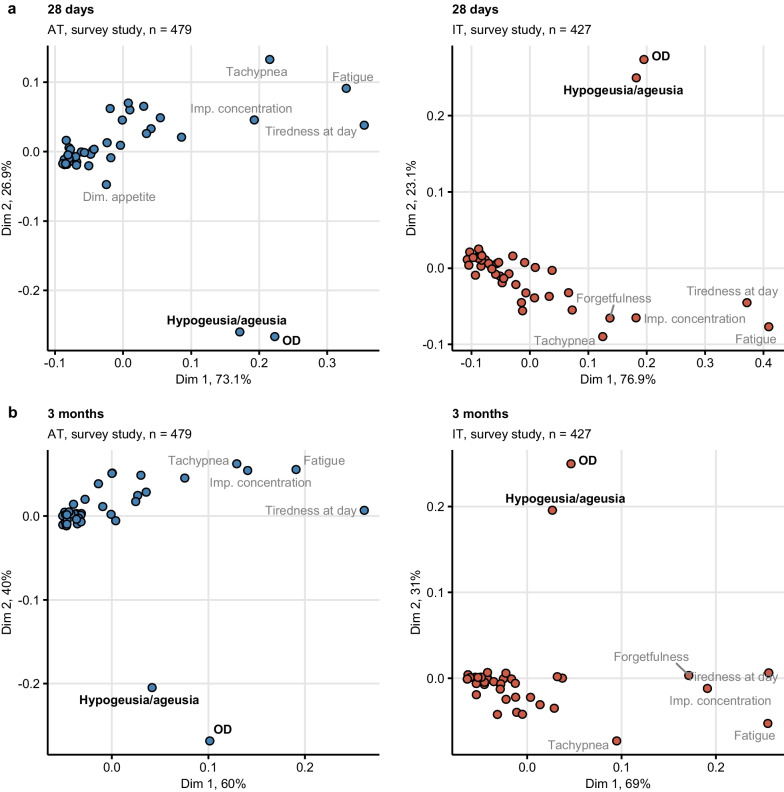
Self-reported olfactory dysfunction and taste disorders are isolated persistent symptoms of COVID-19. Symptom data during at 28 days (a) and 3 months (b) after clinical onset in the Austria (AT) and Italy (IT) survey study cohorts were subjected to two-dimensional multi-dimensional scaling (MDS) with simple matching distance between the symptoms. MDS coordinates are presented in scatter plots. Selected data points are labeled with the symptom names. Percentages of the data set variance associated with the MDS dimensions are indicated in the plot axes. Numbers of complete observations are indicated in the plot captions. OD self-reported olfactory dysfunction, Imp. concentration impaired concentration
Fig. 4
Fig. 4
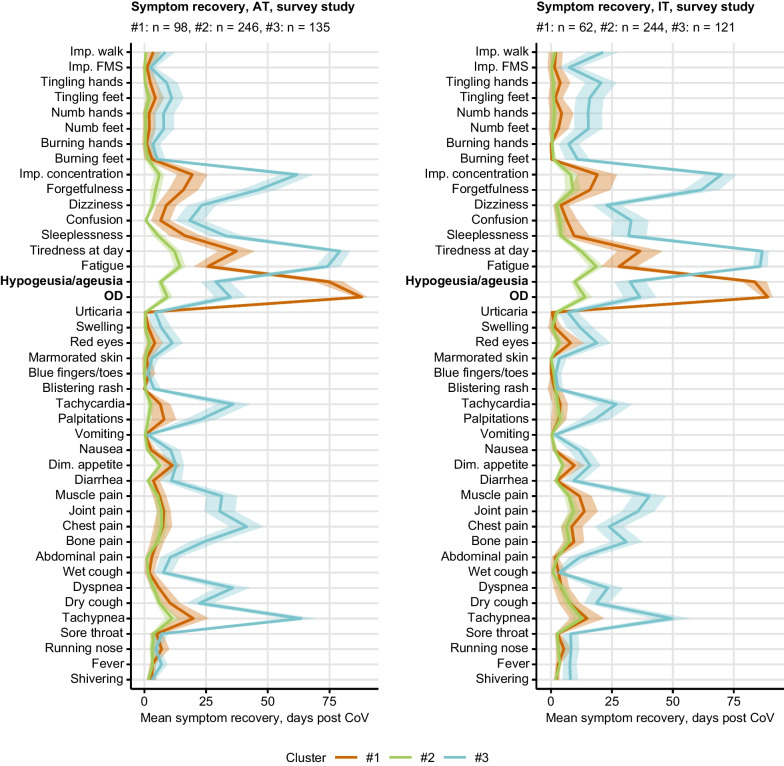
Differing duration of neurocognitive and respiratory symptoms, fatigue, olfactory dysfunction and taste disorders defines the COVID-19 recovery clusters. Clustering of the survey study participants in respect to symptom-specific recovery times was done by semi-supervised PAM algorithm (partitioning around medoids, Euclidean distance, training cohort: Austria [AT], test cohort: Italy [IT]). Mean recovery times in the recovery clusters are presented as lines, 2 × SEM intervals are displayed as tinted regions. Numbers of individuals assigned to the recovery clusters are indicated in the plot captions. OD self-reported olfactory dysfunction, Dim. appetite diminished appetite, Imp. concentration impaired concentration, Imp. walk impaired walk, Imp. FMS impaired fine motor skills
Fig. 5
Fig. 5
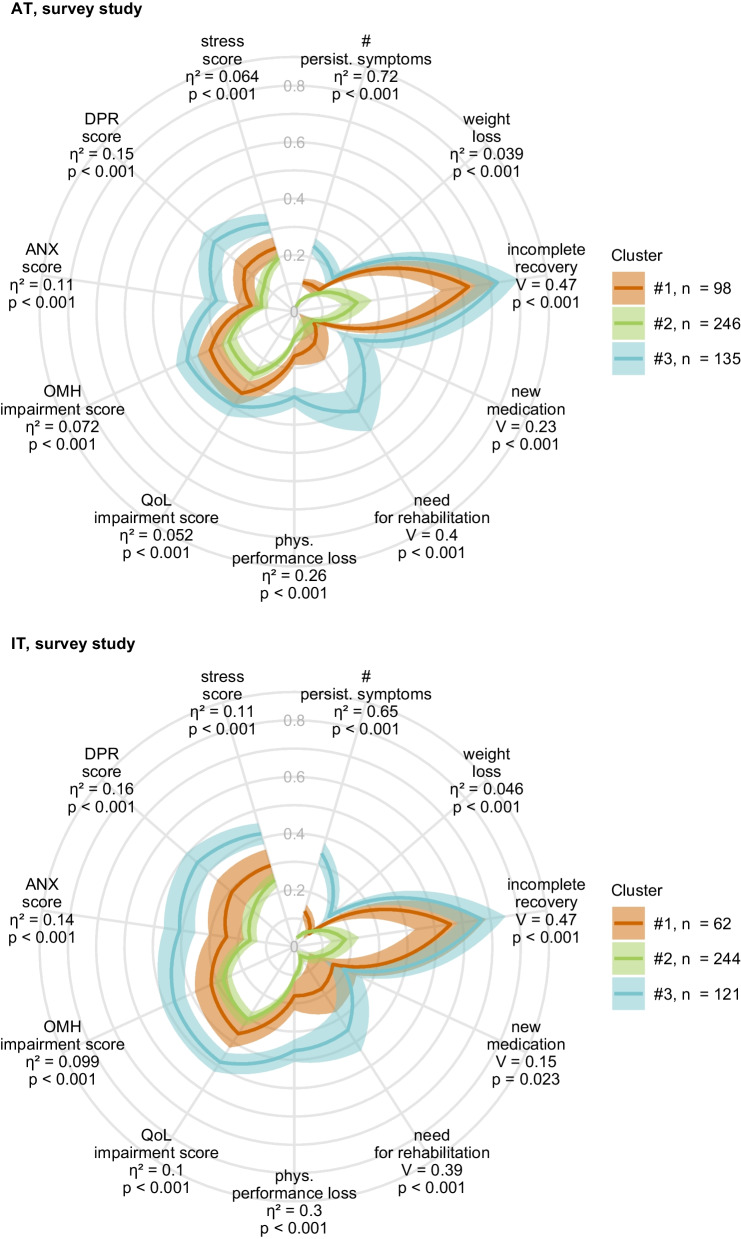
Physical and mental health, and quality of life in the COVID-19 recovery clusters. Clustering of the survey study participants in respect to symptom-specific recovery times was done by the semi-supervised PAM algorithm (partitioning around medoids, Euclidean distance, training cohort: Austria [AT], test cohort: Italy [IT]). Minimum/maximum scaled readouts of clinical and physical recovery, mental health and quality of life at the time of survey completion in the clusters in the Austria (AT) and Italy (IT) survey study cohorts are presented. Dichotomous items (incomplete convalescence, weight loss, new medication and need for rehabilitation) were binarized (yes: 1, no: 0) prior to visualization. Statistical significance for differences between the clusters was assessed by Kruskal–Wallis with η2 effect size statistic (numeric variables) or χ2 test with Cramer V effect size statistic (categorical variables). P values were corrected for multiple testing with Benjamini–Hochberg method. Lines represent mean values, 2 × SEM intervals are displayed as tinted regions. Effect sizes and p values are shown in the plots. Numbers of individuals assigned to the recovery clusters are indicated in the plot legends. Incomplete recovery: self-reported incomplete recovery; # persist. symptoms: number of symptoms at 28 days after clinical onset; phys. Performance loss: physical performance loss as compared with the time before COVID-19; QoL impairment score: score of impaired quality of life; OMH impairment score: overall mental health impairment score; ANX score anxiety score, Patient Health Questionnaire, PHQ-4; DPR depression score, Patient Health Questionnaire, PHQ-4; stress score: mental stress score, 7 item PHQ stress module

References

    1. Sahanic S, Tymoszuk P, Ausserhofer D, et al. Phenotyping of acute and persistent coronavirus disease 2019 features in the outpatient setting: exploratory analysis of an international cross-sectional online survey. Clin Infect Dis. 2022;75:e418–e431. doi: 10.1093/cid/ciab978. - DOI - PMC - PubMed
    1. Sonnweber T, Sahanic S, Pizzini A, et al. Cardiopulmonary recovery after COVID-19: an observational prospective multicentre trial. Eur Respir J. 2021 doi: 10.1183/13993003.03481-2020. - DOI - PMC - PubMed
    1. Hüfner K, Tymoszuk P, Ausserhofer D, et al. Who Is at risk of poor mental health following coronavirus disease-19 outpatient management? Front Med. 2022 doi: 10.3389/fmed.2022.792881. - DOI - PMC - PubMed
    1. Sudre CH, Murray B, Varsavsky T, et al. Attributes and predictors of long COVID. Nat Med. 2021 doi: 10.1038/s41591-021-01292-y. - DOI - PMC - PubMed
    1. Sonnweber T, Tymoszuk P, Sahanic S, et al. Investigating phenotypes of pulmonary COVID-19 recovery: a longitudinal observational prospective multicenter trial. Elife. 2022 doi: 10.7554/ELIFE.72500. - DOI - PMC - PubMed

Publication types

Supplementary concepts

Associated data