


Infectious disease control: from health security strengthening to health systems improvement at global level
- PMID: 37670331
- PMCID: PMC10478312
- DOI: 10.1186/s41256-023-00319-w
Infectious disease control: from health security strengthening to health systems improvement at global level
Abstract
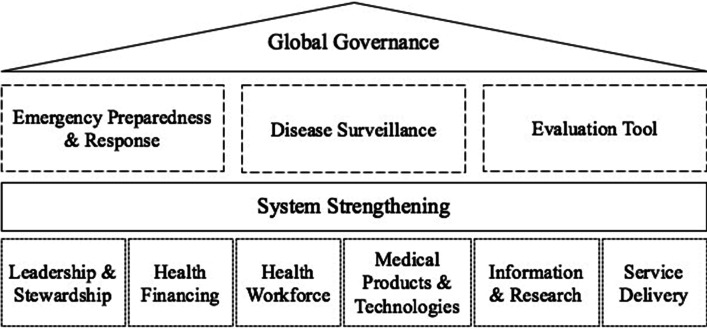
Since the twenty first century, the outbreaks of global infectious diseases have caused several public health emergencies of international concern, imposing an enormous impact on population health, the economy, and social development. The COVID-19 pandemic has once again exposed deficiencies in existing global health systems, emergency management, and disease surveillance, and highlighted the importance of developing effective evaluation tools. This article outlines current challenges emerging from infectious disease control from the perspective of global health, elucidated through influenza, malaria, tuberculosis, and neglected tropical diseases. The discordance among government actors and absent data sharing platforms or tools has led to unfulfilled targets in health system resilience and a capacity gap in infectious disease response. The current situation calls for urgent action to tackle these threats of global infectious diseases with joined forces through more in-depth international cooperation and breaking governance barriers from the purview of global health. Overall, a systematic redesign should be considered to enhance the resilience of health systems, which warrants a great need to sustain capacity-building efforts in emergency preparedness and response and raises an emerging concern of data integration in the concept of One Health that aims to address shared health threats at the human-animal-environment interface.
Keywords: Global health; Health security; Health system; Infectious disease control.
© 2023. Wuhan University Global Health Institute.
Conflict of interest statement
Hao Xiang and Zhuo Chen are on the editorial board of Global Health Research and Policy. They were not involved in the peer-review or handling of the manuscript. The authors have no other competing interests to disclose.
Figures
References
-
- Centers for Disease Control and Prevention. History of Quarantine. 2020. https://www.cdc.gov/quarantine/historyquarantine.html. Accessed 10 Jun 2023.
-
- Boutayeb A. The impact of infectious diseases on the development of Africa. In: Handbook of disease burdens and quality of life measures. New York: Springer New York; 2022. 1171–88.
Publication types
MeSH terms
LinkOut - more resources
Full Text Sources
Medical
Miscellaneous
