Review
. 2023 Aug 21:14:1243395.
doi: 10.3389/fgene.2023.1243395. eCollection 2023.

Histone 4 lysine 20 tri-methylation: a key epigenetic regulator in chromatin structure and disease

Affiliations
Review

Histone 4 lysine 20 tri-methylation: a key epigenetic regulator in chromatin structure and disease

Alejandra Agredo et al. Front Genet. .

Abstract

Chromatin is a vital and dynamic structure that is carefully regulated to maintain proper cell homeostasis. A great deal of this regulation is dependent on histone proteins which have the ability to be dynamically modified on their tails via various post-translational modifications (PTMs). While multiple histone PTMs are studied and often work in concert to facilitate gene expression, here we focus on the tri-methylation of histone H4 on lysine 20 (H4K20me3) and its function in chromatin structure, cell cycle, DNA repair, and development. The recent studies evaluated in this review have shed light on how H4K20me3 is established and regulated by various interacting partners and how H4K20me3 and the proteins that interact with this PTM are involved in various diseases. Through analyzing the current literature on H4K20me3 function and regulation, we aim to summarize this knowledge and highlights gaps that remain in the field.

Keywords: H4K20me3; cancer; chromatin; disease; heterochromatin; histone; homeostasis; methylation.


Conflict of interest statement

The authors declare that the research was conducted in the absence of any commercial or financial relationships that could be construed as a potential conflict of interest.

Figures

FIGURE 1
FIGURE 1
H4K20me3 formation at heterochromatin regions and overall abundance in the chromosome. (A) H4K20me3 approximated levels at different regions of the chromosome (Allshire and Madhani, 2018). SINEs, Short interspersed nuclear elements; LINEs, Long interspersed nuclear elements; IAPs, Intracisternal A-particle. (B) In constitutive heterochromatic regions of the genome KMT1A methyltransferase induces H3K9 trimethylation, which is then recognized by HP1β (Bosch-Presegué et al., 2017). HP1β then recruits KMT5C to that region, and KMT5C trimethylates H4K20me1 or H4K20me2 (not shown) (Schotta et al., 2008; Hahn et al., 2013). HP1β, Heterochromatin protein 1 β isoform. Created with BioRender.com.
FIGURE 2
FIGURE 2
The effect of KMT5C alterations on telomere length. (A) KMT5C deficiency reduces H4K20me3 levels at telomeres and subtelomeres, thereby increasing telomeric lenght (Benetti et al., 2007a). (B) Loss of PWP1, a protein involved in shelterin complex stabilization reduces H4K20me3 at telomeres and decreases telomere lenght (Yu et al., 2019). PWP1, Periodic tryptophan protein 1. Created with BioRender.com.
FIGURE 3
FIGURE 3
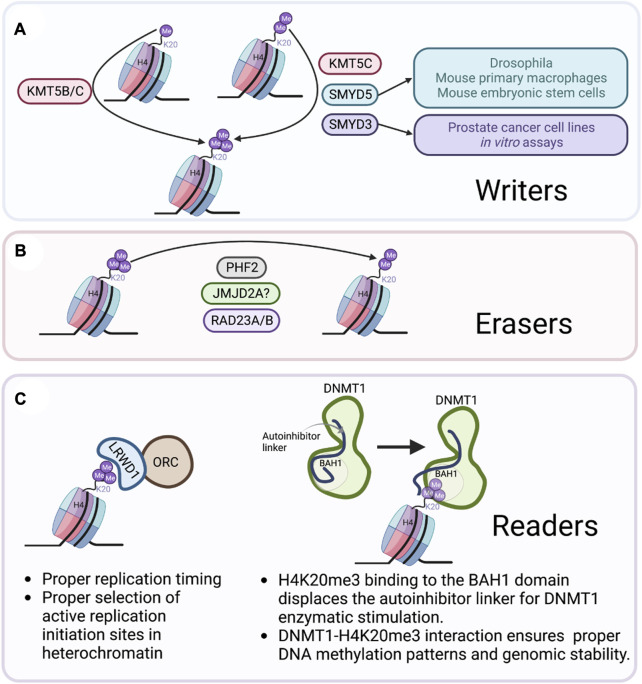
Writers, erasers, and readers of H4K20me3. (A) KMT5C (Schotta et al., 2008) is the main writer of H4K20me3. However, the methyltransferases KMT5B (Schotta et al., 2004), SMYD5 (Stender et al., 2012; Kidder et al., 2017a; Kidder et al., 2017b), and SMYD3 (Foreman et al., 2011; Vieira et al., 2015) have been correlated with H42K0me3 formation depending on the cellular context. (B) Human RAD23A/B demethylates H4K20me3 in HEK-293T cells (Cao et al., 2020). PHF2 demethylates H4K20me3 at promoters of inflammatory response genes (Stender et al., 2012). JMJD2A recognizes H4K20me3 but demethylase activity has yet to be demonstrated (Lee et al., 2008). (C) H4K20me3 readers include an element of the origin of replication complex ORC/LRWD1 (Brustel et al., 2017), and the DNA demethylase DNMT1 (Ren et al., 2021). Created with BioRender.com.
FIGURE 4
FIGURE 4
KMT5B/C interacting partners and their effect cellular consequence when they are deleted. (A) Deletion of the KMT5B/C interacting partner RB1, leads to genomic instability and chromosome segregation defects (Gonzalo et al., 2005). (B) AID deficiency associates with decreased H4K20me3 at Sμ sites (Rodríguez-Cortez et al., 2017). RB1: Retinoblastoma protein 1. AID, Activation-induced cytidine deaminase. Created with BioRender.com.
FIGURE 5
FIGURE 5
KMT5C and H4K20me3 RNA interacting partners. (A) Upon growth arrest, upregulation of PAPAS leads to KMT5C mediated H4K20me3 deposition at rDNA regions and IAP elements (Zhao et al., 2016). (B) H4K20me3 interacts with long protein-coding transcripts and non-coding RNAs (ncRNAs) involved in DNA repair, cell redox homeostasis, regulation of cell motility/migration, placental development, epithelial cell differentiation (Kurup and Kidder, 2018). Created with BioRender.com.
FIGURE 6
FIGURE 6
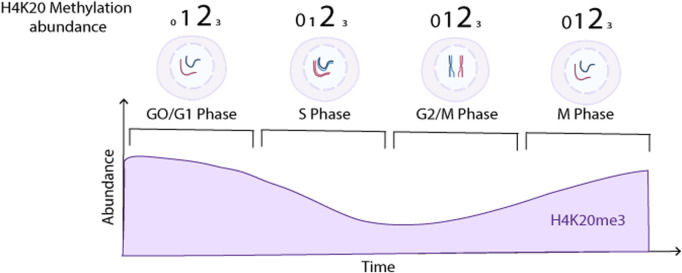
H4K20me3 levels in different cell cycle stages and chromosomal locations. Overall H4K20me0/1/2/3 abundance at different cell cycle stages (indicated by number size). While overall H4K20me3 levels are lower than H4K20me1/2 during the cell cycle, they still oscillate as indicated in the lower portion of the diagram. Created with BioRender.com.

References

    1. Abbas T., Shibata E., Park J., Jha S., Karnani N., Dutta A. (2010). CRL4Cdt2 regulates cell proliferation and histone gene expression by targeting PR-Set7/Set8 for degradation. Mol. Cell 40, 9–21. 10.1016/j.molcel.2010.09.014 - DOI - PMC - PubMed
    1. Allshire R. C., Madhani H. D. (2018). Ten principles of heterochromatin formation and function. Nat. Rev. Mol. Cell Biol. 19, 229–244. 10.1038/nrm.2017.119 - DOI - PMC - PubMed
    1. Balch C., Fang F., Matei D. E., Huang T. H. M., Nephew K. P. (2009). Minireview: epigenetic changes in ovarian cancer. Endocrinology 150, 4003–4011. 10.1210/en.2009-0404 - DOI - PMC - PubMed
    1. Baylin S. B., Ohm J. E. (2006). Epigenetic gene silencing in cancer - a mechanism for early oncogenic pathway addiction? Nat. Rev. Cancer 6, 107–116. 10.1038/nrc1799 - DOI - PubMed
    1. Beck D. B., Burton A., Oda H., Ziegler-Birling C., Torres-Padilla M. E., Reinberg D. (2012). The role of PR-Set7 in replication licensing depends on Suv4-20h. Genes Dev. 26, 2580–2589. 10.1101/gad.195636.112 - DOI - PMC - PubMed