


Barriers to methamphetamine treatment seeking in residential centers in Aguascalientes, Mexico
- PMID: 37671104
- PMCID: PMC10475994
- DOI: 10.3389/fpsyg.2023.1193453
Barriers to methamphetamine treatment seeking in residential centers in Aguascalientes, Mexico
Abstract
Introduction: In the Aguascalientes, most people who seek treatment go to non-governmental residential centers, and about half request treatment for meth use. Although some barriers to treatment seeking among these users are known, few studies have been conducted with the Mexican population, specifically with users of residential centers. The aim of this study was to explore the main barriers reported by these patients, the relationship between reported barriers and meth use, as well as identify possible user profiles based on the barriers and the pattern of consumption.
Methods: We designed a brief survey that evaluated sociodemographic data, consumption pattern, help-seeking for consumption and use of services, barriers in the search for services, depression, and suicide attempts. Here, we report the results of barriers and consumption patterns. The study sample consisted of 865 individuals receiving treatment for meth use in 23 certified residential centers.
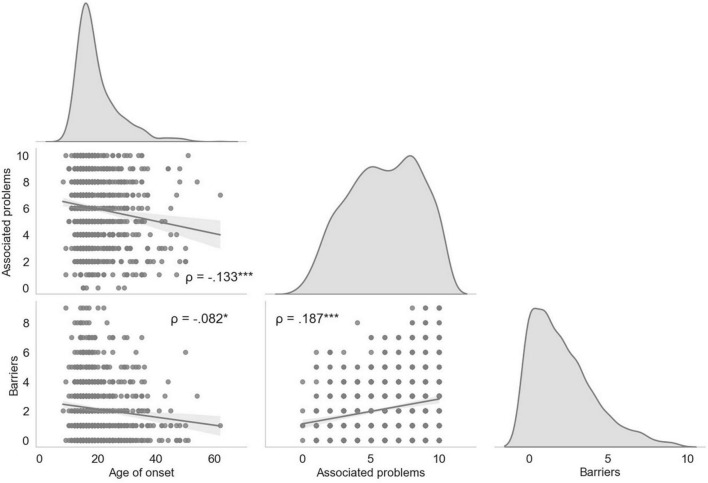
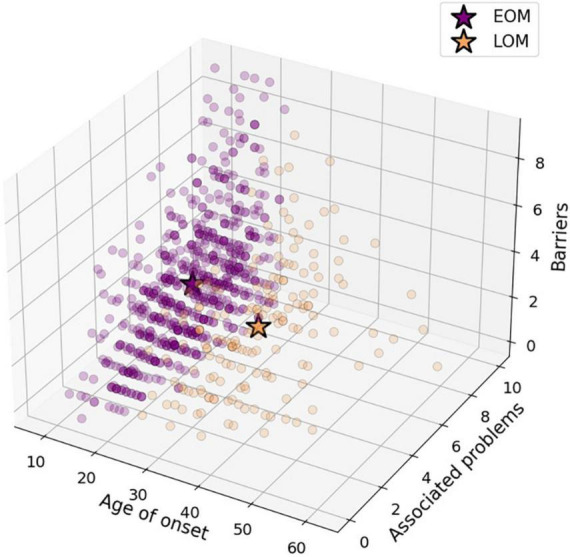
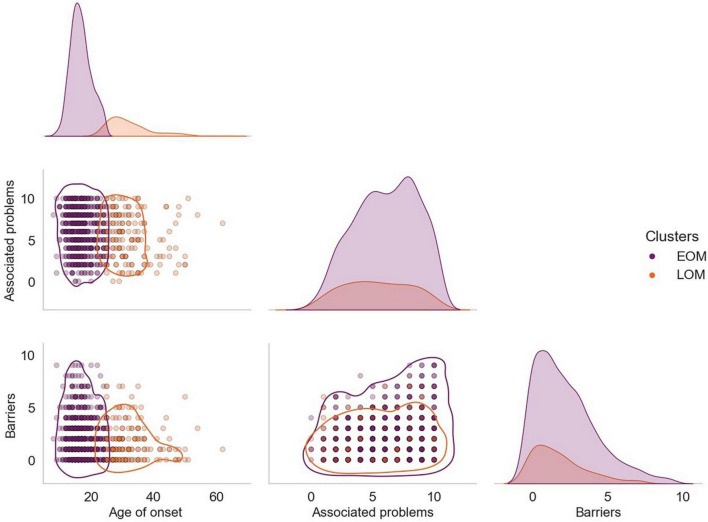
Results: Patients reported an average of 2.12 barriers, the main ones being not considering the services useful for them (41.6%), not considering it important to attend (35%), and not finding time to attend the consultation (29.8%). We found a statistically significant relationship, although weak, between the number of barriers reported by participants and the age of onset of meth use, dangerous perception of meth use, attempts to quit, and the number of problems associated with use. We used a cluster analysis that was performed using the k-means machine learning algorithm, which revealed two clusters. The first was formed by patients who started using meth at a young age which has more problems associated with meth use and more barriers in seeking services, while the other was formed by patients who started at an older age which have fewer problems and fewer barriers. We found statistical differences between groups, where it was found that young group reported consuming more substances, more problems associated, and more barriers in seeking services.
Discussions: This study revealed the main barriers to seeking treatment among patients in residential centers and found that the age of onset of meth use is a risk factor for presenting more barriers and more problems associated with consumption.
Keywords: age of onset meth; barrieres; machine learning; methamphetamine use; residential centers; seeking treatment.
Copyright © 2023 Martínez Martínez, Ojeda Aguilar, Robles Villarreal and Paz Pérez.
Conflict of interest statement
The authors declare that the research was conducted in the absence of any commercial or financial relationships that could be construed as a potential conflict of interest.
Figures
References
-
- Alexander A. C., Obong’o C. O., Chavan P. P., Dillon P. J., Kedia S. K. (2018). Addicted to the ‘life of methamphetamine’: Perceived barriers to sustained methamphetamine recovery. Drugs Educ. Prevent. Policy 25 241–247. 10.1080/09687637.2017.1282423 - DOI
-
- Benjet C., Wittenborn A., Gutierrez-García R. A., Albor Y. C., Contreras E. V., Hernández S. C., et al. (2020). Treatment delivery preferences associated with type of mental disorder and perceived treatment barriers among Mexican University Students. J. Adolesc. Health 67 232–238. 10.1016/j.jadohealth.2020.01.025 - DOI - PubMed
-
- Bholowalia P., Kumar A. (2014). EBK-means: A clustering technique based on elbow method and k-means in WSN. Int. J. Compute. Appl. 105 17–24.
LinkOut - more resources
Full Text Sources
