Meta-Analysis
. 2023 Dec 1;80(12):1196-1207.
doi: 10.1001/jamapsychiatry.2023.2983.

Efficacy and Safety of Antidepressants in Patients With Comorbid Depression and Medical Diseases: An Umbrella Systematic Review and Meta-Analysis

Affiliations
Meta-Analysis

Efficacy and Safety of Antidepressants in Patients With Comorbid Depression and Medical Diseases: An Umbrella Systematic Review and Meta-Analysis

Ole Köhler-Forsberg et al. JAMA Psychiatry. .

Abstract

Importance: Every third to sixth patient with medical diseases receives antidepressants, but regulatory trials typically exclude comorbid medical diseases. Meta-analyses of antidepressants have shown small to medium effect sizes, but generalizability to clinical settings is unclear, where medical comorbidity is highly prevalent.

Objective: To perform an umbrella systematic review of the meta-analytic evidence and meta-analysis of the efficacy and safety of antidepressant use in populations with medical diseases and comorbid depression.

Data sources: PubMed and EMBASE were searched from inception until March 31, 2023, for systematic reviews with or without meta-analyses of randomized clinical trials (RCTs) examining the efficacy and safety of antidepressants for treatment or prevention of comorbid depression in any medical disease.

Study selection: Meta-analyses of placebo- or active-controlled RCTs studying antidepressants for depression in individuals with medical diseases.

Data extraction and synthesis: Data extraction and quality assessment using A Measurement Tool for the Assessment of Multiple Systematic Reviews (AMSTAR-2 and AMSTAR-Content) were performed by pairs of independent reviewers following PRISMA guidelines. When several meta-analyses studied the same medical disease, the largest meta-analysis was included. Random-effects meta-analyses pooled data on the primary outcome (efficacy), key secondary outcomes (acceptability and tolerability), and additional secondary outcomes (response and remission).

Main outcomes and measures: Antidepressant efficacy presented as standardized mean differences (SMDs) and tolerability (discontinuation for adverse effects) and acceptability (all-cause discontinuation) presented as risk ratios (RRs).

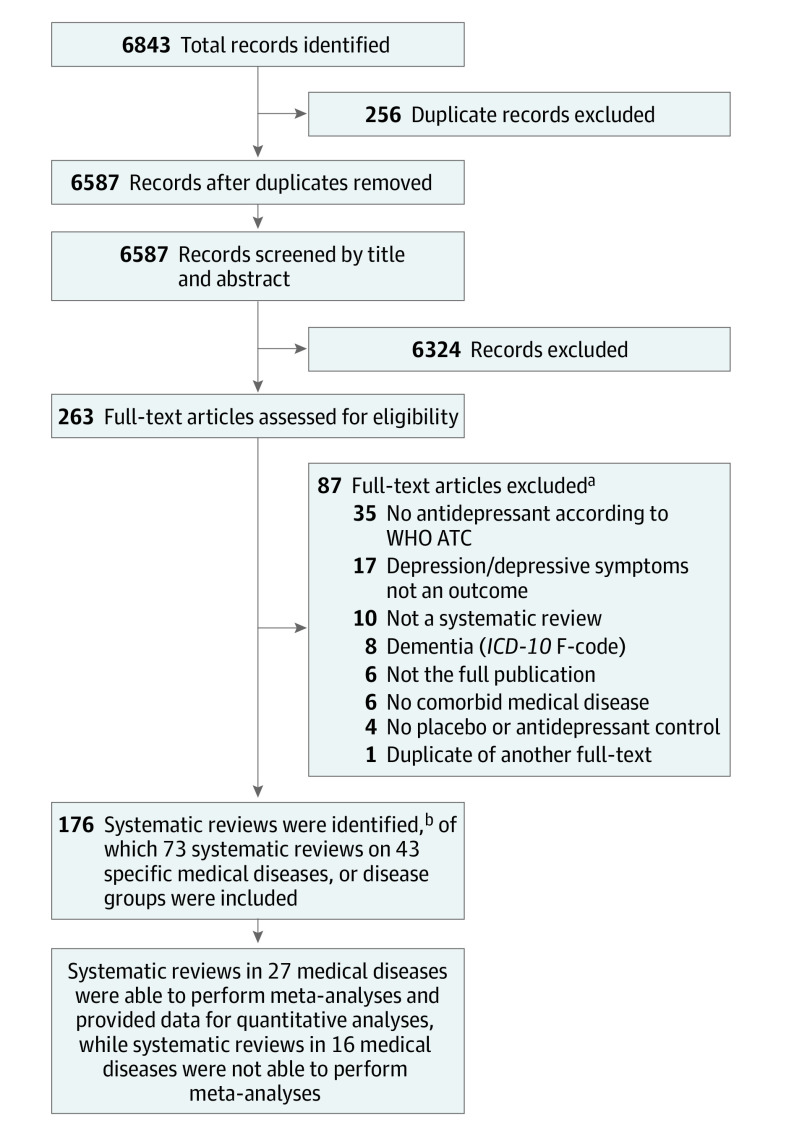
Results: Of 6587 references, 176 systematic reviews were identified in 43 medical diseases. Altogether, 52 meta-analyses in 27 medical diseases were included in the evidence synthesis (mean [SD] AMSTAR-2 quality score, 9.3 [3.1], with a maximum possible of 16; mean [SD] AMSTAR-Content score, 2.4 [1.9], with a maximum possible of 9). Across medical diseases (23 meta-analyses), antidepressants improved depression vs placebo (SMD, 0.42 [95% CI, 0.30-0.54]; I2 = 76.5%), with the largest SMDs for myocardial infarction (SMD, 1.38 [95% CI, 0.82-1.93]), functional chest pain (SMD, 0.87 [95% CI, 0.08-1.67]), and coronary artery disease (SMD, 0.83 [95% CI, 0.32-1.33]) and the smallest for low back pain (SMD, 0.06 [95% CI, 0.17-0.39]) and traumatic brain injury (SMD, 0.08 [95% CI, -0.28 to 0.45]). Antidepressants showed worse acceptability (24 meta-analyses; RR, 1.17 [95% CI, 1.02-1.32]) and tolerability (18 meta-analyses; RR, 1.39 [95% CI, 1.13-1.64]) compared with placebo. Antidepressants led to higher rates of response (8 meta-analyses; RR, 1.54 [95% CI, 1.14-1.94]) and remission (6 meta-analyses; RR, 1.43 [95% CI, 1.25-1.61]) than placebo. Antidepressants more likely prevented depression than placebo (7 meta-analyses; RR, 0.43 [95% CI, 0.33-0.53]).

Conclusions and relevance: The results of this umbrella systematic review of meta-analyses found that antidepressants are effective and safe in treating and preventing depression in patients with comorbid medical disease. However, few large, high-quality RCTs exist in most medical diseases.


Conflict of interest statement

Conflict of Interest Disclosures: Dr Köhler-Forsberg reported personal fees from WCG Clinical and Lundbeck Pharma A/S outside the submitted work. Dr Gamradt reported personal fees from Abcam for giving a webinar presentation outside the submitted work. Dr Chae reported receiving research funding from the Deutsche Forschungsgemeinschaft outside the submitted work. Prof Correll reported receiving personal fees from AbbVie Inc outside the submitted work and consulting, advising, or receiving honoraria from Acadia Pharmaceuticals, Alkermes PLC, Allergan PLC, Angelini Pharma, Aristo Pharma GmbH, Biogen Inc, Boehringer Ingelheim, Cardio Diagnostics, Cerevel Therapeutics, LLC, CNX Therapeutics Ltd, COMPASS Pathways PLC, Darnitsa, Denovo, Gedeon Richter PLC, Hikma Pharmaceuticals PLC, Holmusk, Intra-Cellular Therapies, Janssen/Johnson & Johnson, Karuna Therapeutics, LB Pharmaceuticals, Lundbeck, MedAvante-ProPhase Inc, Medincell, Merck & Co, MindPax, Mitsubishi Tanabe Pharma Corporation, Mylan NV, Neurocrine Biosciences, Inc, Neurelis Inc, Newron Pharmaceuticals SpA, Noven, Novo Nordisk A/S, Otsuka Pharmaceutical Co, Ltd, Pharmabrain GmbH, PPD Biotech, Recordati, Relmada Therapeutics, Inc, Reviva Labs, Laboratorios Farmaceuticos ROVI, Seqirus Limited, SK Life Science Inc, Sunovion Pharmaceutical Inc, Sun Pharmaceutical Industries Ltd, Supernus Pharmaceuticals, Takeda Pharmaceuticals International, Teva Pharmaceutical Industries Ltd, and Viatris Inc; providing expert testimony for Janssen Pharmaceuticals and Otsuka Pharmaceutical Co, Ltd; serving on a data safety monitoring board for COMPASS Pathways PCL, Denovo, Lundbeck, Relmada Therapeutics, Inc, Reviva Labs, Laboratorios Farmaceuticos ROVI, Sage Therapeutics, Supernus Pharmaceuticals, and Teva Pharmaceutical Industries Ltd; receiving grant support from Janssen Pharmaceuticals and Takeda Pharmaceuticals International; receiving royalties from UpToDate; and holding a stock option in Cardio Diagnostics, MindPax, LB Pharmaceuticals, and The Quantic Group. Prof Gold reported receiving personal fees from Hexal AG and Streamed Up and grants from the National Multiple Sclerosis Society, Deutsche Forschungsgemeinschaft DFG, Bundesministerium für Gesundheit, Bundesministerium für Bildung und Forschung, and the European Commission outside the submitted work. Dr Otte reported receiving personal fees from Fortbildungskolleg, Janssen Pharmaceuticals, Lundbeck, Neuraxpharm, PeakProfiling GmbH, and LIMES Klinikgruppe and grants from the German Research Foundation, German Federal Ministry of Education and Research, European Union, and Berlin Institute of Health outside the submitted work. No other disclosures were reported.

Figures

Figure 1.
Figure 1.. Flowchart of the Literature Search and Study Selection
ICD-10 indicates International Statistical Classification of Diseases and Related Health Problems, Tenth Revision; WHO ATC, World Health Organization Anatomical Therapeutic Chemical Code. aeTable 4 in Supplement 2 presents the specific exclusion criteria for each of the 87 systematic reviews that were excluded during full-text screening. bOf the 165 systematic reviews, several were on the same medical disease. Therefore, we included only the largest systematic review for quantitative synthesis.
Figure 2.
Figure 2.. Standardized Mean Differences (SMDs) for Antidepressant Efficacy Compared With Placebo for Comorbid Depression
Weights (size of diamond markers) are determined by random-effects analyses. AMSTAR indicates A Measurement Tool for the Assessment of Multiple Systematic Reviews; CAD, coronary artery disease; CHD, coronary heart disease; COPD, chronic obstructive pulmonary disease; HF, heart failure; IBD, inflammatory bowel disease; IHD, ischemic heart disease; MI, myocardial infarction; MS, multiple sclerosis; NR, not reported; RCTs (as defined in Figure 3), randomized controlled trials; and TBI, traumatic brain injury. The overall SMD of 0.42 in part A is based on all specific meta-analyses presented in part B, with part A furthermore presenting the pooled SMDs within each disease category (eg, the pooled SMD for pain in part B is based on the 4 meta-analyses with pain as the disease group from part B).
Figure 3.
Figure 3.. Risk Ratios (RRs) for Antidepressant Acceptability and Tolerability
Acceptability is measured by all-cause discontinuation of study medication; tolerability is measured by discontinuation of study medication due to adverse effects. Weights (size of markers) are determined by random-effects analyses. AMSTAR indicates A Measurement Tool for the Assessment of Multiple Systematic Reviews; IBD, inflammatory bowel disease; IHD, ischemic heart disease; NR, not reported; RCTs, randomized controlled trials; SSRI, selective serotonin reuptake inhibitor; and TCA, tricyclic antidepressant. If no specific antidepressant drug is mentioned (eg, SSRI), then the analyses were not restricted to specific antidepressants but could cover all antidepressants.
Figure 4.
Figure 4.. Forest Plot Showing Risk Ratios (RRs) for Antidepressant Drugs Compared With Placebo in Preventing the Development of Depression Among Individuals With Medical Diseases
Weights (size of markers) are determined by random-effects analyses. AD indicates antidepressant; HCV, hepatitis C virus; IFN-α, Interferon alfa; RCTs, randomized controlled trials; SSRIs, selective serotonin reuptake inhibitors; and TBI, traumatic brain injury.

References

    1. Otte C, Gold SM, Penninx BW, et al. Major depressive disorder. Nat Rev Dis Primers. 2016;2:16065. doi: 10.1038/nrdp.2016.65 - DOI - PubMed
    1. GBD 2016 Disease and Injury Incidence and Prevalence Collaborators . Global, regional, and national incidence, prevalence, and years lived with disability for 328 diseases and injuries for 195 countries, 1990-2016: a systematic analysis for the Global Burden of Disease Study 2016. Lancet. 2017;390(10100):1211-1259. doi: 10.1016/S0140-6736(17)32154-2 - DOI - PMC - PubMed
    1. Gold SM, Köhler-Forsberg O, Moss-Morris R, et al. Comorbid depression in medical diseases. Nat Rev Dis Primers. 2020;6(1):69. doi: 10.1038/s41572-020-0200-2 - DOI - PubMed
    1. Momen NC, Plana-Ripoll O, Agerbo E, et al. Association between mental disorders and subsequent medical conditions. N Engl J Med. 2020;382(18):1721-1731. doi: 10.1056/NEJMoa1915784 - DOI - PMC - PubMed
    1. Cipriani A, Furukawa TA, Salanti G, et al. Comparative efficacy and acceptability of 21 antidepressant drugs for the acute treatment of adults with major depressive disorder: a systematic review and network meta-analysis. Lancet. 2018;391(10128):1357-1366. doi: 10.1016/S0140-6736(17)32802-7 - DOI - PMC - PubMed

Publication types

Substances