. 2023 Sep 6:382:e076058.
doi: 10.1136/bmj-2023-076058.

Food additive emulsifiers and risk of cardiovascular disease in the NutriNet-Santé cohort: prospective cohort study

Affiliations

Food additive emulsifiers and risk of cardiovascular disease in the NutriNet-Santé cohort: prospective cohort study

Laury Sellem et al. BMJ. .

Abstract

Objective: To assess the associations between exposure to food additive emulsifiers and risk of cardiovascular disease (CVD).

Design: Prospective cohort study.

Setting: French NutriNet-Santé study, 2009-21.

Participants: 95 442 adults (>18 years) without prevalent CVD who completed at least three 24 hour dietary records during the first two years of follow-up.

Main outcome measures: Associations between intake of food additive emulsifiers (continuous (mg/day)) and risk of CVD, coronary heart disease, and cerebrovascular disease characterised using multivariable proportional hazard Cox models to compute hazard ratios for each additional standard deviation (SD) of emulsifier intake, along with 95% confidence intervals.

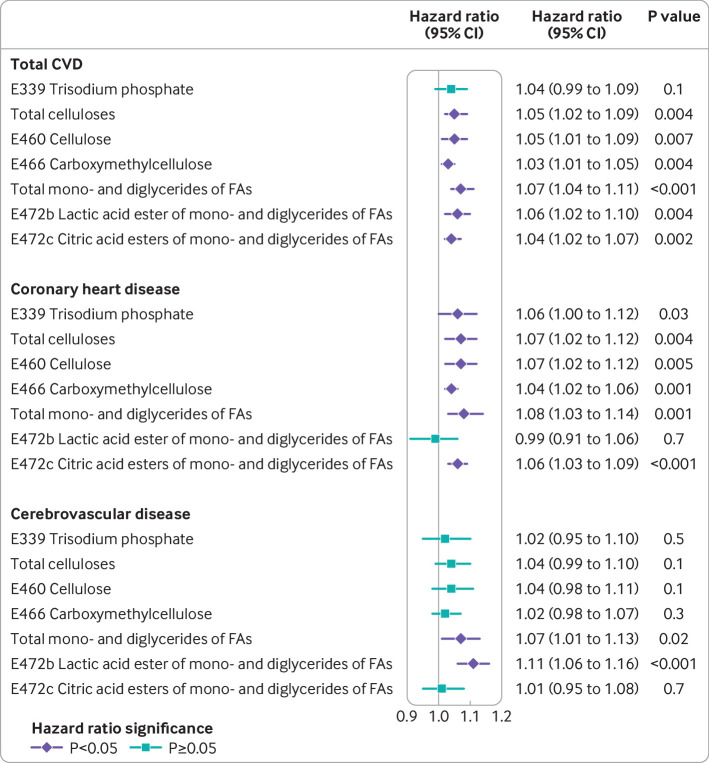
Results: Mean age was 43.1 (SD 14.5) years, and 79.0% (n=75 390) of participants were women. During follow-up (median 7.4 years), 1995 incident CVD, 1044 coronary heart disease, and 974 cerebrovascular disease events were diagnosed. Higher intake of celluloses (E460-E468) was found to be positively associated with higher risks of CVD (hazard ratio for an increase of 1 standard deviation 1.05, 95% confidence interval 1.02 to 1.09, P=0.003) and coronary heart disease (1.07, 1.02 to 1.12, P=0.004). Specifically, higher cellulose E460 intake was linked to higher risks of CVD (1.05, 1.01 to 1.09, P=0.007) and coronary heart disease (1.07, 1.02 to 1.12, P=0.005), and higher intake of carboxymethylcellulose (E466) was associated with higher risks of CVD (1.03, 1.01 to 1.05, P=0.004) and coronary heart disease (1.04, 1.02 to 1.06, P=0.001). Additionally, higher intakes of monoglycerides and diglycerides of fatty acids (E471 and E472) were associated with higher risks of all outcomes. Among these emulsifiers, lactic ester of monoglycerides and diglycerides of fatty acids (E472b) was associated with higher risks of CVD (1.06, 1.02 to 1.10, P=0.002) and cerebrovascular disease (1.11, 1.06 to 1.16, P<0.001), and citric acid ester of monoglycerides and diglycerides of fatty acids (E472c) was associated with higher risks of CVD (1.04, 1.02 to 1.07, P=0.004) and coronary heart disease (1.06, 1.03 to 1.09, P<0.001). High intake of trisodium phosphate (E339) was associated with an increased risk of coronary heart disease (1.06, 1.00 to 1.12, P=0.03). Sensitivity analyses showed consistent associations.

Conclusion: This study found positive associations between risk of CVD and intake of five individual and two groups of food additive emulsifiers widely used in industrial foods.

Trial registration: ClinicalTrials.gov NCT03335644.


Conflict of interest statement

Competing interests: All authors have completed the ICMJE uniform disclosure form at https://www.icmje.org/disclosure-of-interest/ and declare: the funders are named above; no support from any for profit organisation for the submitted work; no financial relationships with any organisations that might have an interest in the submitted work in the previous three years; no other relationships or activities that could appear to have influenced the submitted work.

Figures
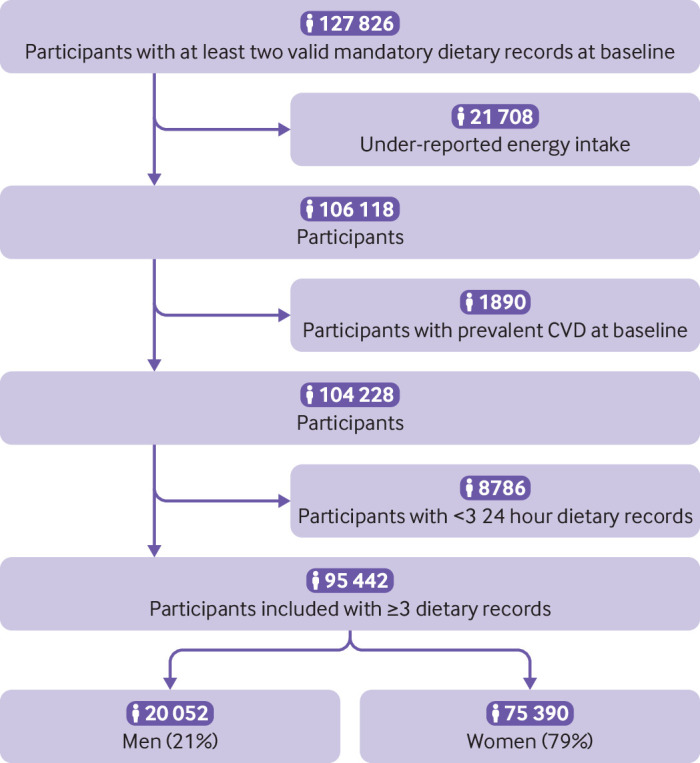
Fig 1
Fig 1
Flowchart of participants included from NutriNet-Santé cohort, 2009-21 (n=95 442)
Fig 2
Fig 2
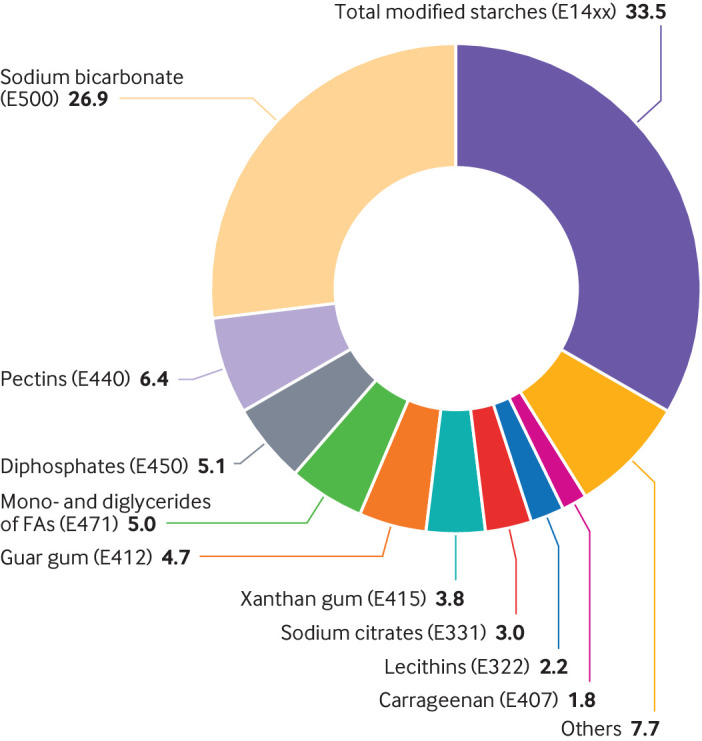
Contribution of individual emulsifiers to total emulsifier intakes (%) among participants from the NutriNet-Santé cohort, 2009-21 (n=95 442). Other emulsifiers included triphosphates (European code E451), gum arabic (E414), polyphosphates (E452), carob bean gum (E410), cellulose (E460), tricalcium phosphate (E341), monoacetyl and diacetyl tartaric acid esters of monoglycerides and diglycerides of FAs (E472e), hydroxypropyl methylcellulose (E464), polyglycerol esters of FAs (E475), lactic acid esters of monoglycerides and diglycerides of FAs (E472b), polydextrose (E1200), sodium stearoyl-2-lactylate (E481), sodium alginate (E401), ammonium salts of phosphatidic acid (E442), esters of monoglycerides and diglycerides of FAs (E472), polyglycerol esters of interesterified ricinoleic acid (E476), citric acid esters of monoglycerides and diglycerides of FAs (E472c), silicon dioxide (E551), tripotassium phosphate (E340), methylcellulose (E461), carboxymethylcellulose (E466), trisodium phosphate (E339), acetic acid esters of monoglycerides and diglycerides of FAs (E472a), agar (E406), sucrose esters of FAs (E473), propylene glycol esters of FAs (E477), gellan gum (E418), sorbitan tristearate (E492), processed Euchema seaweed (E407a), beeswax (E901), potassium alginate (E402), maltitol (E965), triethyl citrate (E1505), xylitol (E967), glycerol esters of rosin (E445), polyoxyethylene sorbitan monooleate (E433), potassium dihydrogen citrate (E332), calcium alginate (E404), calcium stearoyl-2-lactylate (E482), konjac flour (E425), cross linked sodium carboxymethylcellulose (E468), sucrose acetate isobutyrate (E444), sodium tartarate (E335), polyoxyethylene sorbitan monostearate (E435), sorbitan monostearate (E491), alginic acid (E400), propylene glycol (E1520), Quillaia extract (E999), sodium aluminium phosphate (E541), magnesium hydrogen phosphate (E343), propylene glycol alginate (E405), and dimethyl polysiloxane (E900). FAs=fatty acids
Fig 3
Fig 3
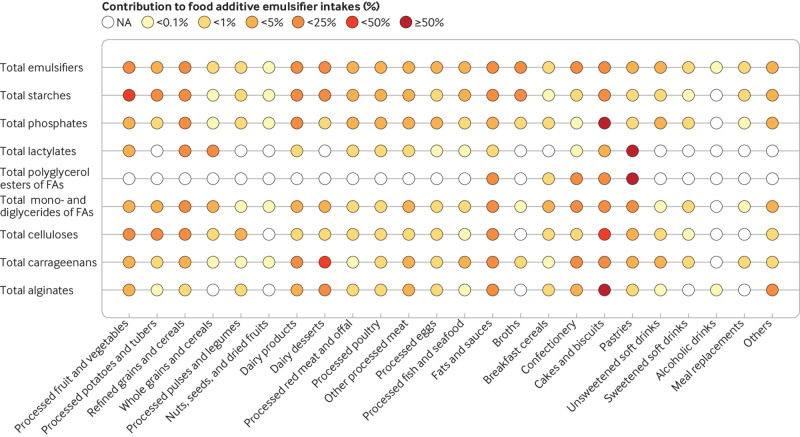
Dietary sources of total and groups of emulsifier intakes among study participants from the NutriNet-Santé cohort, 2009-21 (n=95 442). Groups of emulsifiers were defined as (European codes) total phosphates (E339, E340, E341, E343, E450, E451, E452), total lactylates (E481, E482), total polyglycerol esters of FAs (E475, E476), total monoglycerides and diglycerides of FAs (E471, E472, E472a, E472b, E472c, E472e), total celluloses (E460, E461, E464, E466, E468), total carrageenans (E407, E407a), total alginates (E400, E401, E402, E404, E405), and total modified starches (E14xx). Also see supplementary eTable1. FAs=fatty acids; NA=not applicable
Fig 4
Fig 4
Associations between selected emulsifier intakes and risk of CVD among participants from the NutriNet-Santé cohort, 2009-21 (n=95 442). Hazard ratio for an increment of 1 standard deviation. Groups of emulsifiers were defined as (European codes) total monoglycerides and diglycerides of FAs (E471, E472, E472a, E472b, E472c, E472e) and total celluloses (E460, E461, E464, E466, E468). Emulsifiers with at least one statistically significant association with CVD risk are represented. Supplementary eTable2 provides the investigated associations between emulsifier intakes and CVD risk with corresponding hazard ratios and 95% confidence intervals. Multivariable Cox proportional hazard models were adjusted for age (timescale); sex; body mass index (continuous); physical activity (categorical International Physical Activity Questionnaire variable: high, moderate, low); smoking status (never smoker, former smoker, occasional smoker, regular smoker); number of smoked cigarettes in pack years (continuous); educational level (less than high school degree, <2 years after high school degree, ≥2 years after high school degree); number of dietary records (continuous); family history of CVD (yes/no); energy intake without alcohol (continuous, kcal/day); daily intakes of alcohol (continuous, g/day), saturated FAs (continuous, g/day), sodium (continuous, mg/day), total fibre (continuous, g/day), sugars (continuous, g/day), fruit and vegetables (continuous, g/day), red and processed meats (continuous, g/day), and whole grains (continuous, g/day); and proportion of ultra-processed food consumed in the diet, in weight (continuous, %). Standard deviations of emulsifier intakes (mg/day) were 3170.8 for total emulsifiers, 52.0 for total alginates, 35.3 for E401, 75.7 for total carrageenans, 73.2 for E407, 14.1 for E407a, 502.6 for total phosphates,58.4 for E339, 96.5 for E340, 227.2 for E341, 349.7 for E450, 122.3 for E451, 86.2 for E452, 93.4 for total celluloses, 69.4 for E460, 32.8 for E464, 32.0 for E466, 287.5 for total monoglycerides and diglycerides of FAs, 208.6 for E471, 103.7 for E472b, 57.6 for E472c, 28.3 for E472e, 63.5 for total polyglycerol esters of FAs, 61.5 for E475, 15.7 for E476, 23.1 for total lactylates, 22.7 for E481, 1147.1 for total modified starches, 78.3 for E322, 280.5 for E331, 69.7 for E410, 233.8 for E412, 428.1 for E414, 221.1 for E415, 310.6 for E440, 42.6 for E442, 2116.7 for E500, and 0.6 for E901. CVD=cardiovascular disease; FAs=fatty acids

References

    1. Calixto Andrade G, Julia C, Deschamps V, et al. . Consumption of Ultra-Processed Food and Its Association with Sociodemographic Characteristics and Diet Quality in a Representative Sample of French Adults. Nutrients 2021;13:682. 10.3390/nu13020682 - DOI - PMC - PubMed
    1. Mertens E, Colizzi C, Peñalvo JL. Ultra-processed food consumption in adults across Europe. Eur J Nutr 2022; 61:1521-39. 10.1007/s00394-021-02733-7. - DOI - PMC - PubMed
    1. Martínez Steele E, Baraldi LG, Louzada ML, Moubarac JC, Mozaffarian D, Monteiro CA. Ultra-processed foods and added sugars in the US diet: evidence from a nationally representative cross-sectional study. BMJ Open 2016;6:e009892. 10.1136/bmjopen-2015-009892 - DOI - PMC - PubMed
    1. Srour B, Kordahi MC, Bonazzi E, Deschasaux-Tanguy M, Touvier M, Chassaing B. Ultra-processed foods and human health: from epidemiological evidence to mechanistic insights. Lancet Gastroenterol Hepatol 2022;7:1128-40. 10.1016/S2468-1253(22)00169-8 - DOI - PubMed
    1. Chazelas E, Deschasaux M, Srour B, et al. . Food additives: distribution and co-occurrence in 126,000 food products of the French market. Sci Rep 2020;10:3980. 10.1038/s41598-020-60948-w - DOI - PMC - PubMed

Associated data

LinkOut - more resources