. 2023 Sep 6;14(1):5440.
doi: 10.1038/s41467-023-41199-5.

Xanomeline displays concomitant orthosteric and allosteric binding modes at the M4 mAChR

Affiliations

Xanomeline displays concomitant orthosteric and allosteric binding modes at the M4 mAChR

Wessel A C Burger et al. Nat Commun. .

Abstract

The M4 muscarinic acetylcholine receptor (M4 mAChR) has emerged as a drug target of high therapeutic interest due to its expression in regions of the brain involved in the regulation of psychosis, cognition, and addiction. The mAChR agonist, xanomeline, has provided significant improvement in the Positive and Negative Symptom Scale (PANSS) scores in a Phase II clinical trial for the treatment of patients suffering from schizophrenia. Here we report the active state cryo-EM structure of xanomeline bound to the human M4 mAChR in complex with the heterotrimeric Gi1 transducer protein. Unexpectedly, two molecules of xanomeline were found to concomitantly bind to the monomeric M4 mAChR, with one molecule bound in the orthosteric (acetylcholine-binding) site and a second molecule in an extracellular vestibular allosteric site. Molecular dynamic simulations supports the structural findings, and pharmacological validation confirmed that xanomeline acts as a dual orthosteric and allosteric ligand at the human M4 mAChR. These findings provide a basis for further understanding xanomeline's complex pharmacology and highlight the myriad of ways through which clinically relevant ligands can bind to and regulate GPCRs.


Conflict of interest statement

C.C.F. and S.M.P. are employees of and hold equity in Karuna Therapeutics. C.V., D.M.T. and A.C. have, and R.O.D. had, sponsored research agreements with Karuna Therapeutics. P.M.S. and A.C. are co-founders and hold equity in Septerna Inc. D.W. and R.O.D. hold equity in Septerna Inc. The remaining authors declare no competing interests.

Figures
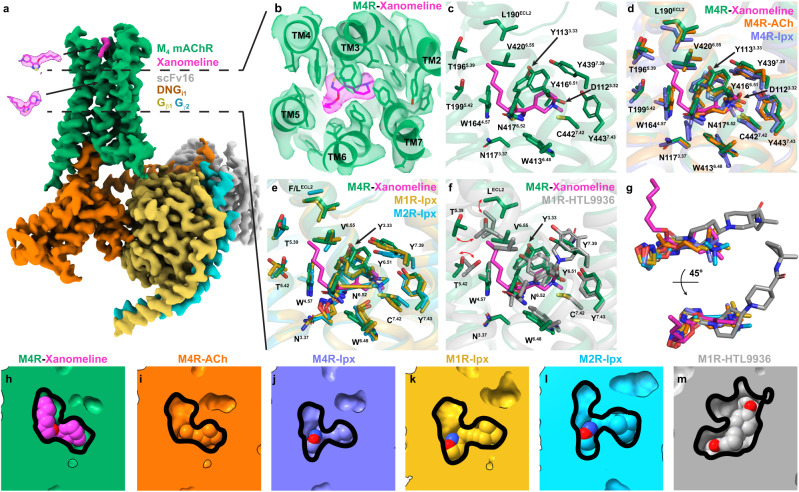
Fig. 1
Fig. 1. Analysis of the orthosteric binding site of xanomeline.
a Consensus cryo-EM map of the M4 mAChR (M4R) in complex with DNGi1/Gβ1γ2/scFv16 bound to xanomeline resolved to 2.5 Å (FSC 0.143). The receptor is shown in green, the dominant negative (DN) heterotrimeric Gi1 protein is shown in orange, gold, and light blue for the α, β, γ subunits, respectively. Xanomeline is shown in magenta and scFv16 in silver. b Cryo-EM density (contour level 0.026) for xanomeline in the orthosteric binding site. c Xanomeline is bound in the canonical orthosteric binding site of the mAChRs positioned under a closed tyrosine lid composed of residues Y3.33, Y6.51 and Y7.39. The hexyloxy tail of xanomeline sticks up towards the ECV region of the M4 mAChR. d Comparison of the xanomeline bound active M4 mAChR to the acetylcholine (ACh) and iperoxo (Ipx) bound M4 mAChR (PDB: 7TRS and 7TRK, respectively). Orthosteric site residues of the xanomeline bound M4 mAChR are shown as green sticks, residues of the ACh and Ipx bound M4 mAChR are shown as orange and blue sticks, respectively. e Comparison of the xanomeline bound active M4 mAChR to the Ipx bound M1/M2 mAChRs (M1R/M2R, PDB: 6OIJ and 6OIK, respectively). Orthosteric site residues of the xanomeline bound M4 mAChR are shown as green sticks, residues of the Ipx bound M1/M2 mAChRs are shown as yellow and light blue sticks, respectively. f Comparison of the xanomeline bound active M4 mAChR to the HTL3396 bound M1 mAChR (PDB: 6ZG4). Orthosteric site residues of the xanomeline bound M4 mAChR are shown as green sticks, residues of HTL3396 bound M1 mAChR are shown as grey sticks, respectively. g Overlay of xanomeline, ACh and Ipx bound to the M4 mAChR, Ipx bound to the M1/M2 mAChRs and HTL9936 bound to bound M1 mAChR. Cross section of the h xanomeline bound M4 mAChR orthosteric binding site, i ACh bound orthosteric M4 mAChR binding site, j Ipx bound M4 mAChR orthosteric binding site, k Ipx bound M1 mAChR orthosteric binding site, l Ipx bound M2 mAChR orthosteric binding site, m HTL3396 bound M1 mAChR orthosteric binding site.
Fig. 2
Fig. 2. Analysis of the allosteric binding site of xanomeline.
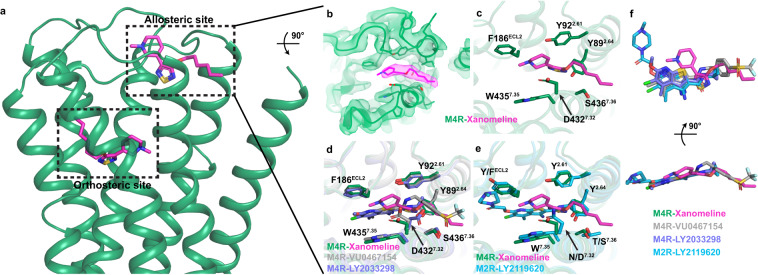
a Xanomeline is bound in both the orthosteric and allosteric binding sites of the M4 mAChR (M4R). b Cryo-EM density (contour level 0.026) for xanomeline in the allosteric binding site. c Xanomeline in the common ‘ECV’ mAChR allosteric binding site with allosteric site residues shown as sticks in green. d Comparison of the xanomeline allosteric binding site to LY2033298 and VU0467154 bound to the allosteric binding site of the M4 mAChR (PDB: 7TRP and 7TRQ). The allosteric binding site residues of the xanomeline bound M4 mAChR are shown as green sticks whereas the allosteric binding site residues of the LY2033298 and VU0467154 bound M4 mAChR are shown in blue and grey sticks, respectively. e Comparison of the xanomeline allosteric binding site to LY2119620 bound to the allosteric binding site of the M2 mAChR (M2R, PDB: 6OIK). The allosteric binding site residues of the M4 mAChR are shown as green sticks whereas the allosteric binding site residues of the M2 mAChR are shown in light blue sticks. f Overlay of M4 mAChR bound xanomeline, LY2033298, VU0467154 and M2 mAChR bound LY2119620.
Fig. 3
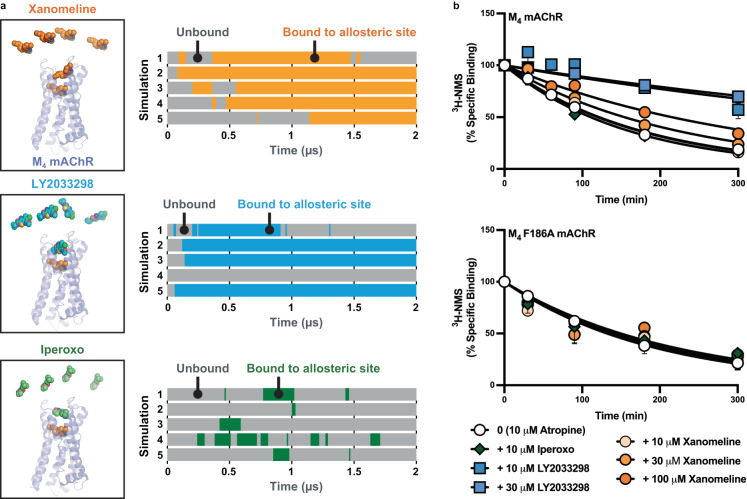
Fig. 3. Computational and pharmacological validation of xanomeline in the allosteric binding site.
a Molecular dynamics simulations reveal that xanomeline spontaneously binds to the M4 mAChR allosteric site for a similar fraction of time as the prototypical PAM, LY2033298, and for a substantially longer fraction of time than the orthosteric agonist, iperoxo. Simulations were initiated with a xanomeline molecule bound in the orthosteric site and with the free ligands in solution—either xanomeline, LY2033298 or iperoxo—all being at the same concentration. Each horizontal bar represents an independent simulation and indicates the amount of time that the allosteric site is vacant (grey) or ligand-bound (non-grey). b [3H]-N-methylscopolamine ([3H]-NMS) dissociation via isotopic dilution with 10 µM atropine alone (0), or in the presence (+), of xanomeline, LY2033298, or iperoxo, at the M4 mAChR wild type and M4 F186ECL2A mutant. Data points represent the mean ± S.E.M. of three to nine individual experiments performed in duplicate. M4 mAChR wild type; 10 µM atropine alone n = 14, + 10 µM iperoxo n = 5, + 30 µM LY2033298 n = 7, + 10 µM LY2033298 n = 4, + 10 µM xanomeline n = 6, + 30 µM xanomeline n = 8, + 100 µM xanomeline n = 13. M4 F186ECL2A; 10 µM atropine alone n = 4, + 10 µM iperoxo & + 30 µM LY2033298 & + 30 µM xanomeline & + 100 µM xanomeline n = 3. A one-phase exponential decay model was fit to the data.
Fig. 4
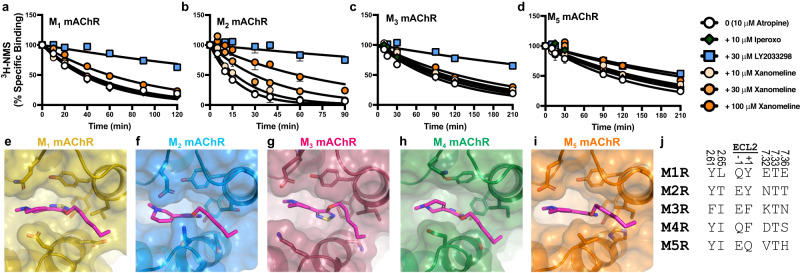
Fig. 4. Xanomeline binds allosterically at all mAChR subtypes.
ad [3H]-N-methylscopolamine ([3H]-NMS) dissociation via isotopic dilution with 10 µM atropine alone (0), or in the presence (+), of xanomeline, LY2033298, or iperoxo, at the a M1, b M2, c M3 or d M5 mAChRs (M1R-M5R). Data points represent the mean ± S.E.M. of four to twelve individual experiments performed in duplicate. M1 mAChR; 10 µM atropine alone & + 10 µM iperoxo & + 10 µM xanomeline & + 30 µM xanomeline & + 100 µM xanomeline n = 6, + 30 µM LY2033298 n = 3. M2 mAChR; 10 µM atropine alone n = 10, + 10 µM iperoxo & + 30 µM LY2033298 & + 10 µM xanomeline & + 30 µM xanomeline & + 100 µM xanomeline n = 6. M3 mAChR; 10 µM atropine alone & + 10 µM iperoxo & + 10 µM xanomeline & + 30 µM xanomeline & + 100 µM xanomeline n = 7, + 30 µM LY2033298 n = 6. M5 mAChR; 10 µM atropine alone & + 10 µM iperoxo & + 10 µM xanomeline & + 30 µM xanomeline & + 100 µM xanomeline n = 5, + 30 µM LY2033298 n = 4. A one-phase exponential decay model was fit to the data. The allosteric binding site of each mAChR subtype can accommodate the binding of xanomeline, as shown by energy minimization of xanomeline in the allosteric site of the e M1 (PDB: 6OIJ), f M2 (PDB: 6OIK), g M3, h M4, or i M5 mAChRs. j Sequence comparison of residues that contact xanomeline in the allosteric site (≤4 Å) across all five mAChR subtypes. Residues in TM2 and TM7 are labelled with the Ballesteros and Weinstein scheme for class A GPCRs and residues in ECL2 are numbered according to their relative position of a conserved cysteine residue (C185 at the M4 mAChR).

Comment in

References

    1. Saha S, Chant D, Welham J, McGrath J. A systematic review of the prevalence of schizophrenia. PLoS Med. 2005;2:0413–0433. - PMC - PubMed
    1. Leucht S, et al. Comparative efficacy and tolerability of 15 antipsychotic drugs in schizophrenia: a multiple-treatments meta-analysis. Lancet. 2013;382:951–962. - PubMed
    1. Lieberman JA, et al. Effectiveness of antipsychotic drugs in patients with chronic schizophrenia. N. Engl. J. Med. 2005;353:1209–1223. - PubMed
    1. Langmead CJ, Watson J, Reavill C. Muscarinic acetylcholine receptors as CNS drug targets. Pharmacol. Ther. 2008;117:232–243. - PubMed
    1. Conn PJ, Christopoulos A, Lindsley CW. Allosteric modulators of GPCRs: a novel approach for the treatment of CNS disorders. Nat. Revi. Drug Discov. 2009;8:41–54. - PMC - PubMed

Publication types