


Chemical and Physical Properties of African Catfish (Clarias gariepinus) Fillet Following Prolonged Feeding with Insect Meal-Based Diets
- PMID: 37674976
- PMCID: PMC10480016
- DOI: 10.1155/2023/6080387
Chemical and Physical Properties of African Catfish (Clarias gariepinus) Fillet Following Prolonged Feeding with Insect Meal-Based Diets
Abstract
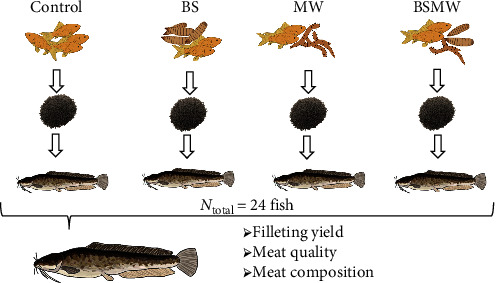
A 25-week experiment was undertaken to explore the effect of partial replacement of dietary fishmeal (FM) with black soldier fly meal (Hermetia illucens) (BS), mealworm meal (Tenebrio molitor) (MW), and a 1 : 1 mixture of both insect meals (BSMW) on fillet quality in African catfish (Clarias gariepinus). A total of 96 fish with an average initial body weight of 248 ± 28 g were stocked into a recirculating aquaculture system and fed in four different dietary groups (control, BS, MW, and BSMW). No mortality was recorded in any of the groups. At the end of the feeding period, 24 fish (n = 6 for each treatment, weight between 690 and 822 g) were used for analysis. There was no alteration in filleting yield or other slaughter indices within experimental groups, except the hepatosomatic index. Among quality attributes, pH 24 hr postmortem exhibited a significant difference (p < 0.05). In respect of the fatty acid profile, the n-6/n-3 ratio ranged between 1.17 and 1.40 but was not significantly modified by the partial replacement of FM. Similarly, the proximate composition of the fillets was not significantly different between the control and experimental diet groups. The ratio of polyunsaturated fatty acid to saturated fatty acids ranged between 0.67 and 0.79 in the fillets, without significant differences between groups. The atherogenic index was increased in the BS group, as compared to the others; however, the thrombogenicity index of fillets was not significantly affected. Similarly, the conventional quality traits of the fillet, such as cooking, drip, and thawing losses, did not differ within treatments. This study demonstrates that the dietary inclusion of black soldier fly and/or mealworm meals used for African catfish at the tested inclusion level has negligible impact on fillet properties.
Copyright © 2023 Askale Gebremichael et al.
Conflict of interest statement
The authors declare that they have no conflicts of interest.
Figures
References
-
- Rana K. J., Siriwardena S., Hasan M. R. Impact of rising feed ingredient prices on aquafeeds and aquaculture production. 2009. FAO Fisheries and Aquaculture Technical Paper http://www.fao.org/…/i1143e00.htm.
-
- Oliva-Teles A., Enes P., Peres H. Feed and Feeding Practices in Aquaculture . Elsevier; 2015. Replacing fishmeal and fish oil in industrial aquafeeds for carnivorous fish; pp. 203–233.
-
- Hua K., Cobcroft J. M., Cole A., et al. The future of aquatic protein: implications for protein sources in aquaculture diets. One Earth . 2019;1(3):316–329. doi: 10.1016/j.oneear.2019.10.018. - DOI
-
- Finke M. D. Complete nutrient composition of commercially raised invertebrates used as food for insectivores. Zoo Biology . 2002;21(3):269–285. doi: 10.1002/zoo.10031. - DOI
-
- Makkar H. P. S., Tran G., Heuzé V., Ankers P. State-of-the-art on use of insects as animal feed. Animal Feed Science and Technology . 2014;197:1–33. doi: 10.1016/j.anifeedsci.2014.07.008. - DOI
LinkOut - more resources
Full Text Sources