Review
. 2022 Sep 5;2(1):36.
doi: 10.1007/s44154-022-00054-1.

Root osmotic sensing from local perception to systemic responses

Affiliations
Review

Root osmotic sensing from local perception to systemic responses

Lucille Gorgues et al. Stress Biol. .

Abstract

Plants face a constantly changing environment, requiring fine tuning of their growth and development. Plants have therefore developed numerous mechanisms to cope with environmental stress conditions. One striking example is root response to water deficit. Upon drought (which causes osmotic stress to cells), plants can among other responses alter locally their root system architecture (hydropatterning) or orientate their root growth to optimize water uptake (hydrotropism). They can also modify their hydraulic properties, metabolism and development coordinately at the whole root and plant levels. Upstream of these developmental and physiological changes, plant roots must perceive and transduce signals for water availability. Here, we review current knowledge on plant osmotic perception and discuss how long distance signaling can play a role in signal integration, leading to the great phenotypic plasticity of roots and plant development.

Keywords: Adaptive development; Drought; Local signaling; Local water deficit; Long distance signaling; Water deficit perception.


Conflict of interest statement

C.M. is a member of the Editorial Board but was not involved in the journal's review of, or any decisions related to, this manuscript.

Figures
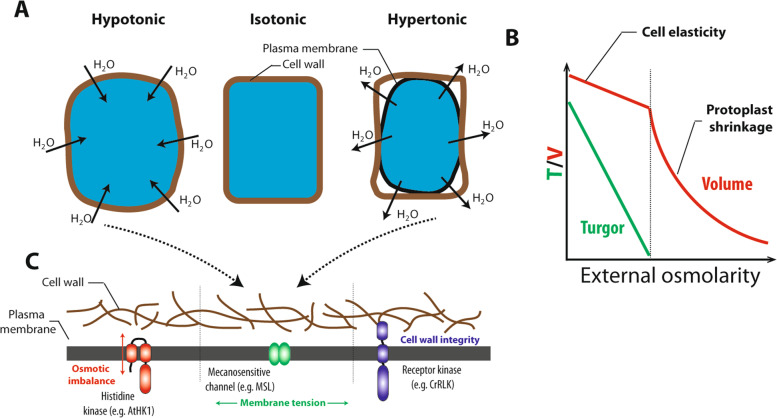
Fig. 1
Fig. 1
Nature of the osmotic signal and suspected sensing mechanisms. A Drawing of the relation between osmotic, water fluxes and cellular volume regulation. A reduced (hypotonic) or increased (hypertonic) external osmolarity results in an influx or efflux of water, respectively. Depending on cell wall elasticity, these fluxes lead to changes in cellular volume. B Relative variations of cell turgor and volume in response to an increase of external osmolarity. In the absence of cellular osmoregulation, the turgor tends to decrease linearly with increasing osmolarity. In contrast, the cellular volume is expected to decrease in a two-phase mode, a quasi-linear mode as long as turgor is maintained in the cell, followed by a hyperbolic decay when turgor is absent. C Based on the literature 3 classes of perception mechanism can sense the osmotic signal. Osmotic signal may be perceived at the membrane from either a local osmotic imbalance (e.g. AtHK1) or a change in membrane tension (e.g. MSL) or from a perturbation of cell wall integrity (e.g. CrRLK)
Fig. 2
Fig. 2
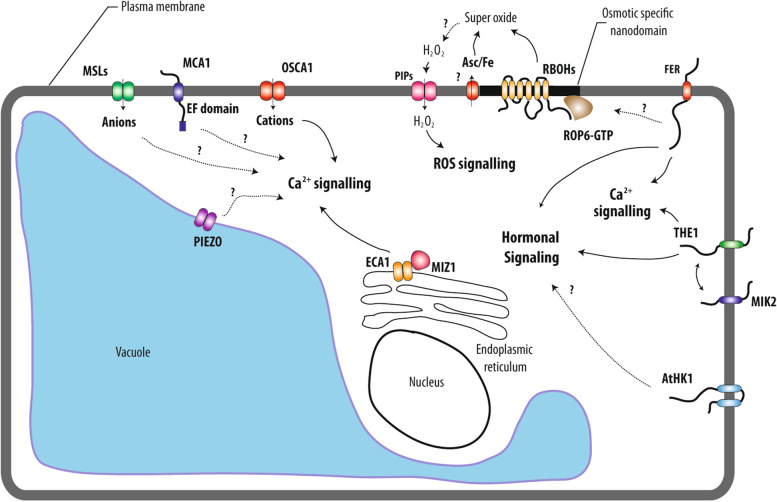
Summary of currently known osmotic perception mechanisms in plants. Changes in membrane tension induced by osmolarity imbalance can be perceived by membrane mechanosensors such as OSCA1, MSLs, MCA1, PIEZO, ECA1/MIZ1. By transporting cations or anions, these sensors initiate cell calcium signaling by as yet unknown mechanisms. Receptor-like kinases belonging to the CrRLK family (e.g. FER, THE) perceive the cell wall status and their activation eventually leads to cell wall reinforcement. Whereas their exact role as osmotic sensors has yet to be established, these receptors definitely fine tune signaling of hormones such as ABA, auxin and jasmonate that are known to regulate plant development and physiological acclimation to osmotic stress. At the cell membrane, a partial integration of signals can be observed. For instance, LRR kinase MIK2, a receptor for phytocytokines that controls plant immunity, genetically interacts with THE, pointing to a link between osmotic and pathogen signaling. By similarity to the yeast system, the AtHK1 two component histidine kinase may also participate in osmotic signaling by modulating ABA signaling. In addition to hormones and calcium signaling, Reactive Oxygen Species (ROS) are also participating in early cell responses to osmotic stimuli. Cellular accumulation of ROS is dependent on NADPH oxidases (RBOHD and F) and iron reduction processes. Upon cell stimulation, ROP6 forms nanodomains together with the superoxide producing enzyme RBOHD/F. As a consequence, superoxide can be dismutated to hydrogen peroxide (H2O2) by apoplastic SOD (Superoxide dismutase). H2O2 transport through the cell membrane is in turn facilitated by aquaporins
Fig. 3
Fig. 3
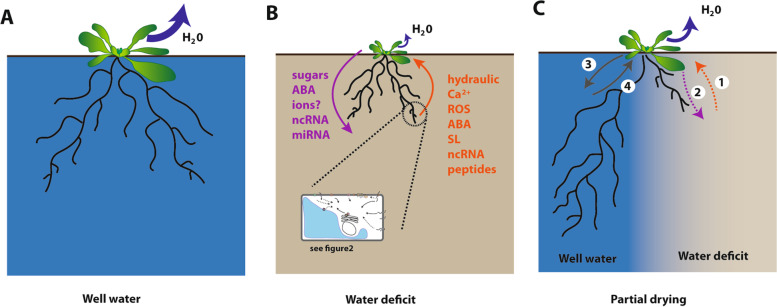
Long-distance and developmental response to homogeneous or local water deficit. A Soil water is absorbed by roots and moves through xylem vessels to the leaves where it is eliminated via transpiration (blue arrow). B When plants experience water shortage, they first dramatically reduce transpiration and modify root and shoot growth according to water availability. Roots, which perceive locally the osmotic stress as described in Fig. 2, activate long-distance signaling (orange arrow) conveyed by hydraulic signals or a wide range of molecules, including calcium (Ca2+), Reactive Oxygen Species (ROS), phytohormones (Abscisic Acid (ABA), Strigolactones (SL), etc), non-coding RNA (ncRNA) and peptides. In return, water deficit induces a shoot-to-root signaling (violet arrow) that relies on a set of molecules including sugars, ABA, ncRNA and micro RNA (miRNA). C When plants encounter a local water deficit also named partial root zone drying (PRD) in agronomy, the transpiration rate is reduced but not as severely as under a uniform water deficit. As a consequence, shoot development can be maintained or has a limited reduction depending on the intensity and duration of the local water deficit or on the plant developmental stage. Root growth in the drying part is strongly repressed whereas it is maintained or stimulated in the wet part through a compensatory growth stimulation. It was proposed that, during PRD, roots are sensing the local low water potential in the drying soil resulting in a reduction in cell turgor, then transmitting the signal to the shoot (arrow 1). In return, a shoot-to-root signal (arrow 2) represses root growth. Since root development and water uptake are stimulated in the well-watered part, the existence of both a shoot-to-root and a root-to-shoot signaling can be hypothesized (arrows 3 and 4). Besides ABA, the nature of other putative signals remains totally unknown

References

    1. Abdallah MMS, El-Bassiouny HMS, AbouSeeda MA. Potential role of kaolin or potassium sulfate as anti-transpirant on improving physiological, biochemical aspects and yield of wheat plants under different watering regimes. Bull Natl Res Cent. 2019;43(1):134. doi: 10.1186/s42269-019-0177-8. - DOI
    1. Al-Babili S, Bouwmeester HJ. Strigolactones, a novel carotenoid-derived plant hormone. Annu Rev Plant Biol. 2015;66:161–186. doi: 10.1146/annurev-arplant-043014-114759. - DOI - PubMed
    1. Attacha S, Solbach D, Bela K, Moseler A, Wagner S, Schwarzländer M, Aller I, Müller SJ, Meyer AJ. Glutathione peroxidase-like enzymes cover five distinct cell compartments and membrane surfaces in Arabidopsis thaliana: subcellular localization of GPXLs in Arabidopsis. Plant Cell Environ. 2017;40(8):1281–1295. doi: 10.1111/pce.12919. - DOI - PubMed
    1. Bacete L, Schulz J, Engelsdorf T, Bartosova Z, Vaahtera L, Yan G, Gerhold JM, Tichá T, Øvstebø C, Gigli-Bisceglia N, Johannessen-Starheim S, Margueritat J, Kollist H, Dehoux T, McAdam SAM, Hamann T. THESEUS1 modulates cell wall stiffness and abscisic acid production in Arabidopsis thaliana. Proc Natl Acad Sci U S A. 2022;119(1):e2119258119. doi: 10.1073/pnas.2119258119. - DOI - PMC - PubMed
    1. Banerjee AK, Lin T, Hannapel DJ. Untranslated regions of a mobile transcript mediate RNA metabolism. Plant Physiol. 2009;151(4):1831–1843. doi: 10.1104/pp.109.144428. - DOI - PMC - PubMed

LinkOut - more resources