. 2023 Nov;64(11):2891-2908.
doi: 10.1111/epi.17751. Epub 2023 Sep 7.

Revisiting the concept of drug-resistant epilepsy: A TASK1 report of the ILAE/AES Joint Translational Task Force

Affiliations

Revisiting the concept of drug-resistant epilepsy: A TASK1 report of the ILAE/AES Joint Translational Task Force

Stéphane Auvin et al. Epilepsia. 2023 Nov.

Abstract

Despite progress in the development of anti-seizure medications (ASMs), one third of people with epilepsy have drug-resistant epilepsy (DRE). The working definition of DRE, proposed by the International League Against Epilepsy (ILAE) in 2010, helped identify individuals who might benefit from presurgical evaluation early on. As the incidence of DRE remains high, the TASK1 workgroup on DRE of the ILAE/American Epilepsy Society (AES) Joint Translational Task Force discussed the heterogeneity and complexity of its presentation and mechanisms, the confounders in drawing mechanistic insights when testing treatment responses, and barriers in modeling DRE across the lifespan and translating across species. We propose that it is necessary to revisit the current definition of DRE, in order to transform the preclinical and clinical research of mechanisms and biomarkers, to identify novel, effective, precise, pharmacologic treatments, allowing for earlier recognition of drug resistance and individualized therapies.

Keywords: adult; mechanisms; model; pediatric; pharmacoresistance.


Conflict of interest statement

S. Auvin is Deputy Editor for Epilepsia. He has served as consultant or gave lectures for Angelini, Biocodex, Eisai, Encoded, Grintherapeutics, Jazz Pharmaceuticals, Neuraxpharm, Orion, Nutricia, Proveca, UCB Pharma, Vitaflo, Xenon, Zogenix. He has been investigator for clinical trials for Eisai, Jazz Pharmaceuticals, Marinus, Proveca, Takeda, UCB Pharma and Zogenix.

A.S. Galanopoulou is the Editor-in-Chief of Epilepsia Open, associate editor of Neurobiology of Disease, and receives royalties from Elsevier (publications, journal editorial board participation) and Medlink (publications).

S.L. Moshé is on the editorial board of Brain and Development, Pediatric Neurology, Annals of Neurology, MedLink and Physiological Research. He received royalties from Elsevier for his work as Associate Editor in Neurobiology of Disease; annual compensation from MedLink; and royalties from 2 books he co-edited.

H. Potschka has received funding for consulting, talks and research collaborations from Eisai, Zogenix, Bayer/Elanco, Roche, Lario/Exeed Epidarex, Angelini, Galapagos, MSD, and Jazz (GW) Pharmaceuticals.

L. Rocha has no disclosures to declare.

M. Walker has received funding for consulting and for talks from Eisai, UCB pharma, Angelini, Seer, Marinus and Jazz. He has shares in EpilepsyGtx.

Figures
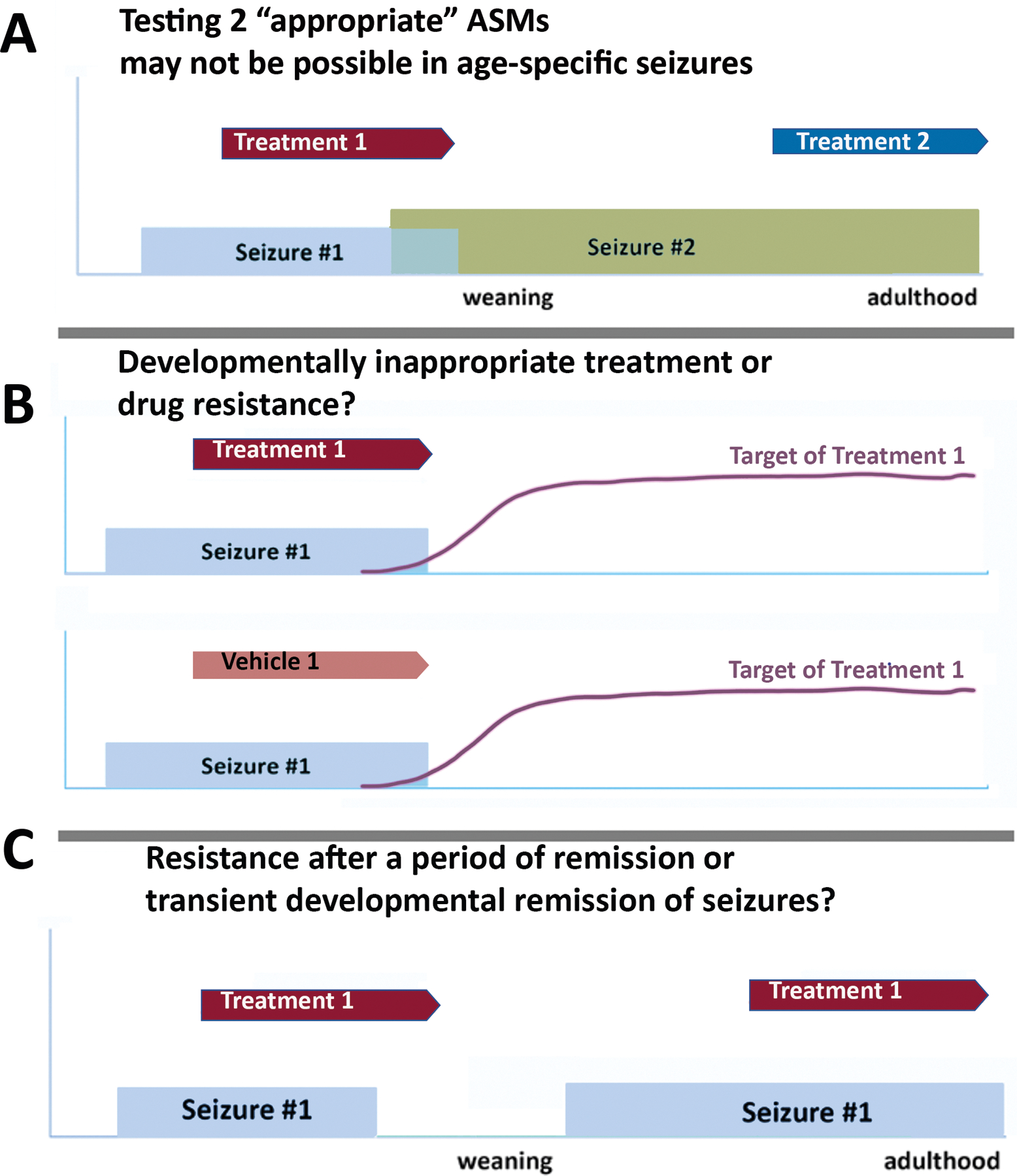
Figure 1.
Figure 1.. Challenges in interpreting drug responsiveness and resistance in models of early life epilepsies.
Development, i.e., the period till the time adulthood is reached, can be relatively short in rodents where puberty is reached around postnatal days 32–36 (PN32–36) and age-specific seizures (seizure #1 in the graphs) may occur during shorter developmental periods. Further, the ongoing brain development leads to continuous developmental changes, including of potential treatment targets. Assessing drug responsiveness in this setting, agnostic of how target expression/function or seizure natural history is, can be challenging, as presented by the following scenarios. A. In a model with an evolving phenotype with early age-specific seizure #1 and late onset of seizure #2, testing two “appropriate” treatments can be challenging as these are likely to be tested upon different types of seizures, and at different stages of brain development. Seizures #1 and #2 may have known different pharmacosensitivities (i.e., spasms vs focal seizures) and therefore effects of drug on seizure #2 may not necessarily predict its effects on seizure #1. Furthermore, testing the treatment #2 in adulthood may not predict the treatment effects in early development if the drug’s target expression or relevance change with age. B. Testing of treatment #1 on age-specific seizure #1 has no effect compared to vehicle, yet the target of treatment #1 is not yet expressed or functional during the period when seizure #1 is present. Is this seizure type resistant to treatment #1 or is the treatment developmentally inappropriate? In the clinical setting we cannot always test this possibility. C. A model has an early appearance of seizure #1, a period without seizures and late reappearance of seizure #1. Treatment #1 appears to stop seizure #1 when given early in life but not when given at the late recurrence. Is this late resistance after a period with drug-sensitive seizures, or a transient developmental remission of seizures treated with an ineffective treatment, or apparent late resistance of seizures because its target (and hence efficacy) is only present during the early developmental period?

References

    1. Sultana B, Panzini MA, Veilleux Carpentier A, et al. Incidence and Prevalence of Drug-Resistant Epilepsy: A Systematic Review and Meta-analysis. Neurology. 2021;96:805–17. - PubMed
    1. WHO. Epilepsy: a public health imperative. Geneva: World Health Organization; 2019.
    1. Chen Z, Brodie MJ, Liew D, et al. Treatment Outcomes in Patients With Newly Diagnosed Epilepsy Treated With Established and New Antiepileptic Drugs: A 30-Year Longitudinal Cohort Study. JAMA Neurol. 2018;75:279–86. - PMC - PubMed
    1. Kwan P, Arzimanoglou A, Berg AT, et al. Definition of drug resistant epilepsy: consensus proposal by the ad hoc Task Force of the ILAE Commission on Therapeutic Strategies. Epilepsia. 2010;51:1069–77. - PubMed
    1. O'Callaghan FJ, Lux AL, Darke K, et al. The effect of lead time to treatment and of age of onset on developmental outcome at 4 years in infantile spasms: evidence from the United Kingdom Infantile Spasms Study. Epilepsia. 2011;52:1359–64. - PubMed

Publication types
