


Mortality and Causes of Death in Children With Cerebral Palsy With Scoliosis Treated With and Without Surgery
- PMID: 37679048
- PMCID: PMC10634643
- DOI: 10.1212/WNL.0000000000207796
Mortality and Causes of Death in Children With Cerebral Palsy With Scoliosis Treated With and Without Surgery
Erratum in
-
Mortality and Causes of Death in Children With Cerebral Palsy With Scoliosis Treated With and Without Surgery.Neurology. 2024 Mar 26;102(6):e208120. doi: 10.1212/WNL.0000000000208120. Epub 2024 Feb 20. Neurology. 2024. PMID: 38546221 Free PMC article. No abstract available.
-
Corrections to Received Date Information.Neurology. 2024 Jul 9;103(1):e209596. doi: 10.1212/WNL.0000000000209596. Epub 2024 Jun 3. Neurology. 2024. PMID: 38830175 Free PMC article. No abstract available.
Abstract
Background and objectives: To compare mortality and causes of death in scoliotic children with cerebral palsy (CP) with and without scoliosis surgery.
Methods: National population-based registries were searched for children with CP and scoliosis with and without surgery for scoliosis and were analyzed for comorbidities, mortality, and causes of death.
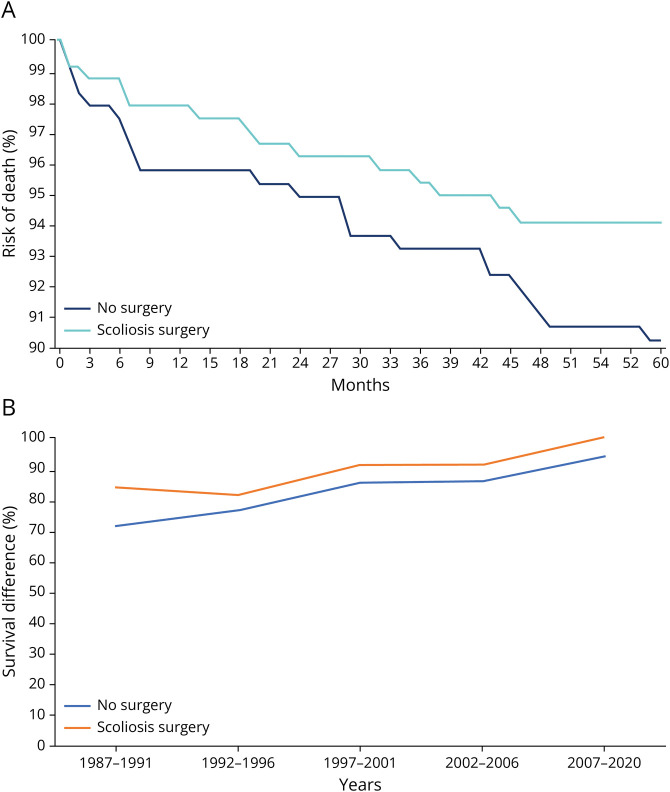
Results: Two hundred thirty-six had not been operated and 238 had been operated on for scoliosis during the median follow-up of 17.8 (interquartile range [IQR] 11.7-25.7) and 23.0 (IQR 18.4-28.2) years, respectively. Both groups had similar comorbidities. During the follow-up, mortality was higher in the nonsurgically treated group than in the surgically treated group (n = 38/236, 16% and 8.7 per 1,000 follow-up years vs n = 29/238, 12% and 5.3 per 1,000 follow-up years, p = 0.047). In patients with nonsurgical treatment, the cause of death was respiratory in 76.3% (29/38) and 37.9% (11/29) in patients with surgical treatment of scoliosis (6.6 and 2.0 per 1,000 follow-up years, p = 0.002). Neurologic causes of death were more common in surgically treated patients than in nonsurgically treated patients, 44.8% (13/29) and 15.8% (6/38), respectively (3.0 and 1.1 per 1,000 follow-up years, p = 0.009).
Discussion: Surgical treatment of scoliosis associates to reduced mortality because of respiratory causes in children with CP and scoliosis.
Classification of evidence: This study provides Class IV evidence of the effects of spinal fusion on mortality of children with severe scoliosis due to CP.
© 2023 American Academy of Neurology.
Conflict of interest statement
The authors report no relevant disclosures. Go to
Figures
References
-
- Saito N, Ebara S, Ohotsuka K, Kumeta H, Takaoka K. Natural history of scoliosis in spastic cerebral palsy. Lancet. 1998;351(9112):1687-1692. - PubMed
-
- Palisano R, Rosenbaum P, Walter S, Russell D, Wood E, Galuppi B. Development and validation of a gross motor function classification system for children with cerebral palsy. Dev Med Child Neurol. 1997;39(4):214-223. - PubMed
-
- Persson-Bunke M, Hägglund G, Lauge-Pedersen H, Wagner P, Westbom L. Scoliosis in a total population of children with cerebral palsy. Spine (Phila Pa 1976). 2012;37(12):E708-E713. - PubMed
Publication types
MeSH terms
LinkOut - more resources
Full Text Sources
Medical
Research Materials
Miscellaneous
