. 2023 Sep 7;13(1):14775.
doi: 10.1038/s41598-023-41867-y.

Microbial signature of plaque and gut in acute coronary syndrome

Affiliations

Microbial signature of plaque and gut in acute coronary syndrome

Eugenia Pisano et al. Sci Rep. .

Abstract

Gut microbiota is an emerging editable cardiovascular risk factor. We aim to investigate gut and coronary plaque microbiota, using fecal samples and angioplasty balloons from patients with acute coronary syndrome (ACS), chronic coronary syndrome (CCS) and control subjects. We examined bacterial communities in gut and coronary plaques by 16S rRNA sequencing and we performed droplet digital PCR analysis to investigate the gut relative abundance of the bacterial genes CutC/CntA involved in trimethylamine N-oxide synthesis. Linear discriminant analysis effect size (LEfSe) at the genus and species levels displayed gut enrichment in Streptococcus, Granulicatella and P. distasonis in ACS compared with CCS and controls; Roseburia, C. aerofaciens and F. prausnitzii were more abundant in controls than in patients. Principal component analysis (PCA) of 41 differentially abundant gut taxa showed a clustering of the three groups. In coronary plaque, LEfSe at the genus level revealed an enrichment of Staphylococcus and Streptococcus in ACS, and Paracoccus in CCS, whereas PCA of 15 differentially abundant plaque taxa exhibited clustering of ACS and CCS patients. CutC and CntA genes were more abundant in ACS and CCS than in controls while no significant difference emerged between ACS and CCS. Our results indicate that ACS and CCS exhibit a different gut and plaque microbial signature, suggesting a possible role of these microbiotas in coronary plaque instability.


Conflict of interest statement

The authors declare no competing interests.

Figures
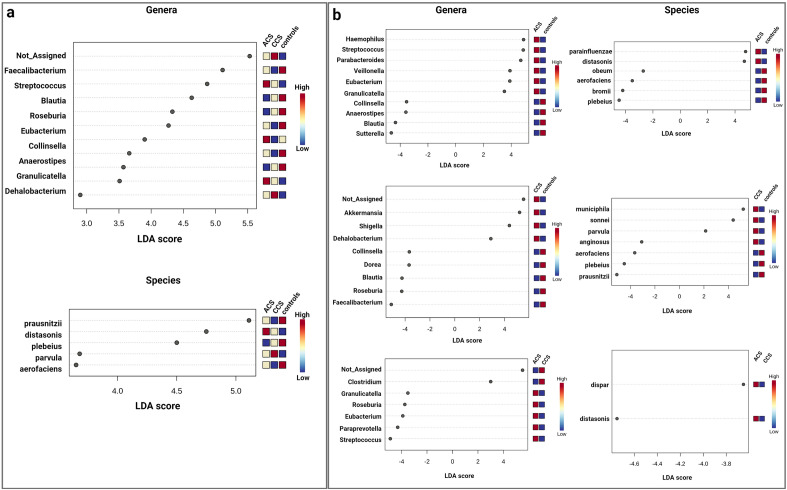
Figure 1
Figure 1
(a) Linear discriminant analysis (LDA) effect size (LEfSe) analysis among ACS, CCS and controls in the gut. LEfSe analysis detects statistically significant changes at the genus and species levels among the three groups. (b) LEfSe analysis detects statistically significant changes at the genus and species levels in ACS vs. controls, controls vs. CCS and ACS vs. CCS. Microbial taxa that are different between groups are highlighted with log differences on the x-axis (p < 0.05).
Figure 2
Figure 2
Principal component analysis (PCA) based on deregulated OTUs in the gut. (a) PCA between controls, ACS patients and CCS patients. (b) CCS vs. controls, p = 4.3e−07; ACS vs. controls, p = 1.5e−07 and ACS vs. CCS, p = 0.002. Wilcoxon test was used.
Figure 3
Figure 3
Changes in the functional potential of gut microbiota in ACS, CCS and controls. (a) Differential PICRUSt-predicted functional categories based on the COG database in ACS, CCS and controls; (b) differential PICRUSt-predicted KEGG pathways between ACS, CCS and controls.
Figure 4
Figure 4
Linear discriminant analysis (LDA) effect size (LEfSe) analysis between ACS and CCS in coronary plaques. (a) The LEfSe analysis detects statistically significant changes at the genus and species levels between the two groups. Microbial taxa that are different between groups are highlighted with log differences on the x-axis (p < 0.05). (b) Principal component analysis (PCA) based on deregulated OTUs in coronary plaques.
Figure 5
Figure 5
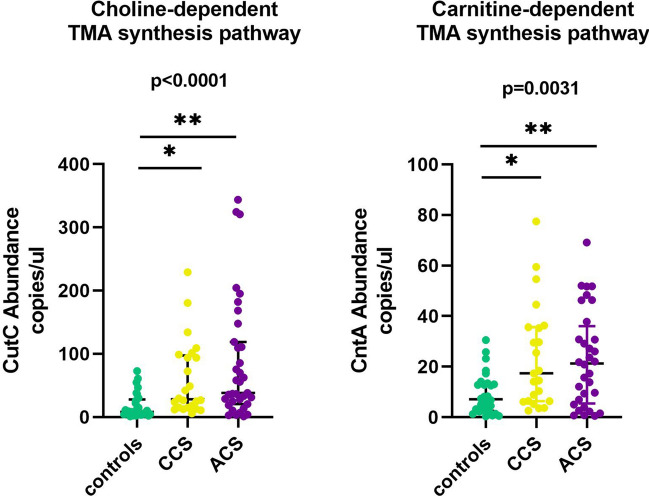
Abundance analysis of choline TMA-lyase gene CutC and Rieske-type oxygenase gene CntA in the gut of ACS, CCS and controls. Choline-dependent TMA synthesis pathway: CutC gene is significantly more abundant in ACS and CCS patients compared with controls, p = 0.0001 and p = 0.0012, respectively; Carnitine-dependent TMA synthesis pathway: CntA gene is significantly more abundant in ACS and CCS patients compared with controls, p = 0.013 and p = 0.0074, respectively.

References

    1. Wellcome Trust Case Control Consortium Genome-wide association study of 14,000 cases of seven common diseases and 3000 shared controls. Nature. 2007;447(7145):661–78. - PMC - PubMed
    1. Ardissino D, Berzuini C, Merlini PA, et al. Influence of 9p21.3 genetic variants on clinical and angiographic outcomes in early-onset myocardial infarction. J. Am. Coll. Cardiol. 2011;58:426–434. - PubMed
    1. Ripatti S, Tikkanen E, Orho-Melander M, et al. A multilocus genetic risk score for coronary heart disease: Case-control and prospective cohort analyses. Lancet. 2010;376:1393–1400. - PMC - PubMed
    1. Feng Q, Liu Z, Zhong S, et al. Integrated metabolomics and metagenomics analysis of plasma and urine identified microbial metabolites associated with coronary heart disease. Sci. Rep. 2016;6:22525. - PMC - PubMed
    1. Wang Z, Klipfell E, Bennett BJ, Koeth R, Levison BS, Dugar B, et al. Gut flora metabolism of phosphatidylcholine promotes cardiovascular disease. Nature. 2011;472(7341):57–63. - PMC - PubMed

Publication types

Substances