Biochemical recurrence in patients with prostate cancer after primary definitive therapy: treatment based on risk stratification
- PMID: 37679602
- PMCID: PMC11096125
- DOI: 10.1038/s41391-023-00712-z
Biochemical recurrence in patients with prostate cancer after primary definitive therapy: treatment based on risk stratification
Abstract
Background: Nearly one-third of patients with prostate cancer (PCa) experience biochemical recurrence (BCR) after primary definitive treatment. BCR increases the risk of distant metastasis and mortality in patients with prognostically unfavorable features. These patients are best managed with a tailored treatment strategy incorporating risk stratification using clinicopathological factors, next-generation imaging, and genomic testing.
Objective: This narrative review examines the utility of risk stratification for the management of patients with BCR in the context of clinical trial data, referencing the latest recommendations by European and US medical societies.
Methods: PubMed was searched for relevant studies published through May 21 2023 on treatment of patients with BCR after radical prostatectomy (RP) or external beam radiotherapy (EBRT).
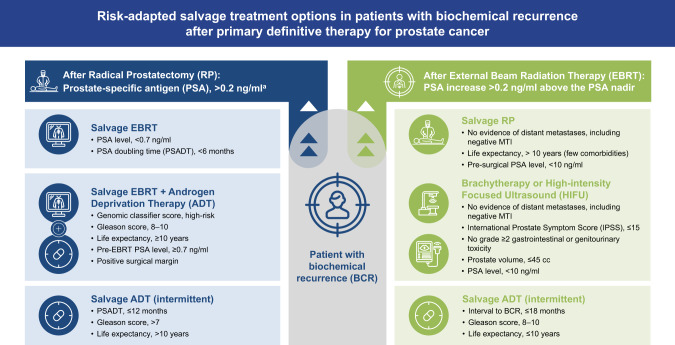
Results: European and US guidelines support the risk-stratified management of BCR. Post-RP, salvage EBRT (with or without androgen deprivation therapy [ADT]) is an accepted treatment option for patients with BCR. Post-EBRT, local salvage therapies (RP, cryotherapy, high-intensity focused ultrasound, stereotactic body radiotherapy, and low-dose-rate and high-dose-rate brachytherapy) have demonstrated comparable relapse-free survival rates but differing adverse event profiles, short and long term. Local salvage therapies should be used for local-only relapses while ADT should be considered for regional or distant relapses. In practice, patients often receive ADT, with varying guidance for intermittent ADT vs. continuous ADT, due to consideration of quality-of-life effects.
Conclusions: Despite a lack of consensus for BCR treatment among guideline associations and medical societies, risk stratification of patients is essential for personalized treatment approaches, as it allows for an informed selection of therapeutic strategies and estimation of adverse events. In lower-risk disease, observation is recommended while in higher-risk disease, after failed repeat local therapy, ADT and/or clinical trial enrollment may be appropriate. Results from ongoing clinical studies of patients with BCR should provide consensus for management.
© 2023. The Author(s).
Conflict of interest statement
NDS certifies that all conflicts of interest, including specific financial interests and relationships and affiliations relevant to the subject matter or materials discussed in the manuscript (e.g. employment/affiliation, grants or funding, consultancies, honoraria, stock ownership or options, expert testimony, royalties, or patents filed, received, or pending), are as follows: NDS – grant support and consulting fees from AbbVie, Amgen, Astellas Pharma, AstraZeneca, Bayer, Clovis Oncology, Dendreon, Ferring, GenesisCare, Janssen Oncology, Merck, Myovant, Pfizer, Sanofi–Genzyme, and Tolmar Pharmaceuticals. JWM – stock or other ownership with Pfizer, Johnson & Johnson, Bavarian Nordic, Eli Lilly, Procter & Gamble, Walgreens, AstraZeneca, Novartis, and Theralogix; honoraria from AbbVie, Bayer, Ferring, Dendreon, Janssen, Astellas Pharma, Sanofi, Genomic Health, GenomeDx, and Pfizer; consulting or advisory role with AbbVie, Bayer, Theralogix, Tolmar, and Blue Earth Diagnostics; speakers’ bureau for Bayer, Ferring, Dendreon, Janssen, Sanofi, Genomic Health, and GenomeDx; research funding from Astellas Pharma (Inst) and Pfizer (Inst). KJP – founder, equity holder of Keystone Biopharma, Inc.; consultant with Cue Biopharma, Inc.; research funding from Progenics, Inc. JC – founder, equity holder of Sofie Biosciences and Trethera Therapeutics; advisory board member of Actinium, Actis, RayzeBio, and Jubillant. MTK – grant support and consulting fees from AstraZeneca, Bayer, and Palette Life Sciences. SJF – consultant to Astellas, AstraZeneca, Bayer, Dendreon Pharmaceuticals, Janssen, Merck, Myovant Sciences, Pfizer, and Sanofi.
Figures