


Resident-Performed Phacoemulsification Cataract Surgery: Impact of Resident-Level Characteristics
- PMID: 37680293
- PMCID: PMC10481973
- DOI: 10.4103/joco.joco_58_21
Resident-Performed Phacoemulsification Cataract Surgery: Impact of Resident-Level Characteristics
Abstract
Purpose: To evaluate the rate of complications in resident-performed phacoemulsification and influencing factors.
Methods: In this retrospective cohort study, the outcomes of cataract surgeries performed by 18 ophthalmology residents were analyzed. The outcome of first 80 phacoemulsification cataract surgeries (1440 cataract surgeries) performed by each resident were analyzed. Outcome measures included the rate of intraoperative capsular rupture requiring anterior vitrectomy, nucleus drop, and incomplete attempts at uncomplicated procedures. Changes in the rate of complications over the surgical training course were also assessed.
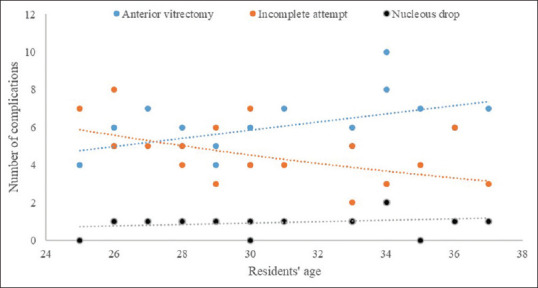
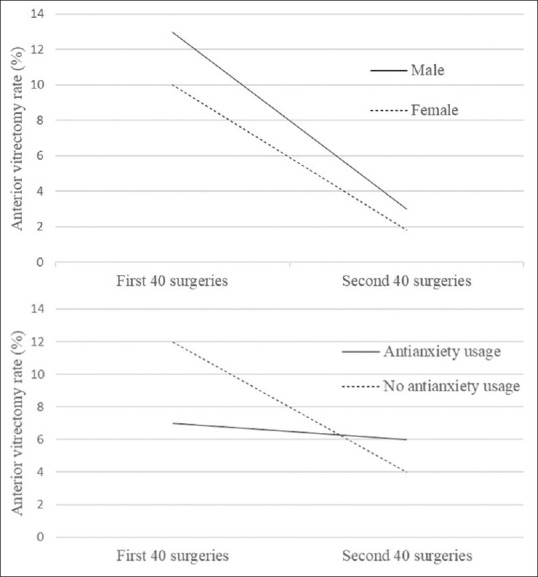
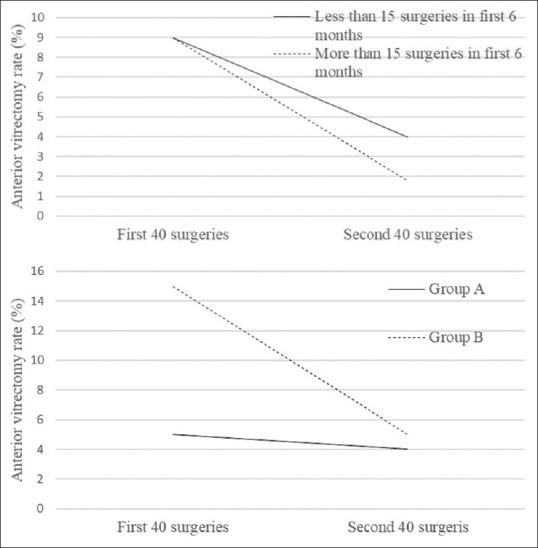
Results: The most common surgical complications were capsular rupture (7.5%), followed by incomplete attempt(s) (5.9%), and nucleus drop (1.1%). Comparing the first 40 and second 40 surgeries, the rate of complications decreased as a function of surgeon experience in all resident cohorts. Greater theoretical skills and younger surgeon age were associated with a lower rate of intraoperative capsular rupture (hazard ratios = 1.421 and 1.481, respectively; P = 0.047 and P = 0.041, respectively). The use of antianxiety drugs and number of surgeries in the first 6 months demonstrated no predictive value for a lower rate of intraoperative complications (hazard ratios = 0.929 and 1.002; P = 0.711 and P = 0.745, respectively).
Conclusion: The use of antianxiety medication and more surgeries in the first 6 months did not decrease the rate of intraoperative complications of phacoemulsification, while improvement of theoretical skills may have increased the safety of resident-performed cataract surgery.
Keywords: Cataract; Learning curve; Phacoemulsification.
Copyright: © 2023 Journal of Current Ophthalmology.
Conflict of interest statement
There are no conflicts of interest.
Figures

References
-
- Vision Atlas. International Agency for the Prevention of Blindness. [Last accessed on 2020 Jan 05]. Available from: https://www.iapb.org/learn/vision-atlas/causes-of-vision-loss/
-
- Global Initiative for the Elimination of Avoidable Blindness: Action Plan;2006-2011. World Health Organization. [Last accessed on 2020 Jan 05]. Available from: https://www.who.int/blindness/Vision2020_report.pdf .
-
- Durand ML. Endophthalmitis. In: Bennett JE, Dolin R, Blaser MJ, editors. Mandell, Douglas, and Bennett's Principles and Practice of Infectious Diseases. Canada: Elsevier; 2015. pp. 1415–22.
-
- Hashmi FK, Khan QA, Chaudhry TA, Ahmad K. Visual outcome of cataract surgery. J Coll Physicians Surg Pak. 2013;23:448–9. - PubMed
-
- World Health Organization. “World Report on Vision”2019. [Last accessed on 2019 Jan 05]. Available from: https://apps.who.int/iris/bitstream/handle/10665/328717/9789240008564-ch... .
LinkOut - more resources
Full Text Sources