


Predictive factors of urinary tract infections caused by extended-spectrum β-lactamase-producing Escherichia coli in children: a prospective Tunisian study
- PMID: 37682274
- PMCID: PMC11138556
Predictive factors of urinary tract infections caused by extended-spectrum β-lactamase-producing Escherichia coli in children: a prospective Tunisian study
Abstract
Aim: To identify the predictive factors for the occurrence of community-acquired urinary tract infections caused by Extended-Spectrum β-Lactamase-Producing Escherichia coli in children.
Methods: This was a single-center prospective observational study of children and young adults with community-acquired urinary tract infections caused by Extended-Spectrum β-Lactamase-Producing Escherichia coli. The study was conducted in the pediatric nephrology department in Charles Nicolle Hospital, Tunis, Tunisia from January 1st, 2019, to December 31, 2020. Patients ≤20 years with community-acquired urinary tract infection caused by Escherichia coli were included prospectively in our study.
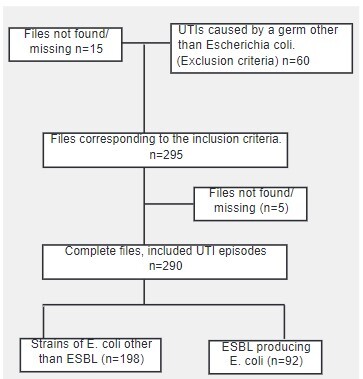
Results: We collected 290 urinary tract infections in 218 patients, including 92 urinary tract infections due to Extended-Spectrum β-Lactamase-Producing Escherichia coli. The mean age of children was 50.10±54.28 months, with a female predominance in 65.2% of cases. Risk factors for the acquisition of multidrug-resistant bacteria were antibiotic therapy in the previous three months, antibiotic prophylaxis, hospitalization in the year preceding the urinary tract infections, and outpatient care in the previous six months (p < 0.05). Resistance to Ceftazidime, Cefotaxime, Cefixime, Gentamicin and Ofloxacin was significantly associated with the presence of an Extended-Spectrum β-Lactamase strain. Antibiotic resistance was significantly more observed in the age group above 6 years. Co-habitation with health care worker was a risk factor for resistance to Amoxicillin-Clavulanic Acid.
Conclusion: Understanding the epidemiological profile and risk factors for ESBL-producing UTIs, including Extended-Spectrum β-Lactamase-producing Escherichia coli in the pediatric population, could improve the therapeutic approach and lead to more rational prescription of antibiotics.
Figures
References
-
- Millner R, Becknell B. Urinary Tract Infections. Pediatr Clin North Am. 2019;66(1):1–13. - PubMed
-
- Simões e Silva AC, Oliveira EA. Update on the approach of urinary tract infection in childhood. J Pediatr. 2015;91(1):2–10. - PubMed
-
- Karmazyn BK, Alazraki AL, Anupindi SA, Dempsey ME, Dillman JR, Dorfman SR, et al. Expert panel on pediatric imaging: ACR appropriateness criteria, urinary tract infection-child. J Am Coll Radiol. 2017;14(5):362–371. - PubMed
-
- Stephens GM, Akers S, Nguyen H, Woxland H. Evaluation and management of urinary tract infections in the school-aged child. 2015;42(1):33–41. - PubMed
-
- ‘t Hoen LA, Bogaert G, Radmayr C, Dogan HS, Nijman RJM, Quaedackers J, Rawashdeh YF, Silay MS, Tekgul S, Bhatt NR, Stein R. Update of the EAU/ESPU guidelines on urinary tract infections in children. J Pediatr Urol. 2021;17(2):200–207. - PubMed
Publication types
MeSH terms
Substances
LinkOut - more resources
Full Text Sources
Medical
