. 2023 Aug 14;26(9):107621.
doi: 10.1016/j.isci.2023.107621. eCollection 2023 Sep 15.

SARS-CoV-2 vaccine-induced antibodies protect against Omicron breakthrough infection

Collaborators, Affiliations

SARS-CoV-2 vaccine-induced antibodies protect against Omicron breakthrough infection

Eva A M Baerends et al. iScience. .

Abstract

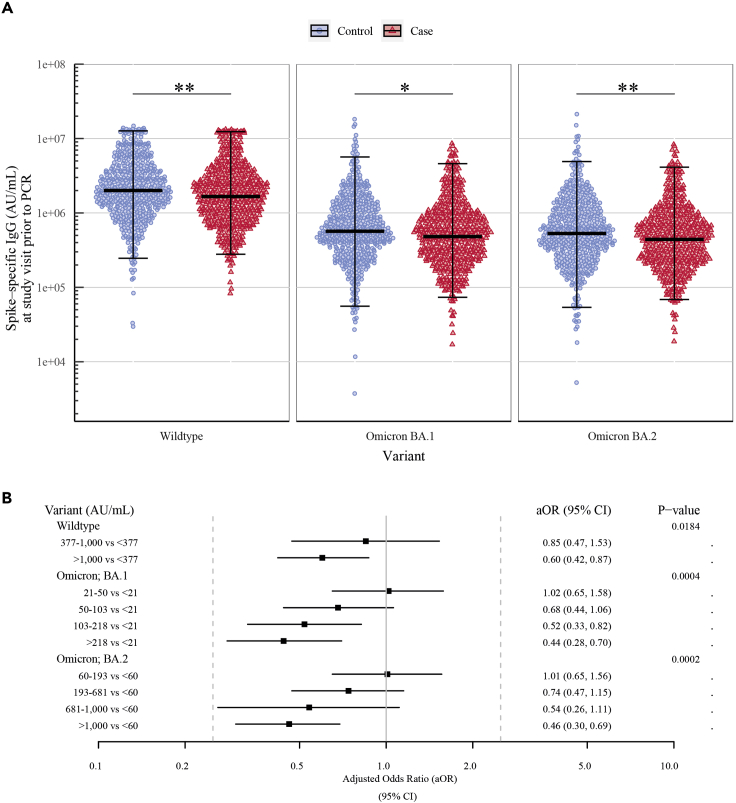
SARS-CoV-2 Omicron quickly spread globally, also in regions with high vaccination coverage, emphasizing the importance of exploring the immunological requirements for protection against Omicron breakthrough infection. The test-negative matched case-control study (N = 964) characterized Omicron breakthrough infections in triple-vaccinated individuals from the ENFORCE cohort. Within 60 days before a PCR test spike-specific IgG levels were significantly lower in cases compared to controls (GMR [95% CI] for BA.2: 0.83 [0.73-0.95], p = 0.006). Multivariable logistic regression showed significant associations between high antibody levels and lower odds of infection (aOR [95% CI] for BA.2 spike-specific IgG: 0.65 [0.48-0.88], p = 0.006 and BA.2 ACE2-blocking antibodies: 0.46 [0.30-0.69], p = 0.0002). A sex-stratified analysis showed more pronounced associations for females than males. High levels of vaccine-induced antibodies provide partial protection against Omicron breakthrough infections. This is important knowledge to further characterize a threshold for protection against new variants and to estimate the necessity and timing of booster vaccination.

Keywords: Immune response; Immunology; Molecular medicine.


Conflict of interest statement

N.B.S. declares to have served as an investigator in clinical trials sponsored by Pfizer, Gilead, and Bavarian Nordic. H.N. declares to have been on advisory boards for GSK and MSD. T.B. declares receipt of unrestricted grants from Novo Nordisk Foundation, Simonsen Foundation, Lundbeck Foundation, Kai Foundation, Erik and Susanna Olesen’s Charitable Fund, GSK, Pfizer, Gilead Sciences, and MSD; and being advisory board member for GSK, Pfizer, Gilead Sciences, MSD, Janssen, and Astra Zeneca; and being principal investigator on clinical trials conducted by Pfizer, Boehringer Ingelheim, Gilead Sciences, MSD, Roche, Novartis, Kancera AB, Bavarian Nordic, and Janssen; and being board member on Pentabase; and receiving consulting fees from GSK and Pfizer; and receiving honorarium for lectures from GSK, Pfizer, Gilead Sciences, Boehringer Ingelheim, AbbVie, Astra Zeneca, and Bavarian Nordic; and receiving donation of trial medication (baricitinib) from Eli Lilly. MT declares to be on a Data Safety Monitoring Board for Immunocore. The remaining authors declare no competing interests.

Figures
None
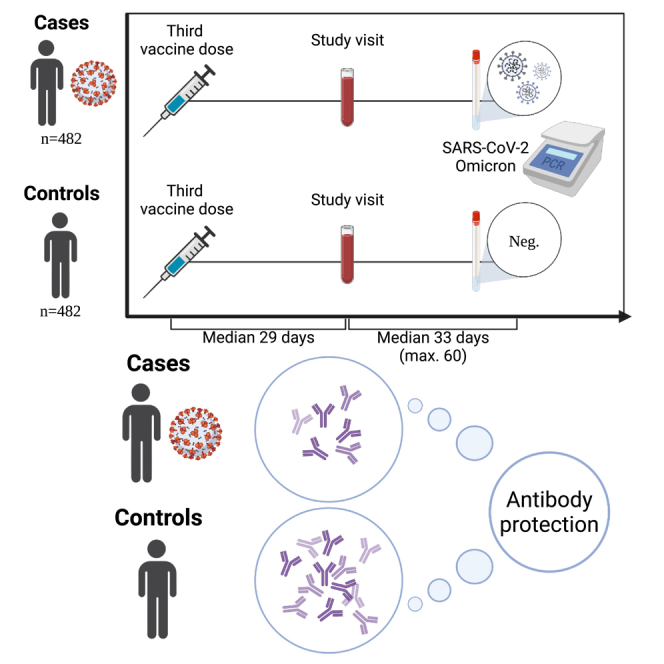
Graphical abstract
Figure 1
Figure 1
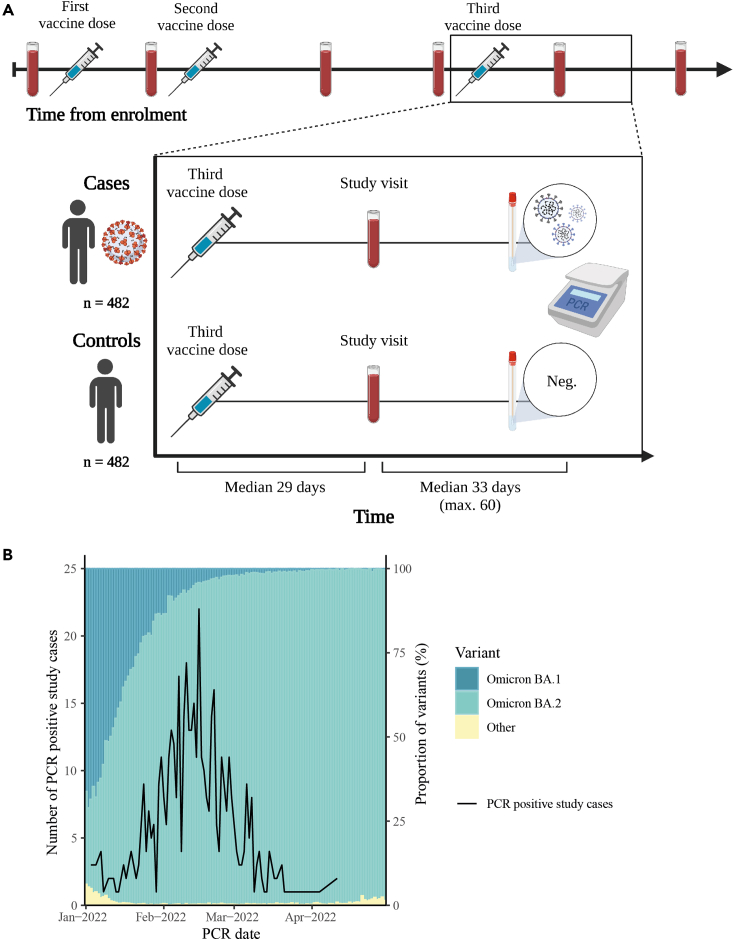
Study design and inclusion of participants (A) Schematic overview of the ENFORCE study design with focus on inclusion of study participants for evaluation of Omicron breakthrough infections. All study participants had received a third vaccine dose and completed a subsequent study visit maximum 60 days prior to a positive (case) or negative (control) PCR test. (B) Illustration of the proportion of SARS-CoV-2 variants (Omicron BA.1 and Omicron BA.2) in Denmark from January 1st to May 1st 2022 and the number of PCR positive study cases included by PCR date.
Figure 2
Figure 2
High levels of spike-specific IgG and ACE2-blocking antibody titers were associated with lower odds of Omicron breakthrough infection (A) Comparison of spike-specific IgG levels (AU/mL) quantified at a study visit prior to a positive (cases, n = 482) or negative PCR test (controls, n = 482) showing the geometric mean and 95% CI. SARS-CoV-2 variants from left to right: Wildtype (Wuhan-Hu-1), Omicron BA.1, and Omicron BA.2. ∗ = p ≤ 0.05 and ∗∗ = p < 0.01. (B) Multivariable logistic regression showing the adjusted odds ratios (aORs) and 95% CI for breakthrough infection for ACE2-blocking antibody titers in tertiles (wildtype) or quintiles (Omicron variants). The analysis adjusts for the matched variables: age group, sex, vaccine, and study visit, and for the unmatched variables: vaccine priority group, Charlson comorbidity index (CCI), visit year, days from study visit to PCR test, and days from third vaccination to PCR test.
Figure 3
Figure 3
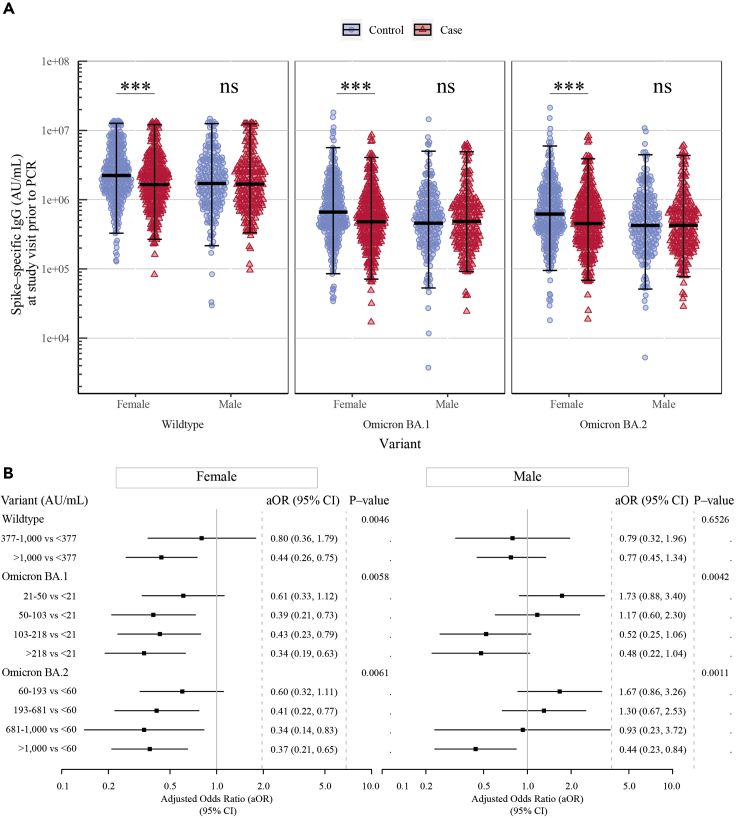
Association between high levels of vaccine-induced antibodies and lower odds of Omicron breakthrough infection were more pronounced in females than to males (A) Comparison of spike-specific IgG levels (AU/mL) quantified at a study visit prior to a positive (case) or negative (control) PCR test stratified by sex showing the geometric mean and 95% CI (n = 285 females and n = 197 males). SARS-CoV-2 variants from left to right: Wildtype (Wuhan-Hu-1), Omicron BA.1, and Omicron BA.2. ∗∗∗ = p < 0.001. (B) Multivariable logistic regression showing the adjusted odds ratios (aORs) and 95% CI for breakthrough infection for ACE2-blocking antibody titers in tertiles (wildtype) or quintiles (Omicron variants) stratified by sex. The analysis adjusts for the matched variables: age group, sex, vaccine, and study visit, and for the unmatched variables: vaccine priority group, Charlson comorbidity index (CCI), visit year, days from study visit to PCR test, and days from third vaccination to PCR test.
Figure 4
Figure 4
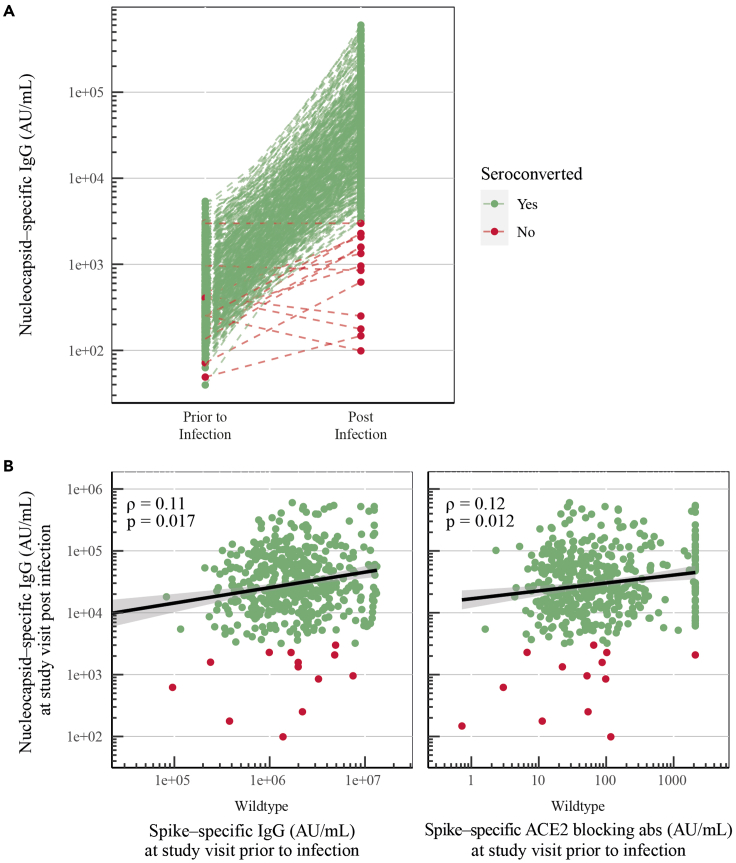
Nucleocapsid-specific IgG seroconversion following breakthrough infection was not correlated with vaccine-induced immunity (A) Nucleocapsid-specific IgG levels (AU/mL) prior to and post breakthrough infection for cases (n = 457). Seroconversion is defined by nucleocapsid-specific antibodies >3,000 AU/mL and a 2-fold increase. (B) Spearman correlations between infection-induced nucleocapsid-specific IgG (AU/mL), and vaccine-induced spike-specific IgG (AU/mL) (Wuhan-Hu-1) and ACE2-blocking antibodies (AU/mL) (Wuhan-Hu-1).

References

    1. Watson O.J., Barnsley G., Toor J., Hogan A.B., Winskill P., Ghani A.C. Global impact of the first year of COVID-19 vaccination: a mathematical modelling study. Lancet Infect. Dis. 2022;22:1293–1302. doi: 10.1016/S1473-3099(22)00320-6. - DOI - PMC - PubMed
    1. Cao Y., Wang J., Jian F., Xiao T., Song W., Yisimayi A., Huang W., Li Q., Wang P., An R., et al. Omicron escapes the majority of existing SARS-CoV-2 neutralizing antibodies. Nature. 2022;602:657–663. doi: 10.1038/s41586-021-04385-3. - DOI - PMC - PubMed
    1. Tseng H.F., Ackerson B.K., Luo Y., Sy L.S., Talarico C.A., Tian Y., Bruxvoort K.J., Tubert J.E., Florea A., Ku J.H., et al. Effectiveness of mRNA-1273 against SARS-CoV-2 Omicron and Delta variants. Nat. Med. 2022;28:1063–1071. doi: 10.1038/s41591-022-01753-y. - DOI - PMC - PubMed
    1. Zhou Y., Zhi H., Teng Y. The outbreak of SARS-CoV-2 Omicron lineages, immune escape, and vaccine effectivity. J. Med. Virol. 2023;95:e28138. doi: 10.1002/jmv.28138. - DOI - PMC - PubMed
    1. Liu L., Iketani S., Guo Y., Chan J.F.W., Wang M., Liu L., Luo Y., Chu H., Huang Y., Nair M.S., et al. Striking antibody evasion manifested by the Omicron variant of SARS-CoV-2. Nature. 2022;602:676–681. doi: 10.1038/s41586-021-04388-0. - DOI - PubMed