


Stroke Riskometer Application (SRA™) influence on lifestyle changes of home bound familial Malaysian stroke caregivers: a randomised controlled trial in a primary care based longer term stroke care facility
- PMID: 37684626
- PMCID: PMC10486033
- DOI: 10.1186/s12875-023-02138-x
Stroke Riskometer Application (SRA™) influence on lifestyle changes of home bound familial Malaysian stroke caregivers: a randomised controlled trial in a primary care based longer term stroke care facility
Abstract
Background: In countries where access to Specialist stroke care services are limited, primary care physicians often manage stroke patients and the caregiving family members. This study aimed to evaluate the impact of Stroke Riskometer Application (SRA™) on promoting healthier lifestyles among familial stroke caregivers for primary prevention.
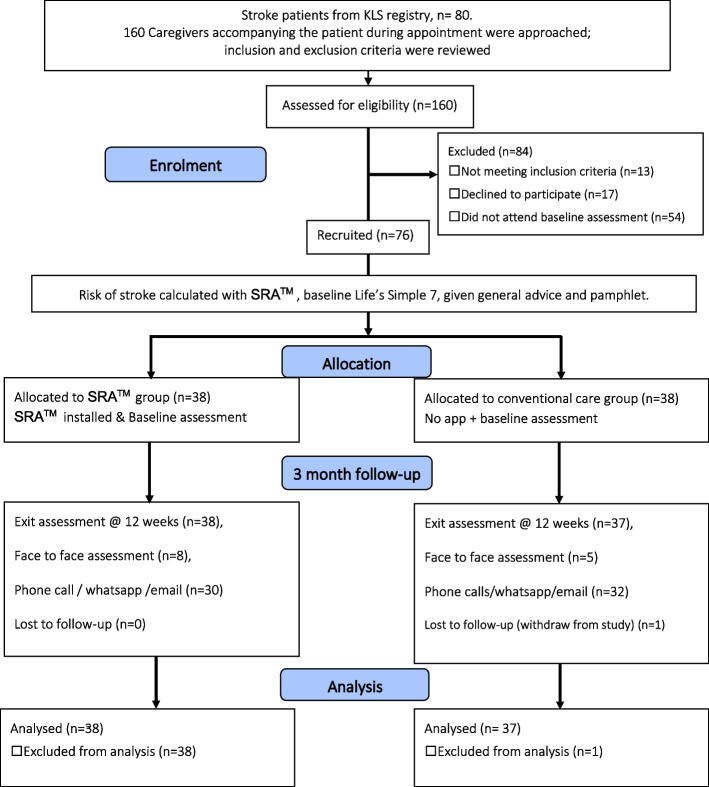
Methods: A parallel, open-label, 2-arm prospective, pilot randomised controlled trial was conducted at a long-term stroke service at a university based primary care clinic. All stroke caregivers aged ≥ 18 years, proficient in English or Malay and smartphone operation were invited. From 147 eligible caregivers, 76 participants were randomised to either SRA™ intervention or conventional care group (CCG) after receiving standard health counselling. The intervention group had additional SRA™ installed on their smartphones, which enabled self-monitoring of modifiable and non-modifiable stroke risk factors. The Stroke Riskometer app (SRATM) and Life's Simple 7 (LS7) questionnaires assessed stroke risk and lifestyle practices. Changes in clinical profile, lifestyle practices and calculated stroke risk were analysed at baseline and 3 months. The trial was registered in the Australia-New Zealand Clinical Trial Registry, ACTRN12618002050235.
Results: The demographic and clinical characteristics of the intervention and control group study participants were comparable. Better improvement in LS7 scores were noted in the SRA™ arm compared to CCG at 3 months: Median difference (95% CI) = 0.88 (1.68-0.08), p = 0.03. However, both groups did not show significant changes in median stroke risk and relative risk scores at 5-, 10-years (Stroke risk 5-years: Median difference (95% CI) = 0.53 (0.15-1.21), p = 0.13, 10-years: Median difference (95% CI) = 0.81 (0.53-2.15), p = 0.23; Relative risk 5-years: Median difference (95% CI) = 0.84 (0.29-1.97), p = 0.14, Relative risk 10-years: Median difference (95% CI) = 0.58 (0.36-1.52), p = 0.23).
Conclusion: SRA™ is a useful tool for familial stroke caregivers to make lifestyle changes, although it did not reduce personal or relative stroke risk after 3 months usage.
Trial registration: No: ACTRN12618002050235 (Registration Date: 21st December 2018).
Keywords: Caregiver; Informal caregiver; Stroke; Stroke rehabilitation.
© 2023. BioMed Central Ltd., part of Springer Nature.
Conflict of interest statement
The authors declare no competing interests.
References
-
- Chellathurai S. Caregivers of Post stroke Patients in an Urban Setting: An Evaluation of Caregiving Strain, its associated factors and Quality of Life. Kuala Lumpur: (Master's thesis), Universiti Kebangsaan Malaysia; 2016. p. 66.
-
- Kooi CW, Peng HC, Aziz ZA, Looi I. A review of stroke research in Malaysia from 2000–2014. Med J Malaysia. 2016;71(June):58–69. - PubMed
-
- O’Donnell MJ, Chin SL, Rangarajan S, Xavier D, Liu L, Zhang H, et al. Global and regional effects of potentially modifiable risk factors associated with acute stroke in 32 countries (INTERSTROKE): a case-control study. Lancet. 2016;388(10046):761–75. doi: 10.1016/S0140-6736(16)30506-2. - DOI - PubMed
Publication types
MeSH terms
Associated data
LinkOut - more resources
Full Text Sources
Medical