. 2023 Aug 25;12(17):3208.
doi: 10.3390/foods12173208.

Study of the Total Antioxidant Capacity (TAC) in Native Cereal-Pulse Flours and the Influence of the Baking Process on TAC Using a Combined Bayesian and Support Vector Machine Modeling Approach

Affiliations

Study of the Total Antioxidant Capacity (TAC) in Native Cereal-Pulse Flours and the Influence of the Baking Process on TAC Using a Combined Bayesian and Support Vector Machine Modeling Approach

Daniel Rico et al. Foods. .

Abstract

During the last few years, the increasing evidence of dietary antioxidant compounds and reducing chronic diseases and the relationship between diet and health has promoted an important innovation within the baked product sector, aiming at healthier formulations. This study aims to develop a tool based on mathematical models to predict baked goods' total antioxidant capacity (TAC). The high variability of antioxidant properties of flours based on the aspects related to the type of grain, varieties, proximal composition, and processing, among others, makes it very difficult to innovate on food product development without specific analysis. Total phenol content (TP), oxygen radical absorbance capacity (ORAC), and ferric-reducing antioxidant power assay (FRAP) were used as markers to determine antioxidant capacity. Three Bayesian-type models are proposed based on a double exponential parameterized curve that reflects the initial decrease and subsequent increase as a consequence of the observed processes of degradation and generation, respectively, of the antioxidant compounds. Once the values of the main parameters of each curve were determined, support vector machines (SVM) with an exponential kernel allowed us to predict the values of TAC, based on baking conditions (temperature and time), proteins, and fibers of each native grain.

Keywords: Bayesian model; antioxidant capacity; cereals; flour; prediction; pulses; support vector machines (SVM); thermal processing.


Conflict of interest statement

The authors declare no conflict of interest.

Figures
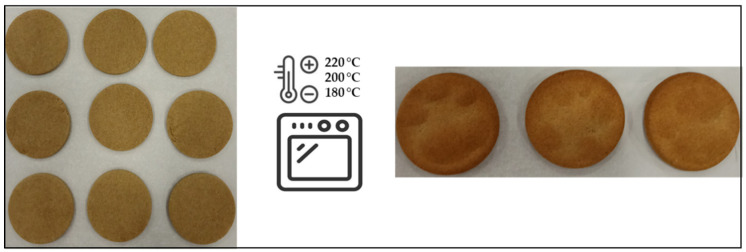
Figure 1
Figure 1
Biscuits prepared before and after thermal treatment (baking process) at different temperatures (180, 200, and 220 °C and times (0–1500 s).
Figure 2
Figure 2
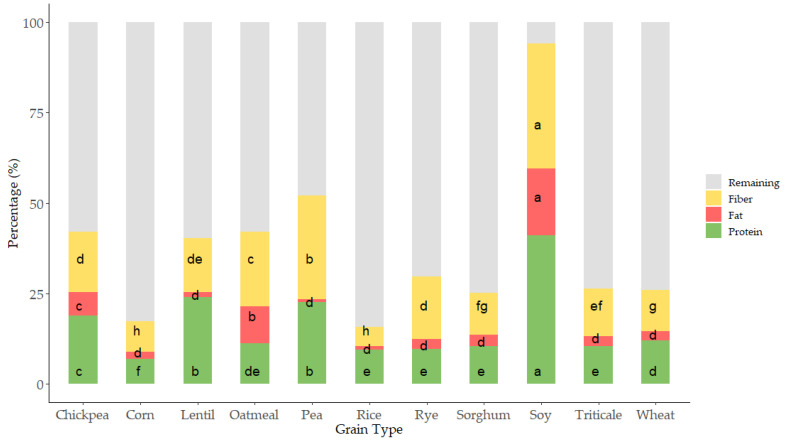
Stacked bar graph representing the proximal profile according to grain type. Letters of each color denote statistical differences between means (one-way ANOVA, posthoc Duncan’s test, p ≤ 0.05). Data was expressed in percentages (g 100 g−1 d.m.).
Figure 3
Figure 3
Boxplot distribution for (I) Protein, (II) Fat, and (III) Fiber (Total Dietary Fiber) according to the grain. Data was expressed in percentages (g 100 g−1 d.m.). Letters denote statistical differences between means (one-way ANOVA, posthoc Duncan’s test, p ≤ 0.05).
Figure 4
Figure 4
Boxplot distribution for (I) Luminosity, (II) a* and (III) b* according to the grain. Letters denote statistical differences between means (one-way ANOVA, posthoc Duncan’s test, p ≤ 0.05).
Figure 5
Figure 5
Boxplot distribution for TP (mg GAE 100 g−1) according to the grain. Data are mean values. Letters denote statistical differences between means (one-way ANOVA, posthoc Duncan’s test, p ≤ 0.05).
Figure 6
Figure 6
Box plot distribution for (I) ORAC (µmol Eq Trolox 100 g−1) and (II) FRAP (µmol reduced iron 100 g−1) according to the grain. Data are mean values. Letters denote statistical differences between means (one-way ANOVA, post hoc Duncan’s test, p ≤ 0.05).
Figure 7
Figure 7
Representation of the proximal profile (I) and colorimeter parameters (II) of the grain types based on principal components analysis (PCA).
Figure 8
Figure 8
Distributed stochastic neighbor embedding (T-SNE) distribution of type of grains based on their antioxidant parameters (TP, ORAC, and FRAP).
Figure 9
Figure 9
Level curves of total phenols, ORAC and FRAP, predicted with the first level model for the series according to baking temperature.
Figure 10
Figure 10
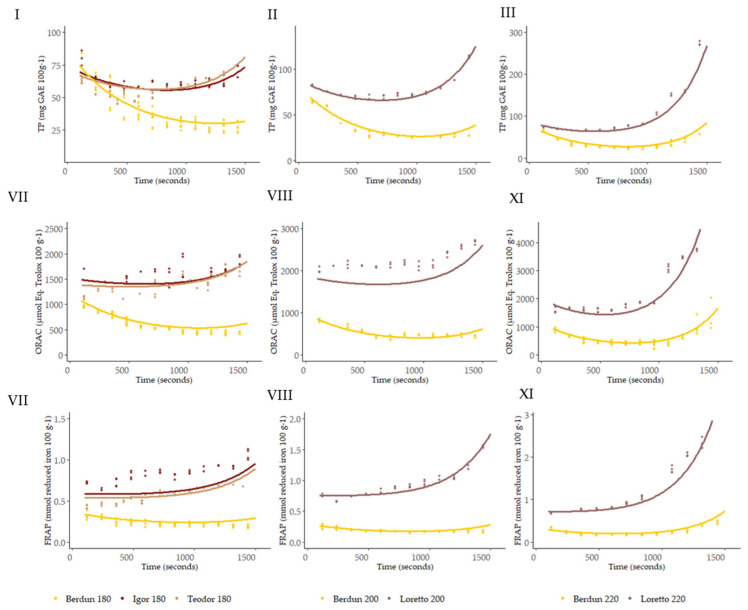
Curves of the level of TP (IIII), ORAC (IVVI), and FRAP (VIIIX) predicted with the second level models for the series according to baking temperature.
Figure 11
Figure 11
Prediction curves for total phenol content (TP) based on different baking temperatures on wheat (I) and rye (II).
Figure 12
Figure 12
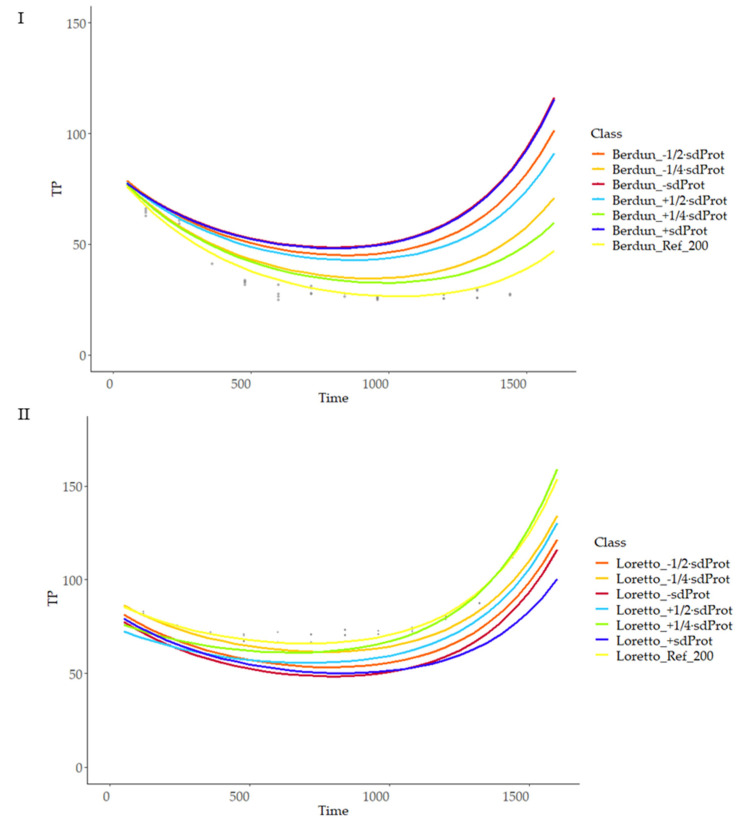
Prediction curves for total phenol content (TP) based on different protein content (g 100 g−1) on wheat (I) and rye (II).
Figure 13
Figure 13
Prediction curves for total phenol content (TP) based on different fiber (g 100 g−1) content on wheat (I) and rye (II).
Figure 14
Figure 14
Schematic representation of the global model.

References

    1. Sajdakowska M., Gębski J., Jeżewska-Zychowicz M., Królak M. Consumer Choices in the Bread Market: The Importance of Fiber in Consumer Decisions. Nutrients. 2021;13:132. doi: 10.3390/nu13010132. - DOI - PMC - PubMed
    1. Anderson J., Hanna T. Whole grains and protection against coronary heart disease: What are the active components and mechanisms? Am. J. Clin. Nutr. 1999;70:307–308. doi: 10.1093/ajcn/70.3.307. - DOI - PubMed
    1. Anderson J.W., Hanna T.J., Peng X., Kryscio R.J. Whole grain foods and heart disease risk. J. Am. Coll. Nutr. 2000;19((Suppl. S3)):291S–299S. doi: 10.1080/07315724.2000.10718963. - DOI - PubMed
    1. Bourdon I., Yokoyama W., Davis P., Hudson C., Backus R., Richter D., Knuckles B., Schneeman B.O. Postprandial lipid, glucose, insulin and cholecystokinin responses in men fed barley pasta enriched with beta-glucan. Am. J. Clin. Nutr. 1999;69:55–63. doi: 10.1093/ajcn/69.1.55. - DOI - PubMed
    1. Slavin J., Jacobs D., Marquart L. Whole-grain consumption and chronic disease: Protective mechanisms. Nutr. Cancer. 1997;27:14–21. doi: 10.1080/01635589709514495. - DOI - PubMed

LinkOut - more resources