. 2023 Aug 24;28(17):6226.
doi: 10.3390/molecules28176226.

Synthesis of Aminobisphosphinates through a Cascade Reaction between Hypophosphorous Acid and Bis(trimethylsilyl)imidates Mediated by ZnI2

Affiliations

Synthesis of Aminobisphosphinates through a Cascade Reaction between Hypophosphorous Acid and Bis(trimethylsilyl)imidates Mediated by ZnI2

Nouha Ayadi et al. Molecules. .

Abstract

Among phosphorylated derivatives, phosphinates occupy a prominent place due to their ability to be bioisosteres of phosphates and carboxylates. These properties imply the necessity to develop efficient methodologies leading to phosphinate scaffolds. In recent years, our team has explored the nucleophilic potential of silylated phosphonite towards various electrophiles. In this paper, we propose to extend our study to other electrophiles. We describe here the implementation of a cascade reaction between (trimethylsilyl)imidates and hypophosphorous acid mediated by a Lewis acid allowing the synthesis of aminomethylenebisphosphinate derivatives. The present study focuses on methodological development including a careful NMR monitoring of the cascade reaction. The optimized conditions were successfully applied to various aliphatic and aromatic substituted (trimethylsilyl)imidates, leading to the corresponding AMBPi in moderate to good yields.

Keywords: Lewis acid; bisphosphinates; methodological development; phosphonite.


Conflict of interest statement

The authors declare no conflict of interest.

Figures

Figure 1
Figure 1
(a) Synthesis and uses of silylated phosphonite II in the presence of various electrophiles; (b) structures of HMBPs and their analogues in bisphosphonate and phosphinylphosphonate series. * Refers to activated esters.
Figure 2
Figure 2
(a) Representative bioactive AMBPs. (b) Synthetic pathways to AMBPs. (c) Synthetic pathways to AMBPi.
Figure 3
Figure 3
(a) Preliminary test on the addition of BTSP to nitrile. (b) New methodology leading to AMBPi 3.
Scheme 1
Scheme 1
Synthesis of N,O-bis(silyl)imidates 1.
Figure 4
Figure 4
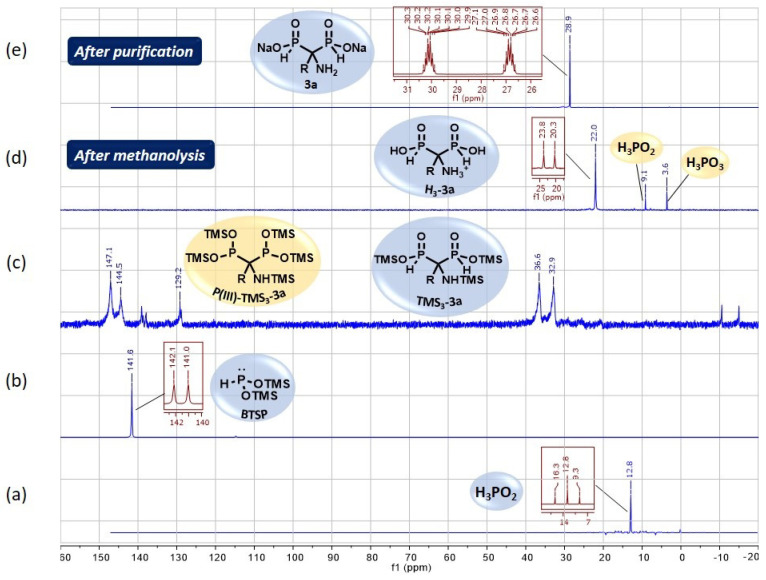
(ae) 31P (dark red) and{1H}31P (blue) NMR monitoring of the optimized cascade reaction between phosphorous acid and N,O-bis(trimethylsilylacetamide 1a.
Scheme 2
Scheme 2
Complementary tests to validate the cascade reaction.
Scheme 3
Scheme 3
Scope of the cascade reaction between various bis(trimethylsilyl)imidates 2al and hypophosphorous acid in the presence of zinc iodide.
Scheme 4
Scheme 4
Postulated mechanism for the formation of AMBPi 3al and α-aminophosphinate 5c,f,g,i,j.

References

    1. Horsman G.P., Zechel D.L. Phosphonate Biochemistry. Chem. Rev. 2017;117:5704–5783. doi: 10.1021/acs.chemrev.6b00536. - DOI - PubMed
    1. Virieux D., Volle J.N., Bakalara N., Pirat J.L. Synthesis and biological applications of phosphinates and derivatives. Top. Curr. Chem. 2015;360:39–114. doi: 10.1007/128_2014_566. - DOI - PubMed
    1. Pradere U., Garnier-Amblard E.C., Coats S.J., Amblard F., Schinazi R.F. Synthesis of nucleoside phosphate and phosphonate prodrugs. Chem. Rev. 2014;114:9154–9218. doi: 10.1021/cr5002035. - DOI - PMC - PubMed
    1. Yu H., Yang H., Shi E., Tang W. Development and Clinical Application of Phosphorus-Containing Drugs. Med. Drug. Discov. 2020;8:100063. doi: 10.1016/j.medidd.2020.100063. - DOI - PMC - PubMed
    1. Montchamp J.-L. Challenges and solutions in phosphinate chemistry. Pure Appl. Chem. 2019;91:113–120. doi: 10.1515/pac-2018-0922. - DOI

LinkOut - more resources