. 2023 Oct 2;20(10):5032-5042.
doi: 10.1021/acs.molpharmaceut.3c00291. Epub 2023 Sep 9.

Effect of Cyclodextrin Complex Formation on Solubility Changes of Each Drug Due to Intermolecular Interactions between Acidic NSAIDs and Basic H2 Blockers

Affiliations

Effect of Cyclodextrin Complex Formation on Solubility Changes of Each Drug Due to Intermolecular Interactions between Acidic NSAIDs and Basic H2 Blockers

Chihiro Tsunoda et al. Mol Pharm. .

Abstract

One of the solubilization of poorly water-soluble drugs is the use of cyclodextrin (CD)-based inclusion complexes. On the other hand, few studies have investigated how CD functions on the solubility of drugs in the presence of multiple drugs that interact with each other. In this study, we used indomethacin (IND) and diclofenac (DIC) as acidic drugs, famotidine (FAM) and cimetidine (CIM) as basic drugs, and imidazole (IMZ), histidine (HIS), and arginine (ARG) as compounds structurally similar to basic drugs. We attempted to clarify the effect of β-CD on the solubility change of each drug in the presence of multiple drugs. IND and DIC formed a eutectic mixture in the presence of CIM, IMZ, and ARG, which greatly increased the intrinsic solubility of the drugs as well as their affinity for β-CD. Furthermore, the addition of high concentrations of β-CD to the DIC-FAM combination, which causes a decrease in solubility due to the interaction, improved the solubility of FAM, which was decreased in the presence of DIC. These results indicate that β-CD synergistically improves the solubility of drugs in drug-drug combinations, where the solubility is improved, whereas it effectively improves the dissolution rate of drugs in situations where the solubility is reduced by drug-drug interactions, such as FAM-DIC. This indicates that β-CD can be used to improve the physicochemical properties of drugs, even when they are administered in combination with drugs that interact with each other.

Keywords: NSAIDs; complexation efficiency; cyclodextrin; phase solubility diagram; polypharmacy.


Conflict of interest statement

The authors declare no competing financial interest.

Figures
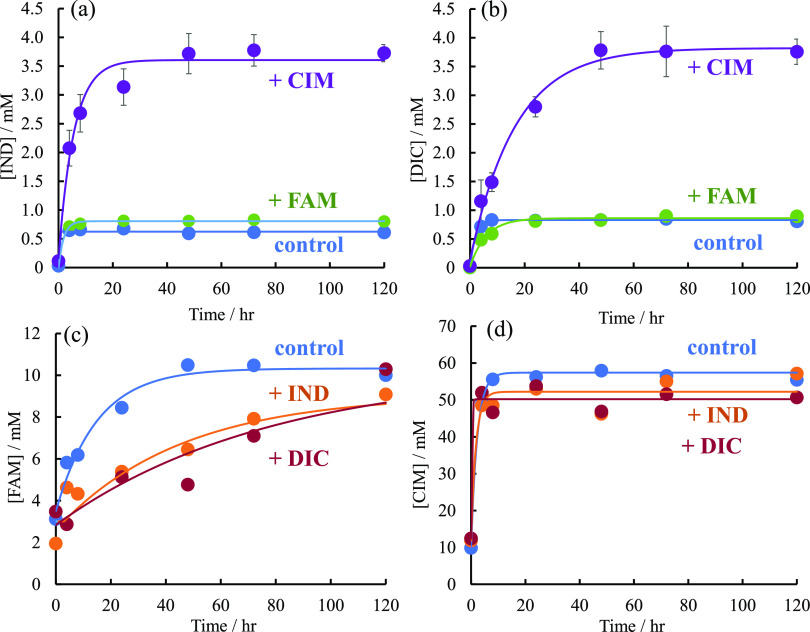
Figure 1
Figure 1
Solubility–time profiles of acidic and basic drugs. Solubility–time profiles of (a) IND in the absence (blue circles) as control and presence of CIM (purple circles) and FAM (green circles), (b) DIC in the absence (blue circles) as control and presence of CIM (purple circles) and FAM (green circles), (c) FAM in the absence (blue circles) as control and presence of IND (orange circles) and DIC (red circles), and (d) CIM in the absence (blue circles) as control and presence of IND (orange circles) and DIC (red circles).
Figure 2
Figure 2
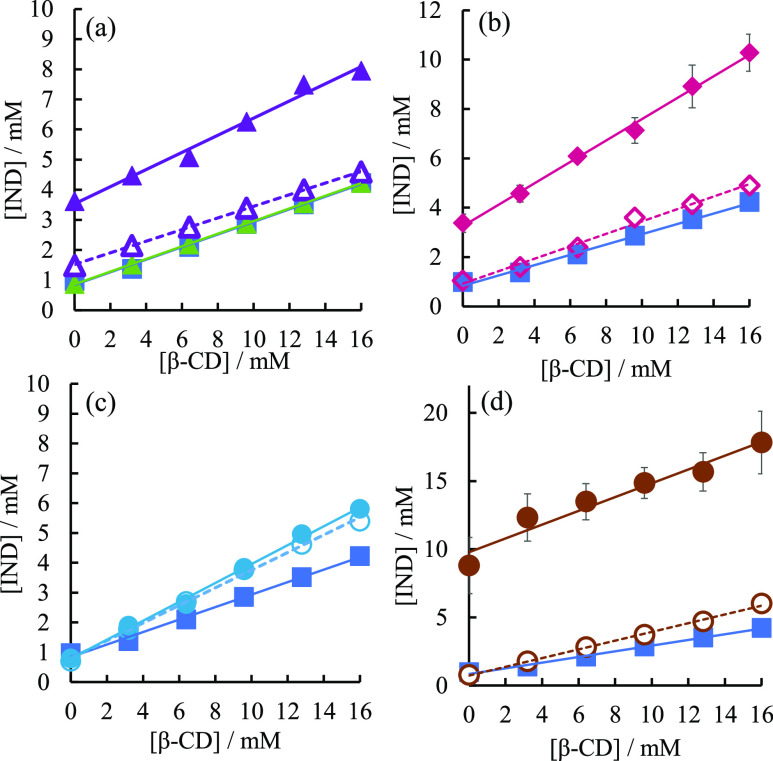
(a) Phase solubility diagram of IND in the absence and presence of CIM and FAM. Without additives (blue square, solid line); in the presence of CIM added by the codissolved method (purple closed triangle, solid line); in the presence of 50 mM CIM added by the predissolved method (purple open triangle, dotted line); in the presence of FAM added by the codissolved method (green closed triangle, solid line). (b) Phase solubility diagram of IND in the absence and presence of IMZ. Without additives (blue squares, solid lines); in the presence of 50 mM IMZ added by the codissolved method (pink closed diamonds, solid lines); in the presence of 50 mM IMZ added by the predissolved method (pink open diamonds, dotted lines). (c) Phase solubility diagram of IND in the absence and presence of HIS. Without additives (blue squares, solid lines); in the presence of 50 mM HIS added by the codissolved method (light blue closed circles, solid lines); in the presence of 50 mM HIS added by the predissolved method (light blue open circles, dotted lines). (d) Phase solubility diagram of IND in the absence and presence of ARG. No additive (blue square, solid line); in the presence of 50 mM ARG added by the codissolved method (brown circle, solid line); in the presence of 50 mM ARG added by the predissolved method (brown open circle, dotted line).
Figure 3
Figure 3
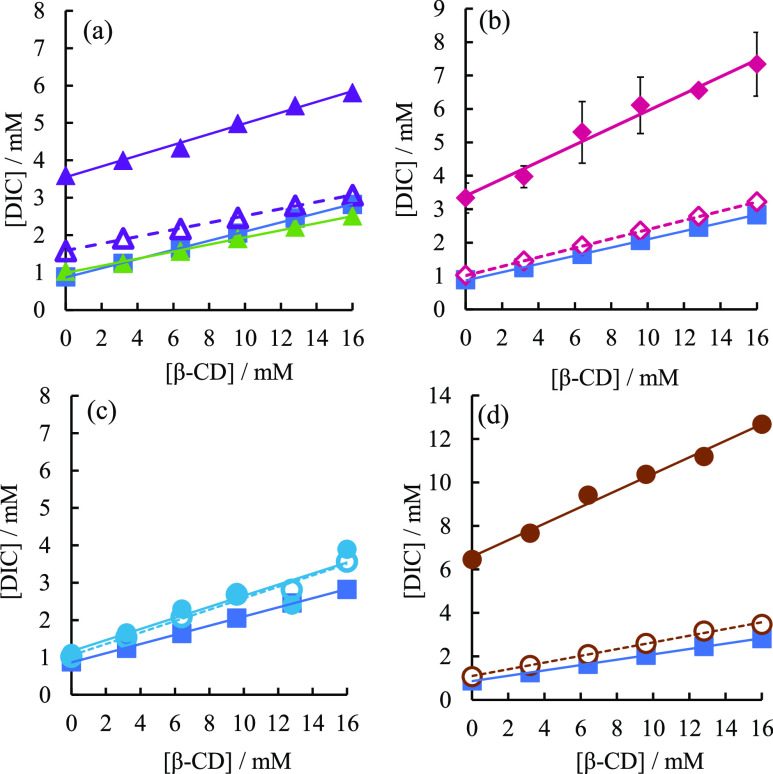
(a) Phase solubility diagram of DIC in the absence and presence of CIM and FAM. Without additives (blue square, solid line); in the presence of CIM added by the codissolved method (purple closed triangle, solid line); in the presence of 50 mM CIM added by the predissolved method (purple open triangle, dotted line); in the presence of FAM added by the codissolved method (green closed triangle, solid line). (b) Phase solubility diagram of DIC in the absence and presence of IMZ. Without additives (blue squares, solid lines); in the presence of 50 mM IMZ added by the codissolved method (pink closed diamonds, solid lines); in the presence of 50 mM IMZ added by the predissolved method (pink open diamonds, dotted lines). (c) Phase solubility diagram of DIC in the absence and presence of HIS. Without additives (blue squares, solid lines); in the presence of 50 mM HIS added by the codissolved method (light blue closed circles, solid lines); in the presence of 50 mM HIS added by the predissolved method (light blue open circles, dotted lines). (d) Phase solubility diagram of DIC in the absence and presence of ARG. No additive (blue square, solid line); in the presence of 50 mM ARG added by the codissolved method (brown circle, solid line); in the presence of 50 mM ARG added by the predissolved method (brown open circle, dotted line).
Figure 4
Figure 4
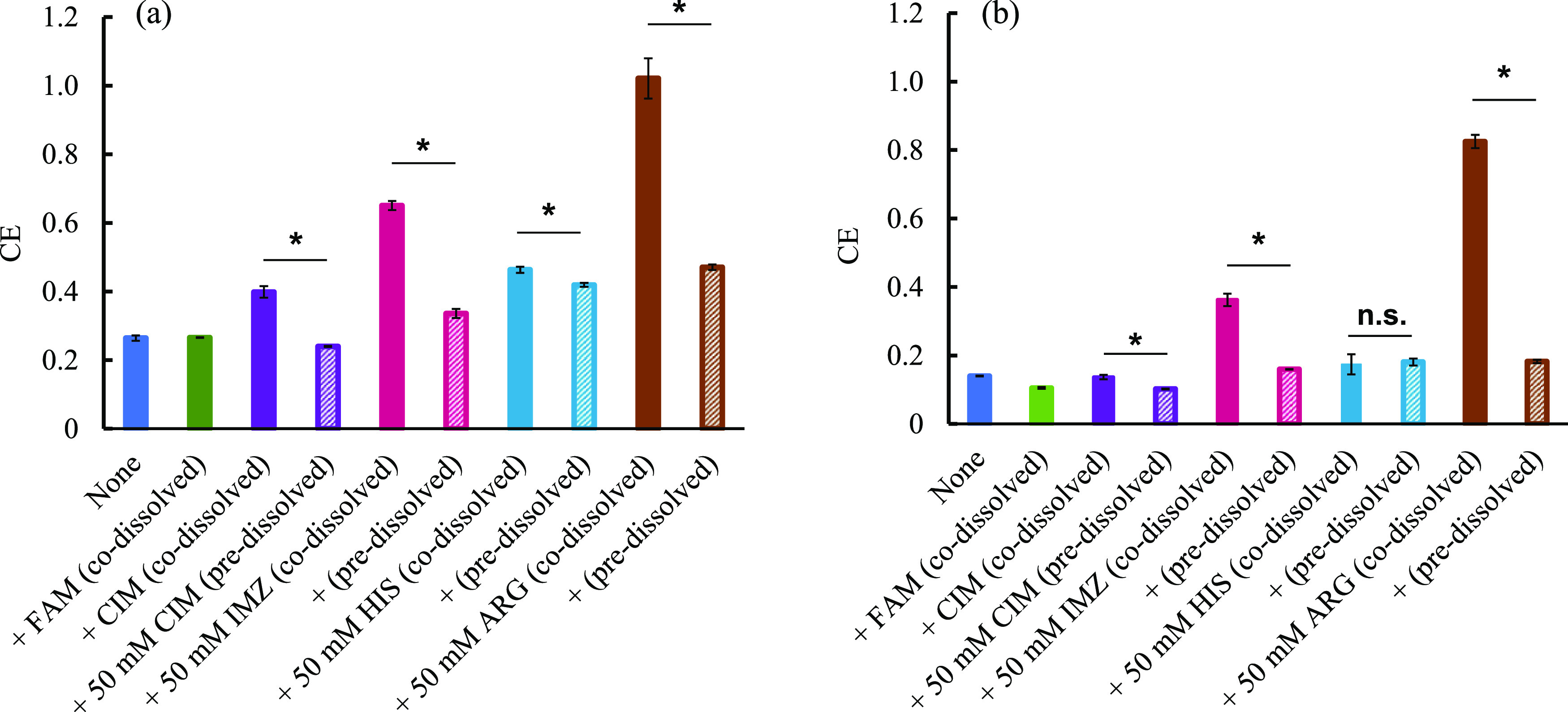
(a) Complexation efficiency CE of IND in the presence of various basic drugs. (b) Complexation efficiency CE of DIC in the presence of various basic drugs. Values are the mean ± SE; *p < 0.05, n.s.: not significant by Student’s t test.
Figure 5
Figure 5
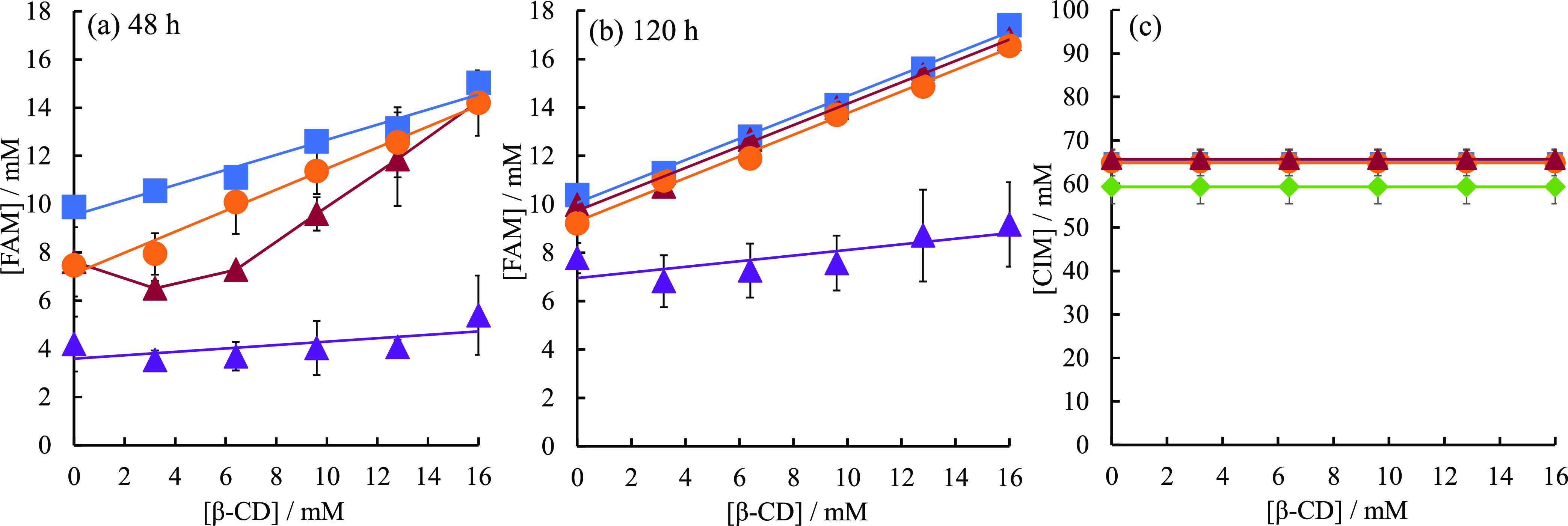
(a) Phase solubility diagram of FAM in the absence and presence of IND and DIC after 48 h of shaking. (b) Phase solubility diagram of FAM in the absence and presence of IND and DIC after 120 h of shaking. (c) Phase solubility diagram of CIM in the absence and presence of IND and DIC after 120 h of shaking. Without additives (blue squares); in the presence of IND added by the codissolved method (orange circles); in the presence of DIC added by the codissolved method (rouge triangles); in the CIM added by the codissolved method (purple triangles); in the FAM added by the codissolved method (green diamonds).
Figure 6
Figure 6
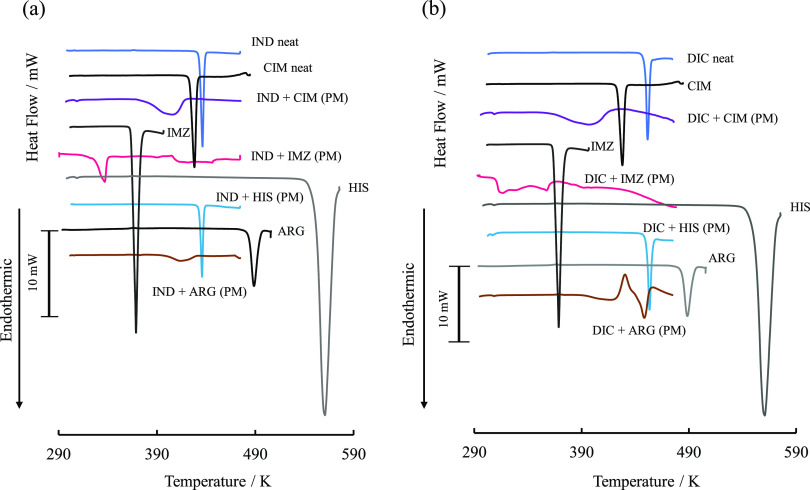
(a) DSC thermograms of a physical mixture consisting of IND and basic drugs. (b) DSC thermograms of a physical mixture consisting of DIC and basic drugs.
Figure 7
Figure 7
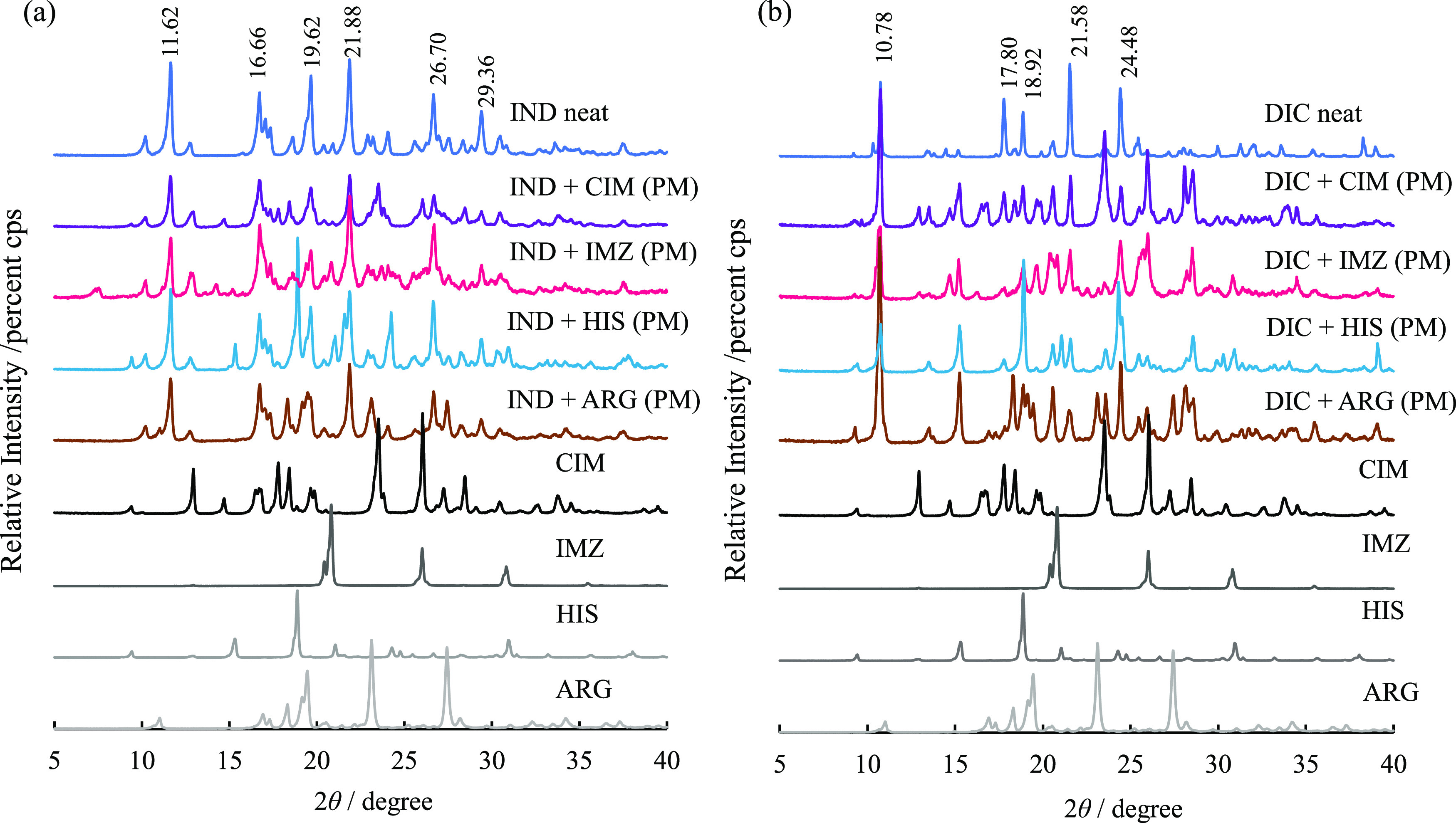
(a) Diffractograms of an equimolar physical mixture of IND and a basic drug. (b) Diffractogram of an equimolar physical mixture of DIC and a basic drug.

References

    1. Meanwell N. A. Improving Drug Candidates by Design: A Focus on Physicochemical Properties as a Means of Improving Compound Disposition and Safety. Chem. Res. Toxicol. 2011, 24, 1420–1456. 10.1021/tx200211v. - DOI - PubMed
    1. Kalepu S.; Nekkanti V. Insoluble Drug Delivery Strategies: Review of Recent Advances and Business Prospects. Acta Pharm. Sin. B 2015, 5 (5), 442–453. 10.1016/j.apsb.2015.07.003. - DOI - PMC - PubMed
    1. Higashi K. Solid State NMR Investigation for Molecular States of Specialized Formulation to Improve the Water Solubility of Poorly Water-Soluble Drugs. Yakugaku Zasshi 2021, 141 (9), 1063–1069. 10.1248/yakushi.21-00124. - DOI - PubMed
    1. Shi Q.; Moinuddin S. M.; Cai T. Advances in Coamorphous Drug Delivery Systems. Acta Pharm. Sin. B 2019, 9 (1), 19–35. 10.1016/j.apsb.2018.08.002. - DOI - PMC - PubMed
    1. Fasinu P.; Pillay V.; Ndesendo V. M. K.; du Toit L. C.; Choonara Y. E. Diverse Approaches for the Enhance-ment of Oral Drug Bioavailability. Biopharm. Drug Dispos. 2011, 32 (4), 185–209. 10.1002/bdd.750. - DOI - PubMed

MeSH terms