


Diagnostic and treatment guidelines for thrombotic thrombocytopenic purpura (TTP) in Japan 2023
- PMID: 37689812
- PMCID: PMC10615956
- DOI: 10.1007/s12185-023-03657-0
Diagnostic and treatment guidelines for thrombotic thrombocytopenic purpura (TTP) in Japan 2023
Abstract
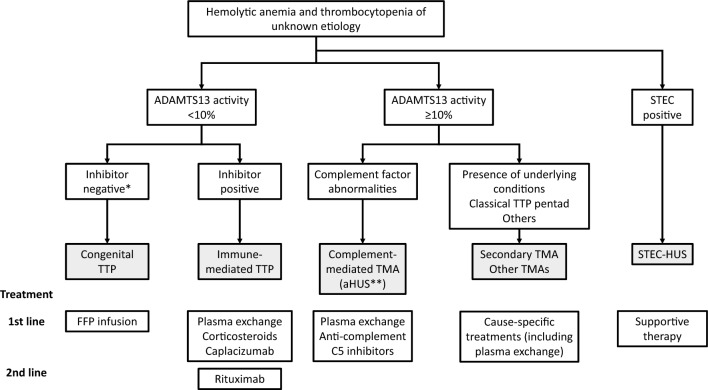
Thrombotic thrombocytopenic purpura (TTP) can rapidly become a life-threatening condition, and the importance of its appropriate diagnosis and treatment cannot be overstated. Until recently, TTP has mainly been diagnosed by clinical findings such as thrombocytopenia and hemolytic anemia. In addition to these clinical findings, however, reduced activity of a disintegrin-like and metalloprotease with thrombospondin type 1 motif 13 (ADAMTS13) below 10% has become internationally accepted as a diagnostic criterion for TTP. TTP is classified as immune-mediated TTP (iTTP) if the patient is positive for anti-ADAMTS13 autoantibodies, and as congenital TTP (cTTP) if ADAMTS13 gene abnormalities are detected. Fresh frozen plasma (FFP) transfusion is performed in patients with cTTP to supplement ADAMTS13. Plasma exchange therapy using FFP is conducted in patients with iTTP to supplement ADAMTS13 and to remove both anti-ADAMTS13 autoantibodies and unusually large von Willebrand factor (VWF) multimers. To suppress autoantibody production, corticosteroid therapy is administered in conjunction with plasma exchange. The monoclonal anti-CD-20 antibody rituximab is effective in patients with iTTP. In addition, caplacizumab, an anti-VWF A1 domain nanobody, has a novel mechanism of action, involving direct inhibition of platelet glycoprotein Ib-VWF binding. The recommended first-line treatments of iTTP in Japan are plasma exchange and corticosteroids, as well as caplacizumab.
Keywords: ADAMTS13; TMA; TTP.
© 2023. The Author(s).
Conflict of interest statement
Masanori Matsumoto received consultant/advisor fees from Sanofi, Takeda Pharmaceutical, Alexion Pharma, and Chugai Pharmaceutical; patent royalties from Alfresa Pharma; research funds from Sanofi and Alexion Pharma; lecture fees from Sanofi, Takeda Pharmaceutical, and Alexion Pharma; and scholarship donations from Chugai Pharmaceutical and Asahi Kasei Pharma. Yoshitaka Miyakawa received medical consultant fees from Zenyaku Kogyo Argenx SE, research funds from Chugai Pharma, Alexion Pharma, Sanofi, Pfizer, Novo Nordisk and Janssen, and lecture fees from Chugai Pharmaceutical, Alexion Pharma, and Sanofi. Koichi Kokame received patent royalties from Kainos, Peptide Institute, and Werfen. Yasunori Ueda received consultant/advisor fees from Sanofi and Otsuka Pharmaceutical, and lecture fees from Sanofi and Japan Blood Products Organization. Hideo Wada declares no conflicts of interest associated with this manuscript. Satoshi Higasa received lecture fees from Sanofi, Takeda Pharmaceutical, CSL Behring, Novo Nordisk Pharma, and Chugai Pharmaceutical; and scholarship donations from Chugai Pharmaceutical. Hideo Yagi declares no conflicts of interest associated with this manuscript. Yoshiyuki Ogawa received lecture fees from Chugai Pharmaceutical and scholarship donations from Bayer Yakuhin. Kazuya Sakai received research funds from Takeda Pharmaceutical and lecture fees from Sanofi. Toshiyuki Miyata received patent royalties from Kainos, Peptide Institute, and Werfen. Eriko Morishita received lecture fees from Sanofi. Yoshihiro Fujimura received consultant/special researcher fees from Japanese Red Cross Society Kinki Block Blood Center, advisor fees from Kainos and Sysmex, patent royalties from Alfresa Pharma, and lecture fees from Alexion Pharma.
Figures
References
-
- Moake JL. Thrombotic thrombocytopenic purpura: the systemic clumping "plague". Annu Rev Med. 2002;53:75–88. - PubMed
-
- Furlan M, Robles R, Galbusera M, Remuzzi G, Kyrle PA, Brenner B, et al. von Willebrand factor-cleaving protease in thrombotic thrombocytopenic purpura and the hemolytic-uremic syndrome. N Engl J Med. 1998;339:1578–1584. - PubMed
-
- George JN, Nester CM. Syndromes of thrombotic microangiopathy. N Engl J Med. 2014;371:1847–1848. - PubMed
-
- Levy GG, Nichols WC, Lian EC, Foroud T, McClintick JN, McGee BM, et al. Mutations in a member of the ADAMTS gene family cause thrombotic thrombocytopenic purpura. Nature. 2001;413:488–494. - PubMed
MeSH terms
Substances
Grants and funding
LinkOut - more resources
Full Text Sources
Miscellaneous
