


A clinical model to predict successful renal replacement therapy (RRT) discontinuation in patients with Acute Kidney Injury (AKI)
- PMID: 37690142
- PMCID: PMC10497780
- DOI: 10.1016/j.clinsp.2023.100280
A clinical model to predict successful renal replacement therapy (RRT) discontinuation in patients with Acute Kidney Injury (AKI)
Abstract
Introduction: Ideal timing of Renal Replacement Therapy (RRT) discontinuation in Acute Kidney Injury (AKI) is still unknown. We aimed to study the role of creatinine-related variables in predicting RRT successful discontinuation and to propose a clinical predictive score.
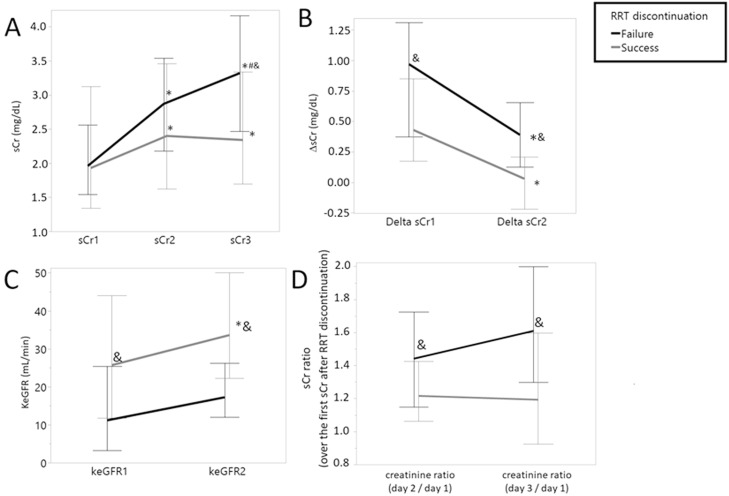
Methods: In this single-centre retrospective study, we evaluated all AKI patients in whom RRT was interrupted for at least 48 hours. Patients who were still RRT-independent 7 days after initial RRT cessation were included in the "Success" group and opposed to the "Failure" group. We evaluated baseline characteristics and variables collected at the time of RRT interruption, as well as the Kinetic estimated Glomerular Filtration Rate (KeGFR), the simple variation in serum Creatinine (ΔsCr), and the incremental creatinine ratio on the first three days after RRT interruption. Multivariable analysis was performed to evaluate prediction of success. Internal validation using a simple binomial generalized regression model with Lasso estimation and 5-fold cross validation method was performed.
Results: We included 124 patients, 49 in the "Failure" group and 75 in the "Success" group. All creatinine-related variables predicted success in simple and multiple logistic regression models. The best model generated a clinical score based on the odds ratio obtained for each variable and included urine output, non-renal SOFA score, fluid balance, serum urea, serum potassium, blood pH, and the variation in sCr values after RRT discontinuation. The score presented an area under the ROC of 0.86 (95% CI 0.76‒1.00).
Conclusion: Creatinine variation between the first 2 consecutive days after RRT discontinuation might predict success in RRT discontinuation. The developed clinical score based on these variables might be a useful clinical decision tool to guide hemodialysis catheter safe removal.
Keywords: Acute kidney injury; Catheter removal; Discontinuation; Hemodialysis; Score.
Copyright © 2023 HCFMUSP. Published by Elsevier España, S.L.U. All rights reserved.
Conflict of interest statement
Conflicts of interest The authors declare no conflicts of interest.
Figures



References
-
- Kdigo WG. KDIGO clinical practice guideline for acute kidney injury. Kidney Inter. 2012;2(Suppl. 1):1–138.
-
- McKenzie C. Antibiotic dosing in critical illness. J Antimicrob Chemother. 2011;66(Suppl. 2) ii25-31. - PubMed
-
- Ronco C, Bellomo R, Kellum JA, Ricci Z. 3rd ed. Elsevier, Inc.; Philadelphia, PA: 2019. Critical Care Nephrology.
-
- Gaudry S, Hajage D, Schortgen F, Martin-Lefevre L, Pons B, Boulet E, et al. Initiation strategies for renal-replacement therapy in the intensive care unit. N Engl J Med. 2016;375(2):122–133. - PubMed
MeSH terms
Substances
LinkOut - more resources
Full Text Sources
