


The Relative Importance of Psychopathy Features as Predictors of Externalizing Behaviors in Youth: A Multimethod Examination
- PMID: 37691858
- PMCID: PMC10488909
- DOI: 10.1007/s10862-022-10017-5
The Relative Importance of Psychopathy Features as Predictors of Externalizing Behaviors in Youth: A Multimethod Examination
Abstract
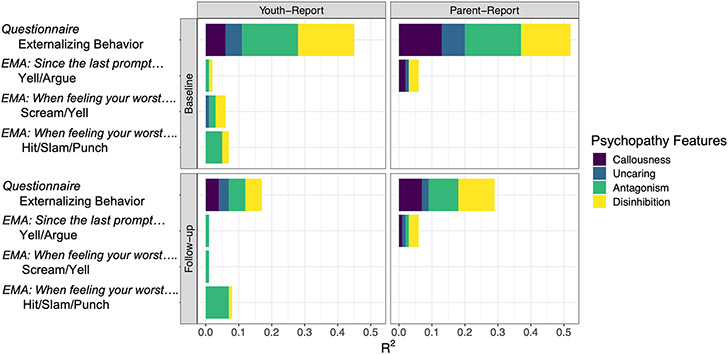
Research in youth psychopathy has focused heavily on the affective features (i.e., callous-unemotional [CU] traits) given robust links to severe and chronic forms of externalizing behaviors. Recently, there have been calls to expand the scope of work in this area to examine the importance of other interpersonal (i.e., antagonism) and behavioral (i.e., disinhibition) features of psychopathy. In the present study, we apply an under-utilized statistical approach (i.e., dominance analysis) to assess the relative importance of CU traits, antagonism, and disinhibition in the prediction of externalizing behaviors in youth, cross-sectionally and at 9-month follow-up. Using a multi-informant (youth- and parent-report), multi-method (questionnaire, ecological momentary assessment [EMA]) preregistered approach in a diverse sample of clinically referred youth (Mage = 12.60 years, SD = .95 years, 47% female; 61% racial/ethnic minority), we found youth- and parent-reported psychopathy features accounted for a significant proportion of variance in externalizing behavior cross-sectionally and longitudinally. However, results provided limited support for our preregistered hypotheses. While antagonism and disinhibition had larger general dominance weights relative to CU traits for both youth- and parent-report, most differences were non-significant. Thus, the interpersonal, affective, and behavioral psychopathy features could not be distinguished from one another in terms of their importance in the prediction of externalizing behavior, assessed cross-sectionally or longitudinally. Taken together, the results highlight promising avenues for future research on the relative importance of youth psychopathy features.
Keywords: Antagonism; Callous-unemotional traits; Disinhibition; Dominance analysis; EMA; Longitudinal.
Conflict of interest statement
Conflict of Interest Colin E. Vize, Amy L. Byrd and Stephanie D. Stepp declare that they have no conflicts of interest to report.
Figures
References
-
- Achenbach TM (1991). Integrative guide for the 1991 CBCL/4–18, YSR, and TRF profiles: Department of Psychiatry. University of Vermont.
-
- Achenbach TM (1999). The Child Behavior Checklist and related instruments. In Maruish ME (Ed.), The use of psychological testing for treatment planning and outcomes assessment (pp. 429–466). Lawrence Erlbaum Associates Publishers.
-
- American Psychiatric Association. (2013). Diagnostic and Satistical Manual of Mental Disorders (5th ed.). American Psychiatric Association. 10.1176/appi.books.9780890425596.744053 - DOI
-
- Andershed H, Colins OF, Salekin RT, Lordos A, Kyranides MN, & Fanti KA (2018). Callous-Unemotional Traits Only Versus the Multidimensional Psychopathy Construct as Predictors of Various Antisocial Outcomes During Early Adolescence. Journal of Psychopathology and Behavioral Assessment, 40, 16–25. 10.1007/s10862-018-9659-5 - DOI - PMC - PubMed
Grants and funding
LinkOut - more resources
Full Text Sources
Research Materials