This is a preprint.
Prioritizing Cardiovascular Disease-Associated Variants Altering NKX2-5 Binding through an Integrative Computational Approach
- PMID: 37693486
- PMCID: PMC10491373
- DOI: 10.1101/2023.09.01.23294951
Prioritizing Cardiovascular Disease-Associated Variants Altering NKX2-5 Binding through an Integrative Computational Approach
Update in
-
Prioritizing cardiovascular disease-associated variants altering NKX2-5 and TBX5 binding through an integrative computational approach.J Biol Chem. 2023 Dec;299(12):105423. doi: 10.1016/j.jbc.2023.105423. Epub 2023 Nov 4. J Biol Chem. 2023. PMID: 37926287 Free PMC article.
Abstract
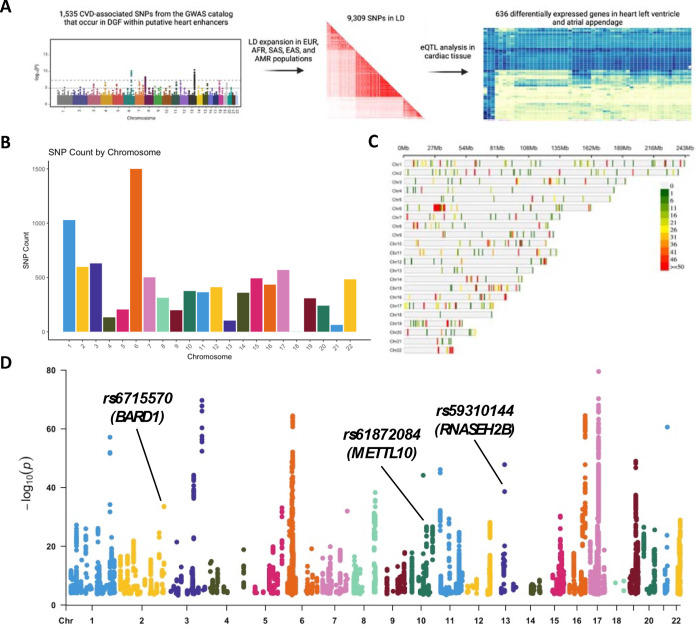
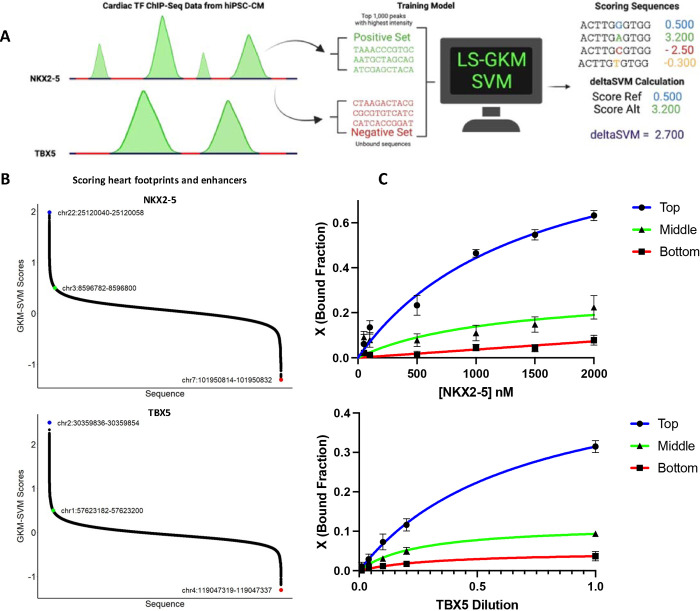
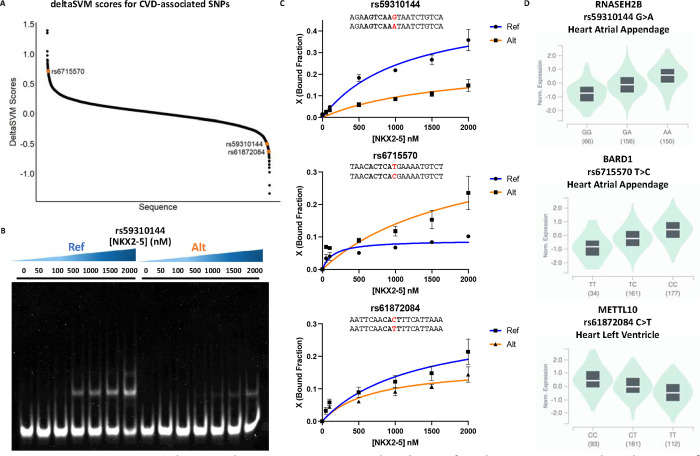
Cardiovascular diseases (CVDs) are the leading cause of death worldwide and are heavily influenced by genetic factors. Genome-wide association studies (GWAS) have mapped > 90% of CVD-associated variants within the non-coding genome, which can alter the function of regulatory proteins, like transcription factors (TFs). However, due to the overwhelming number of GWAS single nucleotide polymorphisms (SNPs) (>500,000), prioritizing variants for in vitro analysis remains challenging. In this work, we implemented a computational approach that considers support vector machine (SVM)-based TF binding site classification and cardiac expression quantitative trait loci (eQTL) analysis to identify and prioritize potential CVD-causing SNPs. We identified 1,535 CVD-associated SNPs that occur within human heart footprints/enhancers and 9,309 variants in linkage disequilibrium (LD) with differential gene expression profiles in cardiac tissue. Using hiPSC-CM ChIP-seq data from NKX2-5 and TBX5, two cardiac TFs essential for proper heart development, we trained a large-scale gapped k-mer SVM (LS-GKM-SVM) predictive model that can identify binding sites altered by CVD-associated SNPs. The computational predictive model was tested by scoring human heart footprints and enhancers in vitro through electrophoretic mobility shift assay (EMSA). Three variants (rs59310144, rs6715570, and rs61872084) were prioritized for in vitro validation based on their eQTL in cardiac tissue and LS-GKM-SVM prediction to alter NKX2-5 DNA binding. All three variants altered NKX2-5 DNA binding. In summary, we present a bioinformatic approach that considers tissue-specific eQTL analysis and SVM-based TF binding site classification to prioritize CVD-associated variants for in vitro experimental analysis.
Keywords: cardiovascular diseases; gene regulation; non-coding variants; support vector machine; transcription factors.
Figures
References
-
- Mensah G. A., Roth G. A. & Fuster V. The Global Burden of Cardiovascular Diseases and Risk Factors: 2020 and Beyond. Journal of the American College of Cardiology vol. 74 2529–2532 (2019). - PubMed
-
- Townsend N. et al. Epidemiology of cardiovascular disease in Europe. Nature Reviews Cardiology vol. 19 133–143 (2022). - PubMed
Publication types
Grants and funding
LinkOut - more resources
Full Text Sources
Research Materials
Miscellaneous