


Prescription opioid misuse in relation to addiction susceptibility among women at a Saudi university
- PMID: 37693733
- PMCID: PMC10491761
- DOI: 10.1016/j.jsps.2023.101764
Prescription opioid misuse in relation to addiction susceptibility among women at a Saudi university
Abstract
Objectives: The trends of prescription opioid misuse are understudied in Arab populations, let alone among university students. Additionally, little is known about the psychological traits that increase susceptibility for such behaviors in this region. Thus, this study aimed to assess the prevalence of prescription opioid misuse and its association with addiction susceptibility, as measured by the Substance Abuse Risk Profile Scale (SURPS).
Methods: We sampled university students from King Saud University's women's campus. Data on prescription opioid misuse, SURPS traits, and demographic characteristics were collected using an electronic self-administered survey.
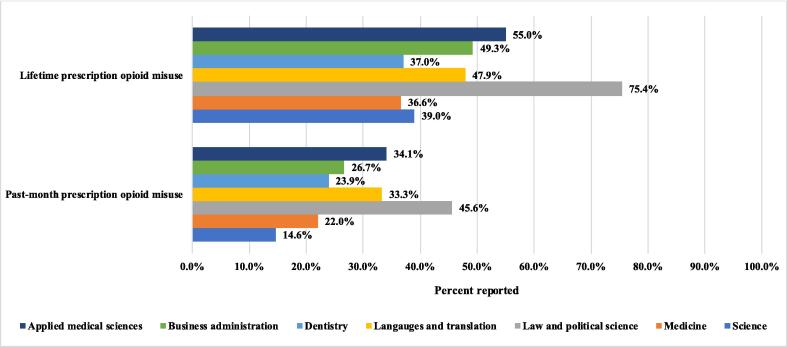
Results: Lifetime prescription opioid misuse was 48.5%, while past-month misuse was 28.9%. On average, SURPS subscale scores for impulsivity (mean = 11.6; SD = 2.8) hopelessness (mean = 12.3; SD = 3.5), sensation seeking (mean = 16.4; SD = 3.8), and anxiety sensitivity (mean = 14.6; SD = 2.6). Anxiety sensitivity composite scores significantly differed between students reporting misuse and those who did not. Moreover, the odds for prescription opioid misuse increased by 7% for every 1 unit increase in anxiety sensitivity (AOR = 1.07; 95% CI = 1.00, 1.14), when controlling for other SURPS measures and student characteristics.
Conclusion: The prevalence of prescription opioid misuse in our study is higher than what is reported in global student populations. This may reflect unmonitored availability of controlled substances and unsupervised medical prescriptions. Additionally, high levels of anxiety sensitivity may be driving such misuse. Further surveillance of prescription drug misuse among university students and motivators for such behavior is needed for planning prevention and control interventions.
Keywords: Anxiety sensitivity; Hopelessness; Impulsivity; Nonmedical drug use; Opioid misuse; Saudi Arabia; Sensation seeking.
© 2023 The Authors.
Conflict of interest statement
The authors declare that they have no known competing financial interests or personal relationships that could have appeared to influence the work reported in this paper.
Figures
References
LinkOut - more resources
Full Text Sources
Miscellaneous
