. 2023 Jul 29;18(6):1586-1598.
doi: 10.1016/j.jtumed.2023.07.008. eCollection 2023 Dec.

Anti-inflammatory effects of banana (Musa balbisiana) peel extract on acne vulgaris: In vivo and in silico study

Affiliations

Anti-inflammatory effects of banana (Musa balbisiana) peel extract on acne vulgaris: In vivo and in silico study

Dwiana Savitri et al. J Taibah Univ Med Sci. .

Abstract

Objective: Acne vulgaris (AV) is a common problem with a relatively high incidence rate among Asian people. The potential antimicrobial and anti-inflammatory properties of banana peels have been demonstrated in previous studies but have not been studied in cases of AV. Therefore, this study was aimed at investigating the protective effects of banana (Musa balbisiana) peel extract (MBPE) against AV.

Methods: Thirty rats were divided into five groups (n = 6 rats per group): an AV group, AV group treated with 0.15% MBPE, AV group administered 0.30% MBPE, AV group administered 0.60% MBPE, and AV group administered clindamycin (the standard drug treatment). We assessed nodule size, bacterial count, histopathology, and cytokine levels (IL-1α, IFN-γ, tumor necrosis factor (TNF)-α, and IL-8). Enzyme linked immunoassays were used to measure the cytokine levels. In addition, we performed molecular docking studies to determine the interactions between phytochemicals (trigonelline, vanillin, ferulic acid, isovanillic acid, rutin, and salsolinol) via the Toll-like receptor 2 (TLR2) and nuclear factor-kappa B (NF-κB) pathways.

Results: All MBPE treatment groups, compared with the AV group, showed suppression of both bacterial growth and proinflammatory cytokine production, as well as resolved tissue inflammation. The nodule size was significantly suppressed in the groups receiving the two highest doses of MBPE, compared with the AV group. However, the pharmacological action of MBPE remained inferior to that of clindamycin. Docking studies demonstrated that rutin was the phytocompound with the most negative interaction energy with TLR2 or NF-κB.

Conclusions: Our results indicated that MBPE has anti-inflammatory effects against AV, by suppressing nodule formation, inhibiting bacterial growth, and decreasing proinflammatory cytokine production.

أهداف البحث: حب الشباب الشائع مشكلة شائعة، مع معدل حدوث مرتفع نسبيا بين الآسيويين. بالمناسبة، تم إثبات الخصائص المحتملة المضادة للميكروبات والمضادة للالتهابات لقشور الموز في دراسات سابقة؛ ومع ذلك، لم يتم دراستها في حالة حب الشباب. هدفت الدراسة الحالية إلى معرفة التأثيرات الوقائية لمستخلص قشر الموز (موسى بالبسيانا) بسبب حب الشباب.

طريقة البحث: تم تقسيم ثلاثين جرذا إلى خمس مجموعات (عدد = 6 فئران في كل مجموعة): مجموعة حب الشباب، مجموعة حب الشباب الشائع المعالجة بـ 0.15 ٪ قشر الموز (موسى بالبيسيانا) ، مجموعة حب الشباب الشائع المعالجة بنسبة 0.30 ٪ قشر الموز (موسى بالبيسيانا)، مجموعة حب الشباب الشائع المعالجة 0.60 ٪ قشر الموز (موسى بالبيسيانا)، وحب الشباب الشائع المجموعة التي تم إعطاؤها الكليندامايسين كدواء قياسي. قمنا بتقييم حجم العقيدات وعدد البكتيريا وعلم الأنسجة ومستويات السيتوكين (انترليوكن-1، وانتر فيرون جاما، وعامل نخر العظم-ألفا، انترليوكن-8). تم استخدام المقايسات المناعية المرتبطة بالإنزيم لقياس مستويات السيتوكين. بالإضافة إلى ذلك، أجرينا دراسات الالتحام الجزيئي لتحديد التفاعلات بين المواد الكيميائية النباتية (تريغونيلين، الفانيلين، حمض الفيروليك، حمض الأيزوفانيليك، الروتين، والسالسولينول) عبر مسارات المستقبل الشبيه بالتول-2 والعامل النووي – كابا ب.

النتائج: أدت جميع جرعات قشر الموز (موسى بالبيسيانا) إلى تثبيط نمو البكتيريا وإنتاج السيتوكينات المنشطة للالتهابات مقارنة بمجموعة حب الشباب، بالإضافة إلى علاج التهاب الأنسجة. تم قمع حجم العقدة بشكل معنوي بأعلى جرعتين من قشر الموز (موسى بالبيسيانا) مقارنة بمجموعة حب الشباب. ومع ذلك، يظل تأثيره الدوائي أدنى من تأثير الكليندامايسين. أظهرت دراسات الالتحام أن المركب النباتي ذو الطاقة التفاعلية الأكثر سلبية مع المستقبل الشبيه بالتول-2 والعامل النووي – كابا ب كان روتيني.

الاستنتاجات: تشير هذه النتائج إلى أن مستخلص قشر الموز (موسى بالبيسيانا) يعمل كعامل مضاد للالتهابات ضد حب الشباب الشائع، عن طريق قمع تكوينات العقيدات، وتثبيط نمو البكتيريا، وتقليل إنتاج السيتوكينات المسببة للالتهابات.

Keywords: Anti-inflammation; Antibacterial; In silico; In vivo; Musa balbisiana.


Figures

Figure 1
Figure 1
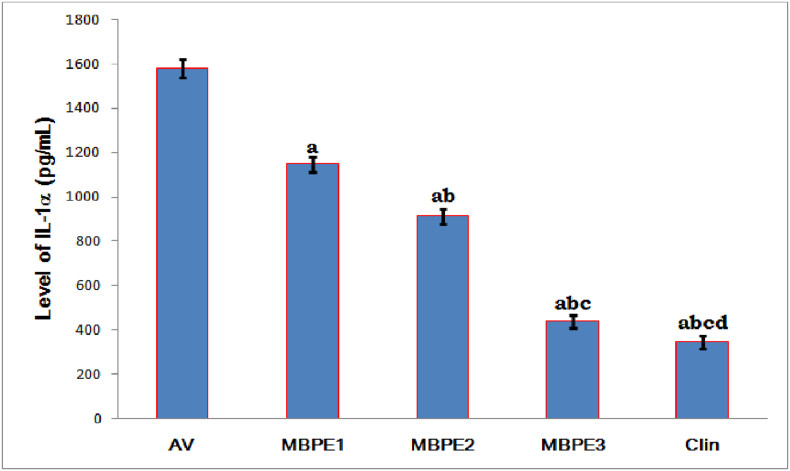
IL-1α levels in various groups. a: significant difference with respect to the acne vulgaris group (negative control); b: significant difference with respect to the acne vulgaris group administered MBPE at a dose of 0.15% (MBPE1); c: significant difference with respect to the acne vulgaris group administered MBPE at a dose of 0.30% (MBPE2); d: significant difference with respect to the acne vulgaris group administered MBPE at a dose of 0.60% (MBPE3). Note: AV: acne vulgaris group; MBPE: banana (Musa balbisiana) peel extract; Clin: acne vulgaris group given the standard drug clindamycin.
Figure 2
Figure 2
IL-8 levels in various groups. a: significant difference with respect to the acne vulgaris group (negative control); b: significant difference with respect to the acne vulgaris group administered MBPE at a dose of 0.15% (MBPE1); c: significant difference with respect to the acne vulgaris group administered MBPE at a dose of 0.30% (MBPE2); d: significant difference with respect to the acne vulgaris group administered MBPE at a dose of 0.60% (MBPE3). Note: AV: acne vulgaris group; MBPE: banana (Musa balbisiana) peel extract; Clin: acne vulgaris group given the standard drug clindamycin.
Figure 3
Figure 3
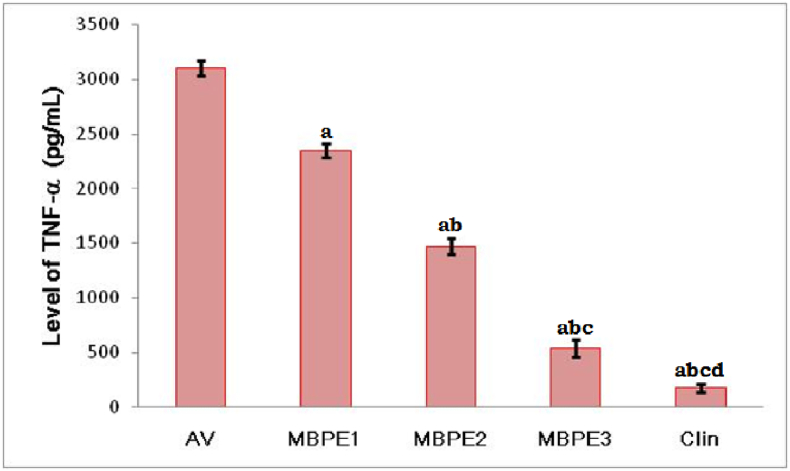
TNF-α levels in various groups. a: significant difference with respect to the acne vulgaris group (negative control); b: significant difference with respect to the acne vulgaris group administered MBPE at a dose of 0.15% (MBPE1); c: significant difference with respect to the acne vulgaris group administered MBPE at a dose of 0.30% (MBPE2); d: significant difference with respect to the acne vulgaris group administered MBPE at a dose of 0.60% (MBPE3). Note: AV: acne vulgaris group; MBPE: banana (Musa balbisiana) peel extract; Clin: acne vulgaris group given the standard drug clindamycin.
Figure 4
Figure 4
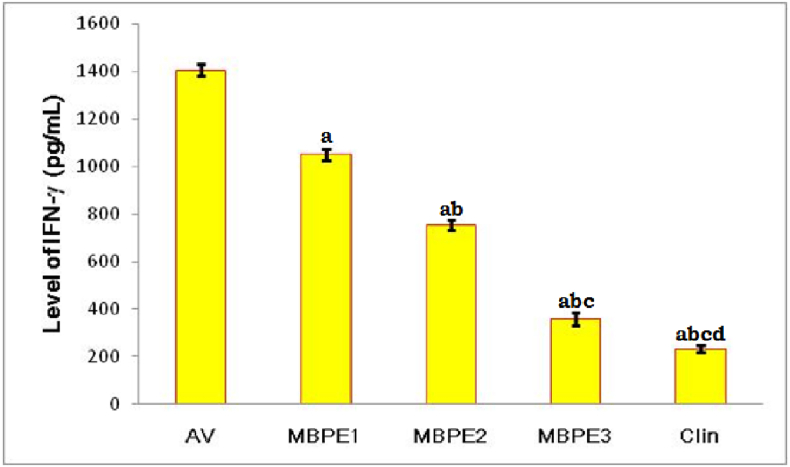
IFN-γ levels in various groups. a: significant difference with respect to the acne vulgaris group (negative control); b: significant difference with respect to the acne vulgaris group administered MBPE at a dose of 0.15% (MBPE1); c: significant difference with respect to the acne vulgaris group administered MBPE at a dose of 0.30% (MBPE2); d: significant difference with respect to the acne vulgaris group administered MBPE at a dose of 0.60% (MBPE3). Note: AV: acne vulgaris group; MBPE: banana (Musa balbisiana) peel extract; Clin: acne vulgaris group given the standard drug clindamycin.
Figure 5
Figure 5
Nodule thickness in various groups. a: significant difference with respect to the acne vulgaris group (negative control); b: significant difference with respect to the acne vulgaris group administered MBPE at a dose of 0.15% (MBPE1); c: significant difference with respect to the acne vulgaris group administered MBPE at a dose of 0.30% (MBPE2); d: significant difference with respect to the acne vulgaris group administered MBPE at a dose of 0.60% (MBPE3). Note: mm: millimeter; AV: acne vulgaris group; MBPE: banana (Musa balbisiana) peel extract; Clin: acne vulgaris group given the standard drug clindamycin.
Figure 6
Figure 6
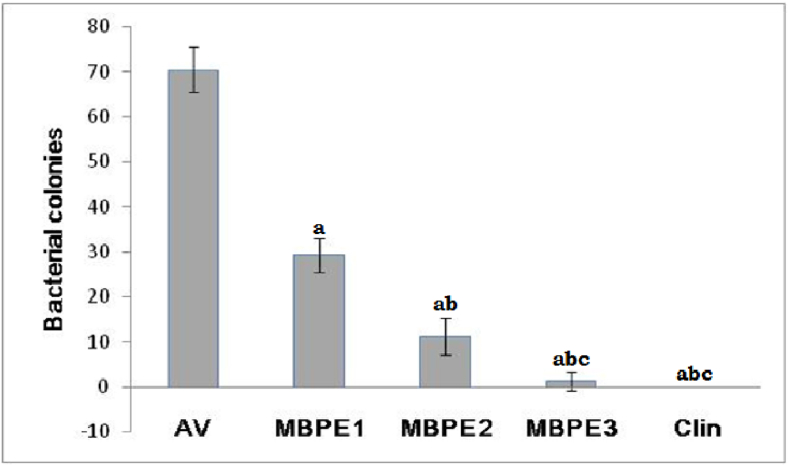
Number of bacterial colonies from various observation groups. a: significant difference with respect to the acne vulgaris group (negative control); b: significant difference with respect to the acne vulgaris group administered MBPE at a dose of 0.15% (MBPE1); c: significant difference with respect to the acne vulgaris group administered MBPE at a dose of 0.30% (MBPE2); d: significant difference with respect to the acne vulgaris group administered MBPE at a dose of 0.60% (MBPE3). Note: AV: acne vulgaris group; MBPE: banana (Musa balbisiana) peel extract; Clin: acne vulgaris group given the standard drug clindamycin.
Figure 7
Figure 7
Histopathology of acne lesions in various groups. Note: AV: acne vulgaris group as a positive control; MBPE: banana (Musa balbisiana) peel extract; Clin: acne vulgaris group given the standard drug clindamycin.
Figure 8
Figure 8
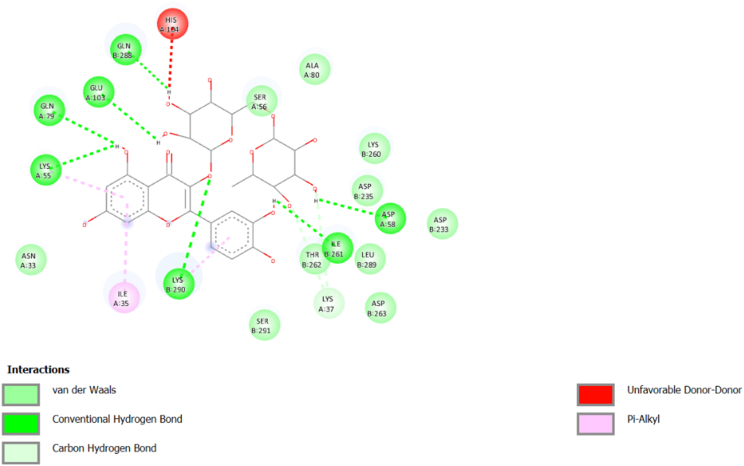
Interaction map of the binding pocket of TLR2 with rutin.
Figure 9
Figure 9
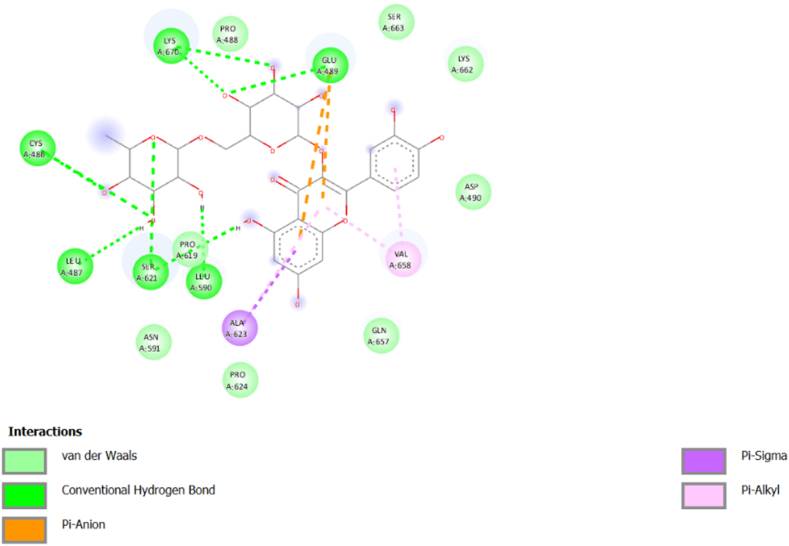
Interaction map of the binding pocket of NF-κβ inducing kinase with rutin.
Figure 10
Figure 10
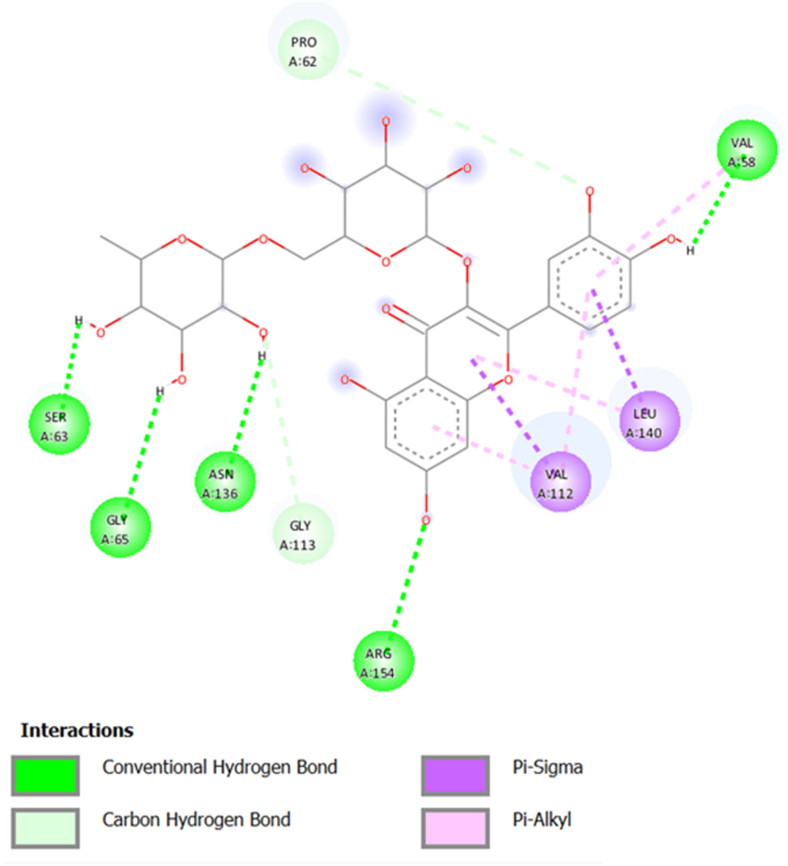
Interaction map of the binding pocket of NF-κβ p50 homodimer with rutin.

References

    1. Vos T., Flaxman A.D., Naghavi M., Lozano R., Michaud C., Ezzati M., et al. Years lived with disability (YLDs) for 1160 sequelae of 289 diseases and injuries 1990–2010: a systematic analysis for the Global Burden of Disease Study 2010. Lancet. 2012;380(9859):2163–2196. - PMC - PubMed
    1. Kim S., Oh S., Noh H.B., Ji S., Lee S.H., Koo J.M., et al. In vitro antioxidant and anti-propionibacterium acnes activities of cold water, hot water, and methanol extracts, and their respective ethyl acetate fractions, from Sanguisorba officinalis L. Roots. Molecules. 2018;23:3001. - PMC - PubMed
    1. Han G., Armstrong A., Desai S., Guenin E. Novel tretinoin 0.05% lotion for the once-daily treatment of moderate-to-severe acne vulgaris in an Asian population. J Drugs Dermatol. 2019;18(9):910–916. - PubMed
    1. Harper J.C. Acne vulgaris: what's new in our 40th year. J Am Acad Dermatol. 2020;82(2):526–527. - PubMed
    1. Zheng N., Zhou M., He Y., Xu H., Chen X., Duan Z., et al. Low curcumin concentrations combined with blue light inhibits cutibacterium acnes biofilm-induced inflammatory response through suppressing MAPK and NF-κβ in keratinocytes. Photodiagnosis Photodyn Ther. 2022;40 - PubMed

LinkOut - more resources