. 2023 May 9:37:100780.
doi: 10.1016/j.lanwpc.2023.100780. eCollection 2023 Aug.

Endemicity and diversification of carbapenem-resistant Acinetobacter baumannii in an intensive care unit

Affiliations

Endemicity and diversification of carbapenem-resistant Acinetobacter baumannii in an intensive care unit

Emma L Doughty et al. Lancet Reg Health West Pac. .

Abstract

Background: Carbapenem-resistant Acinetobacter baumannii (CRAB) is a major public health concern globally. Often studied in the context of hospital outbreaks, little is known about the persistence and evolutionary dynamics of endemic CRAB populations.

Methods: A three-month cross-sectional observational study was conducted in a 28-bed intensive care unit (ICU) in Hangzhou, China. A total of 5068 samples were collected from the hospital environment (n = 3985), patients (n = 964) and staff (n = 119). CRAB isolates were obtained from 10.5% of these samples (n = 532). All of these isolates, plus an additional 19 from clinical infections, were characterised through whole-genome sequencing.

Findings: The ICU CRAB population was dominated by OXA-23-producing global clone 2 isolates (99.3% of all isolates) that could be divided into 20 distinct clusters, defined through genome sequencing. CRAB was persistently present in the ICU, driven by regular introductions of distinct clusters. The hospital environment was heavily contaminated, with CRAB isolated from bed units on 183/335 (54.6%) sampling occasions but from patients on only 72/299 (24.1%) occasions. CRAB was spread to adjacent bed units and rooms, and following re-location of patients within the ICU. We also observed three horizontal gene transfer events between CRAB strains in the ICU, involving three different plasmids.

Interpretation: The epidemiology of CRAB in this setting contrasted with previously described clonal outbreaks in high-income countries, highlighting the importance of environmental CRAB reservoirs in ICU epidemiology and the unique challenges in containing the spread of CRAB in ICUs where this important multidrug-resistant pathogen is endemic.

Funding: This work was undertaken as part of the DETECTIVE research project funded by the Medical Research Council (MR/S013660/1), National Natural Science Foundation of China (81861138054, 32011530116, 31970128, 31770142), Zhejiang Province Medical Platform Backbone Talent Plan (2020RC075), and the National Key Research and Development Program of China grant (2018YFE0102100). W.v.S was also supported by a Wolfson Research Merit Award (WM160092).

Keywords: Antimicrobial resistance; Carbapenem-resistant Acinetobacter baumannii; Genomic epidemiology; Horizontal gene transfer; Infection prevention and control; Intensive care.


Conflict of interest statement

The authors have no relevant conflicts of interest to declare.

Figures
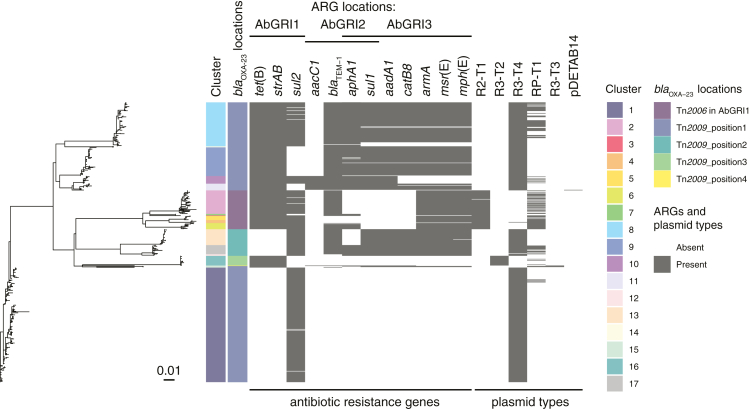
Fig. 1
Fig. 1
Characterisation and comparison of GC2/ST187 CRAB found in the ICU. Evolutionary relationships of the 547 GC2/ST187 isolates from the ICU; coloured tracks adjacent to the phylogenetic tree tip show the cluster designation, Oxford MLST types, KL types and different positions of blaOXA-23 genes; presence of each antibiotic resistance gene and plasmid type is shown in grey and their absence is in white. pDETAB14 represents a novel plasmid type that was found in a single C11 isolate.
Fig. 2
Fig. 2
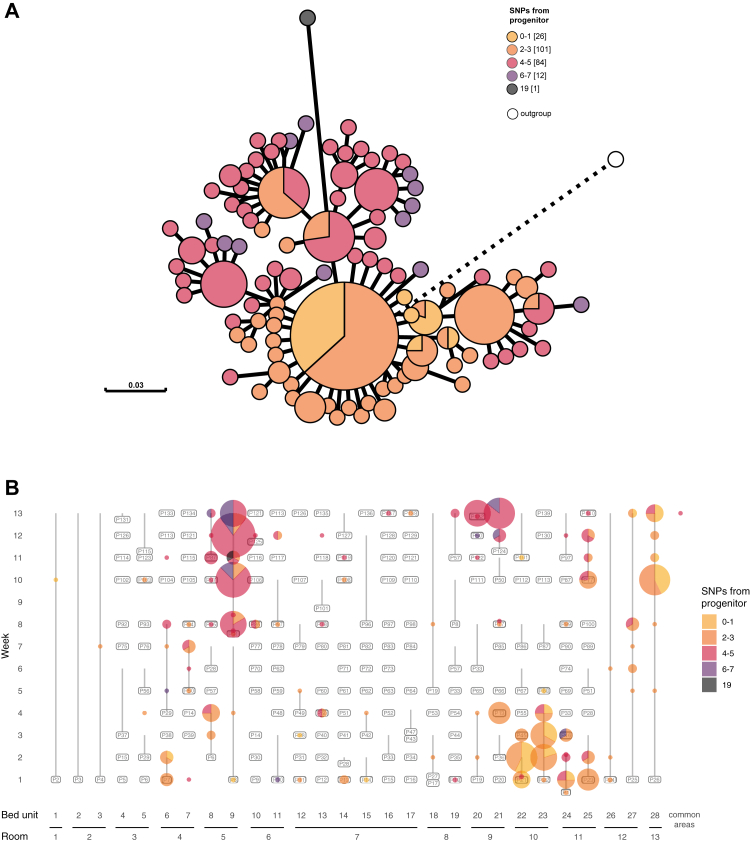
Introduction and spread of cluster 1 within the ICU as measured by whole genome SNPs. A) Maximum-likelihood core-genome phylogeny of all 224 cluster 1 (C1) isolates using a cluster 11 isolate (DETAB-E47) as an outgroup. Visualised in GrapeTree and rooted on the outgroup, shown in white. Colours show the number of SNPs from the most basal C1 isolate, with up to 7 cgSNPs in the nosocomial population, and 19 cgSNPs in the most distal isolate. B) Spatiotemporal distribution of C1 isolates, coloured as in panel A.
Fig. 3
Fig. 3
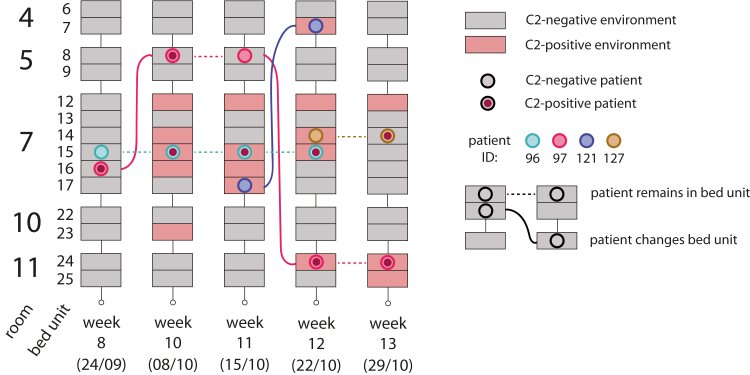
Spatiotemporal distribution of cluster 2 isolates in the ICU. Schematic showing the distribution of all GC2 cluster 2 (C2) isolates in rooms 4, 5, 7, 10 and 11 over weeks 8–13 of the study. These were the only instances where C2 was isolated over the course of the study. Sampling dates (day/month) are shown in brackets. Each bed unit is shown as a rectangle, shaded red when C2 was isolated from the environment and grey when it was not. Patients are shown as coloured circles, with a red fill indicating the presence of C2 in patient-screening samples. Dashed horizontal lines represent a patient's continued presence in a bed unit while solid lines show the relocation of patients between sampling dates.
Fig. 4
Fig. 4
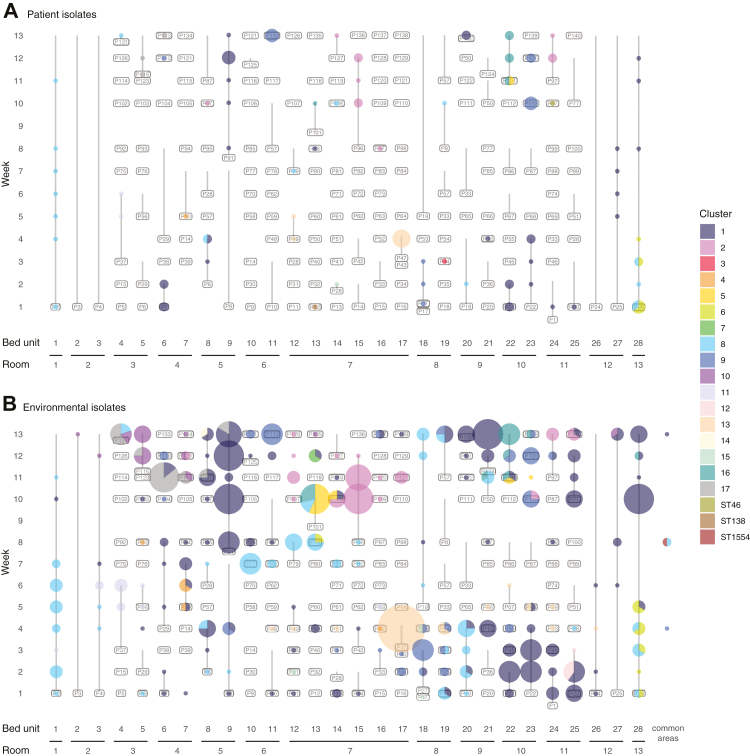
Diversity and distribution of CRAB isolates within the ICU. Distribution of isolates from each CRAB cluster (Panel A: isolates from patient samples, panel B: isolates from environmental samples). Bed unit numbers are indicated across the x-axis and reflect the spatial arrangement of beds in the ICU (Figure S1); isolates from common areas are grouped together but may be from spatially distinct locations; the vertical axis shows the week of sampling; labels show the ID of the patient occupying the bed with vertical lines extending from the date of first to last sample associated with the patient; size of coloured bubbles reflects the number of CRAB isolates found in the patient and their bed unit on each date of sampling; the colour of bubbles corresponds to the CRAB cluster; multi-coloured bubbles are split as a pie chart to reflect the proportion of isolates from each cluster.
Fig. 5
Fig. 5
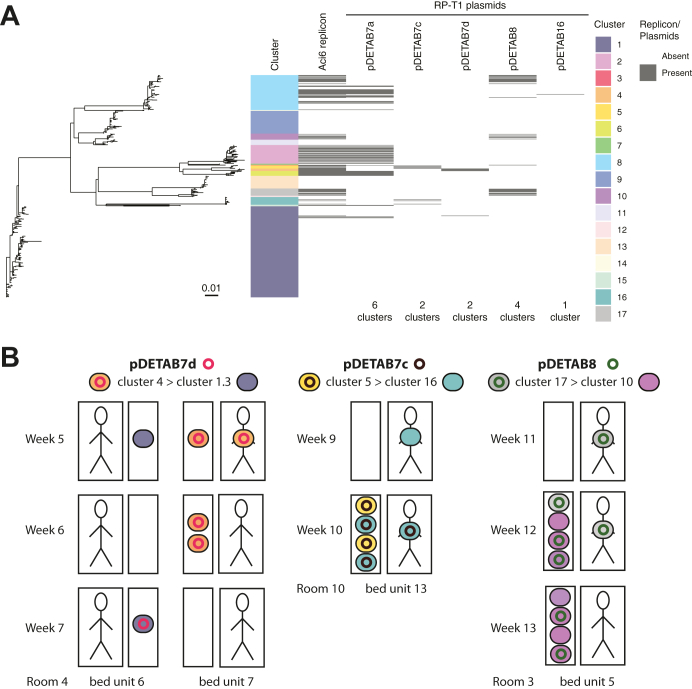
Dissemination of RP-T1 plasmids amongst CRAB clusters. A) Phylogenetic relationships of all GC2/ST187 isolates; tracks adjacent to the tips show isolate cluster designations, presence of the RP-T1 plasmid replicon, and the presence of specific RP-T1 plasmids determined from hybrid genome assemblies or detection of signature sequences in draft genomes. B) Schematic overview of putative pDETAB7d, pDETAB7c and pDETAB8 transfer events. Bed units are shown as paired boxes that represent patient-derived (larger boxes containing figurative person) and environmental (small boxes) sources of isolation. Weeks of isolation and room/bed unit numbers are labelled. Isolates are shown as coloured ovals and plasmids as coloured circles. The name of plasmids and isolate clusters, and the direction or putative plasmid transfer are indicated at the top of the panel. In all indicated transfer events the core genomes of putative recipient and transconjugants strains were identical and at least 50 kbp of the transferred RP-T1 plasmid backbones were identical between donors and transconjugants.

References

    1. Bergogne-Bérézin E., Towner K.J. Acinetobacter spp. as nosocomial pathogens: microbiological, clinical, and epidemiological features. Clin Microbiol Rev. 1996;9(2):148–165. - PMC - PubMed
    1. Hamidian M., Nigro S.J. Emergence, molecular mechanisms and global spread of carbapenem-resistant Acinetobacter baumannii. Microb Genom. 2019;5(10) - PMC - PubMed
    1. Tacconelli E., Carrara E., Savoldi A., et al. Discovery, research, and development of new antibiotics: the WHO priority list of antibiotic-resistant bacteria and tuberculosis. Lancet Infect Dis. 2018;18(3):318–327. - PubMed
    1. Roberts L.W., Forde B.M., Hurst T., et al. Genomic surveillance, characterization and intervention of a polymicrobial multidrug-resistant outbreak in critical care. Microb Genom. 2021;7(3) - PMC - PubMed
    1. Dijkshoorn L., Nemec A., Seifert H. An increasing threat in hospitals: multidrug-resistant Acinetobacter baumannii. Nat Rev Microbiol. 2007;5(12):939–951. - PubMed

LinkOut - more resources