Review
. 2023 Aug 24:14:1249336.
doi: 10.3389/fphar.2023.1249336. eCollection 2023.

From squid giant axon to automated patch-clamp: electrophysiology in venom and antivenom research

Affiliations
Review

From squid giant axon to automated patch-clamp: electrophysiology in venom and antivenom research

Shirin Ahmadi et al. Front Pharmacol. .

Abstract

Ion channels play a crucial role in diverse physiological processes, including neurotransmission and muscle contraction. Venomous creatures exploit the vital function of ion channels by producing toxins in their venoms that specifically target these ion channels to facilitate prey capture upon a bite or a sting. Envenoming can therefore lead to ion channel dysregulation, which for humans can result in severe medical complications that often necessitate interventions such as antivenom administration. Conversely, the discovery of highly potent and selective venom toxins with the capability of distinguishing between different isoforms and subtypes of ion channels has led to the development of beneficial therapeutics that are now in the clinic. This review encompasses the historical evolution of electrophysiology methodologies, highlighting their contributions to venom and antivenom research, including venom-based drug discovery and evaluation of antivenom efficacy. By discussing the applications and advancements in patch-clamp techniques, this review underscores the profound impact of electrophysiology in unravelling the intricate interplay between ion channels and venom toxins, ultimately leading to the development of drugs for envenoming and ion channel-related pathologies.

Keywords: antivenom; drug discovery; electrophysiology; ion channel; neurotoxin; patch-clamp; venom.


Conflict of interest statement

KB is employed by Sophion Bioscience. The remaining authors declare that the research was conducted in the absence of any commercial or financial relationships that could be construed as a potential conflict of interest.

Figures
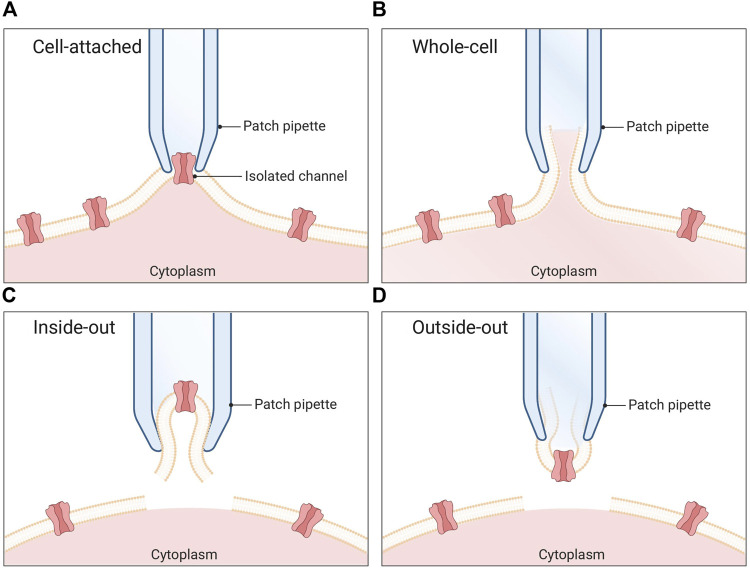
FIGURE 1
FIGURE 1
Patch clamp configurations. (A) Cell-attached mode: The pipette is positioned in proximity to the cell membrane, and gentle suction is applied to establish a tight seal between the pipette and the membrane. This configuration enables the recording of single channel currents. (B) Whole-cell mode: A pipette is utilized to apply a sufficiently strong suction force, resulting in the rupture of the cell membrane. Consequently, the pipette gains access to the cytoplasmic environment of the cell. (C) Inside-out mode: The membrane patch is carefully excised from the cell and immersed in the surrounding bath solution. In this arrangement, the seal remains intact while the rest of the cell is disrupted. (D) Outside-out mode: Initially, the whole-cell method is employed, followed by the retraction of the pipette after membrane rupture. This process causes a section of the membrane to detach from the cell and reconfigure into a small, vesicular structure, with the external side of the membrane exposed to the bath solution.
FIGURE 2
FIGURE 2
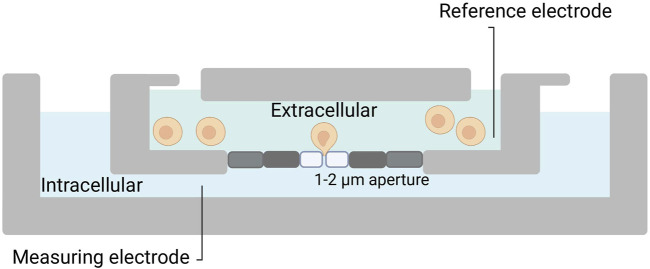
Planar patch-clamp. Silicon or plastic-based micro-fabricated substrates are utilized. Cells in suspension are added to the chip, and with a negative pressure, a cell is placed on top of the patch hole. Thereafter, the process is similar to manual patch-clamp.
FIGURE 3
FIGURE 3
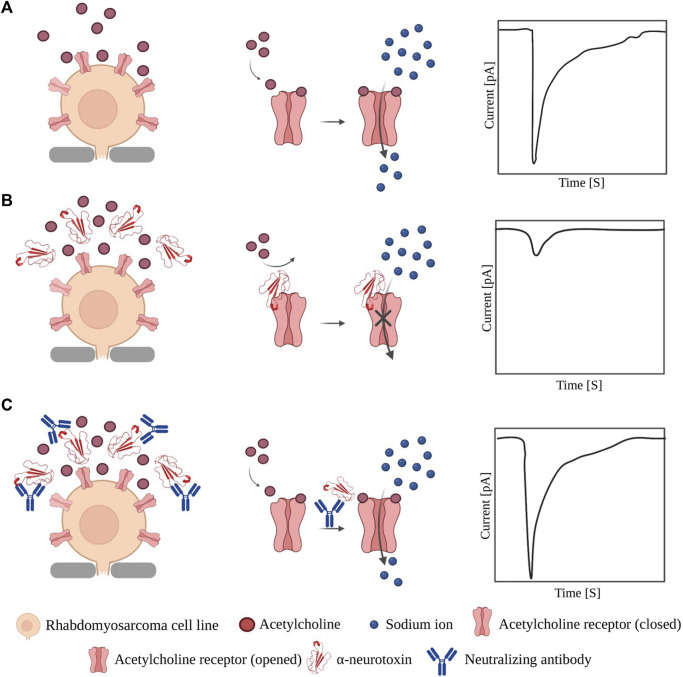
Application of patch-clamp in evaluating neutralization effect of binders against α-NTx. (A) Opening of nAChR upon binding of acetylcholine allows influx of sodium ions which can be measured as a current by patch-clamp instruments. (B) When α-NTxs are added to the cells, the pore and the influx of sodium ions are blocked, which results in a small current difference between the inside and outside of the cell. (C) When a mixture of pre-incubated α-NTx and a neutralizing molecule is added, α-NTxs cannot bind to the receptor, and the influx of sodium ions is not affected. Note: the relative sizes of the components in the figure are not accurately depicted.

References

    1. Arias H. R., Blanton M. P. (2000). Alpha-conotoxins. Int. J. Biochem. Cell. Biol. 32 (10), 1017–1028. 10.1016/S1357-2725(00)00051-0 - DOI - PubMed
    1. Asmild M., Oswald N., Krzywkowski K. M., Friis S., Jacobsen R. B., Reuter D., et al. (2003). Upscaling and automation of electrophysiology: toward high throughput screening in ion channel drug discovery. Recept. Channels 9 (1), 49–58. 10.3109/10606820308258 - DOI - PubMed
    1. Barber C. M., Isbister G. K., Hodgson W. C. (2013). Alpha neurotoxins. Toxicon 66, 47–58. 10.1016/j.toxicon.2013.01.019 - DOI - PubMed
    1. Barfaraz A., Harvey A. L. (1994). The use of the chick biventer cervicis preparation to assess the protective activity of six international reference antivenoms on the neuromuscular effects of snake venoms in vitro . Toxicon 32 (3), 267–272. 10.1016/0041-0101(94)90079-5 - DOI - PubMed
    1. Bell D. C., Dallas M. L. (2021). “Advancing ion channel research with automated patch clamp (APC) electrophysiology platforms,” in Ion channels in biophysics and Physiology. Editor Zhou L. (Singapore: Springer Nature Advances in Experimental Medicine and Biology; ), 21–32. 10.1007/978-981-16-4254-8_2 - DOI - PubMed