


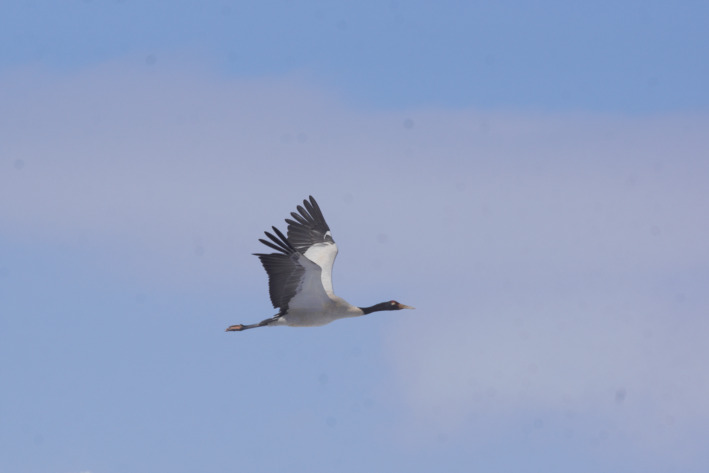
Autumn migration of black-necked crane (Grus nigricollis) on the Qinghai-Tibetan and Yunnan-Guizhou plateaus
- PMID: 37693936
- PMCID: PMC10485337
- DOI: 10.1002/ece3.10492
Autumn migration of black-necked crane (Grus nigricollis) on the Qinghai-Tibetan and Yunnan-Guizhou plateaus
Abstract
Despite previous research efforts, the majority migration routes of the black-necked cranes (Grus nigricollis) have remained veiled. In this study, we utilized satellite telemetry data from 45 cranes between 2015 and 2021 to unveil critical insights. Our results revealed 11 distinct autumn migration routes and one sedentary flock, of which eight routes and the sedentary flock were previously undocumented. Our findings highlighted the remarkable diversity in the migration routes of black-necked cranes, especially in terms of migration orientations, spatial-temporal patterns, and altitudinal movement patterns. Cranes breeding on the eastern, northern, and central Qinghai-Tibetan Plateau migrated southward, while those on the northern slopes of the Himalayas migrated eastward, westward, northward, or opted to remain sedentary. Moreover, we expanded the known range of migration distances to 84-1520 km at both ends (excluding sedentary individuals) and identified two long-term (Da Qaidam and Chaka) and one short-term (Gyatong grassland) stopover sites. Furthermore, our study revealed that the breeding colonies in the Qilian Mountains on the northeastern Qinghai-Tibetan Plateau utilized long-term stopover sites before embarking on significant altitude ascent, while other flocks displayed more urgent migration patterns, preferring to roost only at night. By unveiling the near-complete autumn migration routes of black-necked cranes, our research has contributed to discovering the critical habitats and connectivity among various breeding colonies, which is instrumental in developing effective seasonal conservation plans.
Keywords: Grus nigricollis; Qinghai‐Tibetan Plateau; Yunnan‐Guizhou Plateau; autumn migration; migration routes; satellite tracking.
© 2023 The Authors. Ecology and Evolution published by John Wiley & Sons Ltd.
Conflict of interest statement
The authors declare that they have no competing interests.
Figures


References
-
- Alonso, J. A. , Alonso, J. C. , Cantos, F. J. , & Bautista‐Sopelana, L. M. (1990b). Spring crane Grus grus migration through Gallocanta, Spain. II. Timing and pattern of daily departures. Ardea, 78, 365–378.
-
- Alonso, J. C. , Alonso, J. A. , & Bautista, L. M. (1994). Carrying capacity of staging areas and facultative migration extension in common cranes. Journal of Applied Ecology, 31, 212–222.
-
- Alonso, J. C. , Alonso, J. A. , Cantos, F. J. , & Bautista‐Sopelana, L. M. (1990a). Spring crane Grus grus migration through Gallocanta, Spain. I. Daily variations in migration volume. Ardea, 78, 379–386.
-
- Altshuler, D. L. , & Dudley, R. (2006). The physiology and biomechanics of avian flight at high altitude. Integrative and Comparative Biology, 46, 62–71. - PubMed
Associated data
LinkOut - more resources
Full Text Sources
Other Literature Sources
