. 2023 Aug 19;26(9):107682.
doi: 10.1016/j.isci.2023.107682. eCollection 2023 Sep 15.

Mate copying requires the coincidence detector Rutabaga in the mushroom bodies of Drosophila melanogaster

Affiliations

Mate copying requires the coincidence detector Rutabaga in the mushroom bodies of Drosophila melanogaster

Sabine Nöbel et al. iScience. .

Abstract

Mate choice constitutes a major fitness-affecting decision often involving social learning leading to copying the preference of other individuals (i.e., mate copying). While mate copying exists in many taxa, its underlying neurobiological mechanisms remain virtually unknown. Here, we show in Drosophila melanogaster that the rutabaga gene is necessary to support mate copying. Rutabaga encodes an adenylyl cyclase (AC-Rut+) acting as a coincidence detector in associative learning. Since the brain localization requirements for AC-Rut+ expression differ in classical and operant learning, we determine the functional localization of AC-Rut+ for mate copying by artificially rescuing the expression of AC-Rut+ in neural subsets of a rutabaga mutant. We found that AC-Rut+ has to be expressed in the mushroom bodies' Kenyon cells (KCs), specifically in the γ-KCs subset. Thus, this form of discriminative social learning requires the same KCs as non-social Pavlovian learning, suggesting that pathways of social and asocial learning overlap significantly.

Keywords: Behavioral neuroscience; Biological sciences; Neurogenetics; Neuroscience.


Conflict of interest statement

Authors have nothing to declare.

Figures

None
Graphical abstract
Figure 1
Figure 1
Expression of the Rut-AC+ proteins required in mushroom body (MB) Kenyon cells, but not in the central complex (CC) for mate copying We rescued the expression of the wild type rut gene globally in either the CC (two left bars) with the Gal4 driver line C232 (second bar from left) or in the MB neurons with the driver line VT30559 (fourth bar from left). The wild type and the line rut/rut;UAS-rut+/+ were used as additional controls to test the specific effect of the UAS-rut+/+ construct. Number inside bars: number of trials. Statistics: above bars, P-values of the binomial tests of departure from random choice (represented by the dashed line), and that above the horizontal bar is that of the Fisher test. Error bars represent Agresti-Coull 95% confidence intervals.
Figure 2
Figure 2
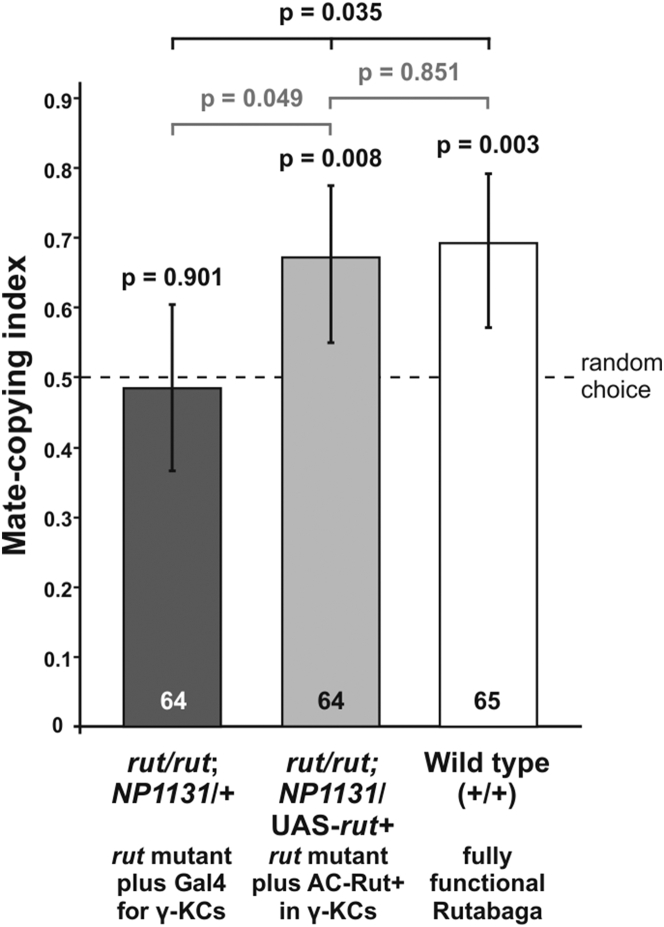
The functional adenylyl-cyclase (Rut-AC+) is required specifically in the γ-Kenyon cells to elicit mate copying Although the rut/rut observer females we used in these experiments could not express a functional adenylyl-cyclase coincidence detector, some of the various construct we built re-establish the expression of the wild type rutabaga gene in very specific neuron subsets of the MB, namely the α/β-Kenyon cells (using the Gal4 driver line C739), the α’/β′-Kenyon cells (using the Gal4 driver line G0050), or the γ-Kenyon cells (using the Gal4 driver line NP1131) independently. Only the use of the latter UAS/Gal4 fully rescued mate copying. Number inside bars: number of trials. Statistics: above bars, P-values of the binomial tests of departure from random choice (represented by the dashed line), and that above the horizontal black bar is that of the treatment effect (GLMM). Gray horizontal bars represent post hoc Fisher tests. Error bars represent Agresti-Coull 95% confidence intervals.
Figure 3
Figure 3
We expressed the wild type rutabaga gene (UAS-rut+) in the γ-neurons of the MB with the Gal4 driver line NP1131 while using pictures of copulating flies instead of real demonstrations The repeating the experiments of the right block of Figure 2. Each of the pictures we used comprised a female copulating with either a green (or a pink) male while a pink (or a green) male was standing by at some distance from the copulating pair. Number inside bars: number of trials. Statistics: above bars, P-values of the binomial tests of departure from random choice (represented by the dashed line), and that above the horizontal black bar is that of the treatment effect (GLMM). Gray horizontal bars represent post hoc Fisher tests. Error bars represent Agresti-Coull 95% confidence intervals.
Figure 4
Figure 4
The Rut-AC+ expression is required in γ-Kenyon cells only during the adult stage to ensure mate copying We expressed the wild type rutabaga gene in the γ-neurons of the MB with the Gal4 driver line NP1131 plus the thermosensitive tubGal80ts. At 18°C, the Gal80ts product blocks the AC-Rut+ expression, while at 30°C AC-Rut+ can be expressed, hence expressing the AC-Rut+ specifically in the γ-KCs during mate-copying experiments. The rut null mutant acts as control. Number inside bars: number of trials. Statistics: above bars, P-values of the binomial tests of departure from random choice (represented by the dashed line), and that above the horizontal black bar is that of the treatment effect (GLMM). Gray horizontal bars represent post hoc Fisher tests. Error bars represent Agresti-Coull 95% confidence intervals.

References

    1. Olsson A., Nearing K.I., Phelps E.A. Learning fears by observing others: The neural systems of social fear transmission. Soc. Cognit. Affect Neurosci. 2007;2:3–11. doi: 10.1093/scan/nsm005. - DOI - PMC - PubMed
    1. Allsop S.A., Wichmann R., Mills F., Burgos-Robles A., Chang C.J., Felix-Ortiz A.C., Vienne A., Beyeler A., Izadmehr E.M., Glober G., et al. Corticoamygdala transfer of socially derived information gates observational learning. Cell. 2018;173:1329–1342.e18. doi: 10.1016/j.cell.2018.04.004. - DOI - PMC - PubMed
    1. Debiec J., Olsson A. Social fear learning: From animal models to human function. Trends Cognit. Sci. 2017;21:546–555. doi: 10.1016/j.tics.2017.04.010. - DOI - PMC - PubMed
    1. Kavaliers M., Choleris E. Social cognition and the neurobiology of rodent mate choice. Integr. Comp. Biol. 2017;57:846–856. doi: 10.1093/icb/icx042. - DOI - PubMed
    1. Loureiro M., Achargui R., Flakowski J., Van Zessen R., Stefanelli T., Pascoli V., Lüscher C. Social transmission of food safety depends on synaptic plasticity in the prefrontal cortex. Science. 2019;364:991–995. doi: 10.1126/science.aaw5842. - DOI - PubMed

LinkOut - more resources