Involvement of the Transient Receptor Channels in Preclinical Models of Musculoskeletal Pain
- PMID: 37694792
- PMCID: PMC10716882
- DOI: 10.2174/1570159X21666230908094159
Involvement of the Transient Receptor Channels in Preclinical Models of Musculoskeletal Pain
Abstract
Background: Musculoskeletal pain is a condition that affects bones, muscles, and tendons and is present in various diseases and/or clinical conditions. This type of pain represents a growing problem with enormous socioeconomic impacts, highlighting the importance of developing treatments tailored to the patient's needs. TRP is a large family of non-selective cation channels involved in pain perception. Vanilloid (TRPV1 and TRPV4), ankyrin (TRPA1), and melastatin (TRPM8) are involved in physiological functions, including nociception, mediation of neuropeptide release, heat/cold sensing, and mechanical sensation.
Objective: In this context, we provide an updated view of the most studied preclinical models of muscle hyperalgesia and the role of transient receptor potential (TRP) in these models.
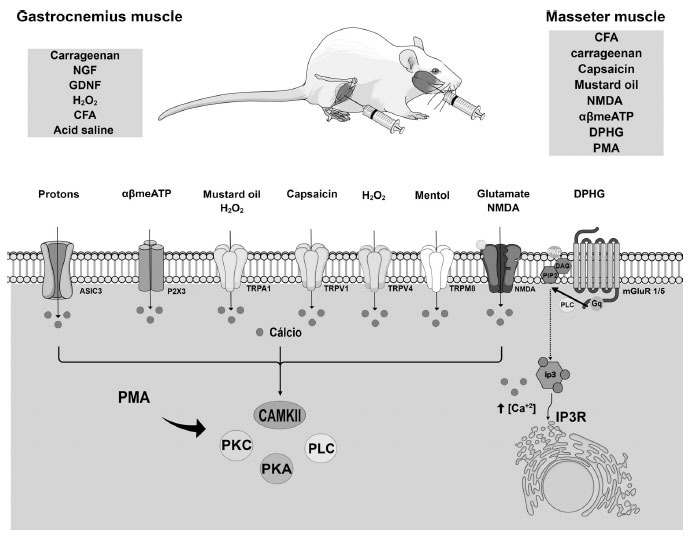
Methods: This review describes preclinical models of muscle hyperalgesia induced by intramuscular administration of algogenic substances and/or induction of muscle damage by physical exercise in the masseter, gastrocnemius, and tibial muscles.
Results: The participation of TRPV1, TRPA1, and TRPV4 in different models of musculoskeletal pain was evaluated using pharmacological and genetic tools. All the studies detected the antinociceptive effect of respective antagonists or reduced nociception in knockout mice.
Conclusion: Hence, TRPV1, TRPV4, and TRPA1 blockers could potentially be utilized in the future for inducing analgesia in muscle hypersensitivity pathologies.
Keywords: CFA; Carrageenan.; Gastrocnemius; masseter; muscle afferents; tibial.
Copyright© Bentham Science Publishers; For any queries, please email at epub@benthamscience.net.
Conflict of interest statement
The authors declare no conflict of interest, financial or otherwise.
Figures
References
-
- Queme L.F., Dourson A., Hofmann M.C., Butterfield A., Paladini R.D., Jankowski MP. Disruption of hyaluronic acid in skeletal muscle induces decreased voluntary activity via chemosensitive muscle afferent sensitization in male mice. eNeuro. 2022;9(2):ENEURO.0522-21.2022. doi: 10.1523/ENEURO.0522-21.2022. - DOI - PMC - PubMed
-
- Treede R.D., Rief W., Barke A., Aziz Q., Bennett M.I., Benoliel R., Cohen M., Evers S., Finnerup N.B., First M.B., Giamberardino M.A., Kaasa S., Korwisi B., Kosek E., Lavand’homme P., Nicholas M., Perrot S., Scholz J., Schug S., Smith B.H., Svensson P., Vlaeyen J.W.S., Wang S.J. Chronic pain as a symptom or a disease: The IASP classification of chronic pain for the international classification of diseases (ICD-11). Pain. 2019;160(1):19–27. doi: 10.1097/j.pain.0000000000001384. - DOI - PubMed
Publication types
MeSH terms
Substances
Grants and funding
LinkOut - more resources
Full Text Sources