. 2023 Oct;13(10):2443-2460.
doi: 10.1007/s13555-023-01008-9. Epub 2023 Sep 11.

Tapinarof Cream 1% Once Daily for the Treatment of Plaque Psoriasis: Case Photography of Clinical Outcomes from Three Phase 3 Trials

Affiliations

Tapinarof Cream 1% Once Daily for the Treatment of Plaque Psoriasis: Case Photography of Clinical Outcomes from Three Phase 3 Trials

Seemal R Desai et al. Dermatol Ther (Heidelb). 2023 Oct.

Abstract

Tapinarof cream 1% (VTAMA®; Dermavant Sciences, Inc.) is a non-steroidal, topical, aryl hydrocarbon receptor agonist approved by the US Food and Drug Administration (FDA) to treat plaque psoriasis in adults and under investigation for the treatment of psoriasis in children down to 2 years of age, and for atopic dermatitis in adults and children down to 2 years of age. The PSOARING phase 3 clinical trial program evaluated tapinarof cream 1% once daily (QD) in adults with mild to severe plaque psoriasis for up to 52 weeks (NCT03956355, NCT03983980, NCT04053387). Here we present case photography documenting outcomes in the PSOARING trials. Cases illustrate various outcomes across different body areas, including responses meeting the formal FDA-mandated regulatory endpoint of a Physician Global Assessment (PGA) score of 0 (clear) or 1 (almost clear) and a decrease of at least 2 points from baseline at week 12, meaningful clinical improvement not meeting this formal endpoint, patient-reported outcomes, and pre-specified adverse events of special interest (AESIs). Tapinarof cream 1% QD demonstrated rapid and highly statistically significant efficacy, with improvements in disease activity and quality of life. In addition, a high rate (40.9%; n = 312/763) of complete disease clearance (PGA = 0) was achieved, and improvements exceeding National Psoriasis Foundation treatment goals were demonstrated. After first achieving complete disease clearance (PGA = 0), patients treated with tapinarof experienced an approximately 4-month remittive effect off therapy. Incidence and severity of folliculitis and contact dermatitis AESIs were generally mild or moderate, localized to the site of application, and associated with low discontinuation rates. Medical images are of importance in trials of dermatologic therapies to inform clinical decision-making and enhance patient assessment. Tapinarof cream 1% QD is efficacious and well tolerated in patients with mild to severe plaque psoriasis, with clinically relevant improvements seen early in the course of treatment.Clinicaltrials.gov numbers: NCT03956355, NCT03983980, NCT04053387.

Keywords: Aryl hydrocarbon receptor agonist; Case photography; PSOARING; Phase 3 randomized controlled trials; Plaque psoriasis; Tapinarof cream 1% once daily; Topical therapy.


Conflict of interest statement

Seemal R. Desai has served as a consultant and investigator for Dermavant Sciences, Inc.; he also serves in multiple other leadership and industry roles unrelated to tapinarof cream 1%. Linda Stein Gold has served as a consultant, and/or has received payment for the development of educational presentations, and/or has received grants from Amgen, Arcutis, Bristol Myers Squibb, Dermavant Sciences, Inc., Eli Lilly, LEO Pharma, Ortho Dermatologics, Pfizer, and UCB Biopharma. Michael C. Cameron has served as a consultant, advisor, or speaker for AbbVie, Bristol Myers Squibb, Dermavant Sciences, Inc., Eli Lilly, EPI Health, Evelo Biosciences, Incyte, Journey Medical, LEO Pharma, Regeneron, and Ortho Pharmaceuticals. Alexandra Golant has received consulting or speaking fees from AbbVie, Amgen, Arcutis, Dermavant Sciences, Inc., Eli Lilly, Evelo Biosciences, Incyte, Janssen, LEO Pharma, Regeneron, and Sanofi. G. Michael Lewitt has served as a consultant, speaker, investigator, or advisory board member and/or has received grants from AbbVie, Amgen, Inc., Bristol Myers Squibb, Dermavant Sciences, Inc., DermTech, Eli Lilly, Galderma, LEO Pharma, Janssen, Novan, Inc., Pfizer, Ortho Dermatologics, and UCB Biopharma. Matthew J. Bruno has served as a consultant and/or received payment for promotional presentations from AbbVie, Almirall, Bristol Myers Squibb, Dermavant Sciences, Inc., EPI Health, Journey Medical Corporation, Mayne Pharma, Medimetriks Pharmaceuticals, Pfizer, Regeneron/Sanofi-Genzyme, and Sun Pharmaceuticals. George Martin has served as a speaker and/or consultant and/or has been involved in scientific advisory boards for AbbVie, Almirall, Alumis, Bristol Myers Squibb, Celgene, Dermavant Sciences, Inc., DUSA/Sun, Eli Lilly, Evelo, Galderma, Horizon, Incyte, Janssen, LEO Pharma, Nobelpharma, Ortho/Bausch Health, Organogenesis, Pfizer, Trevi, and UCB Biopharma. Philip M. Brown, David S. Rubenstein, Victoria Butners, and Anna M. Tallman are employees of Dermavant Sciences, Inc., with stock options.

Figures
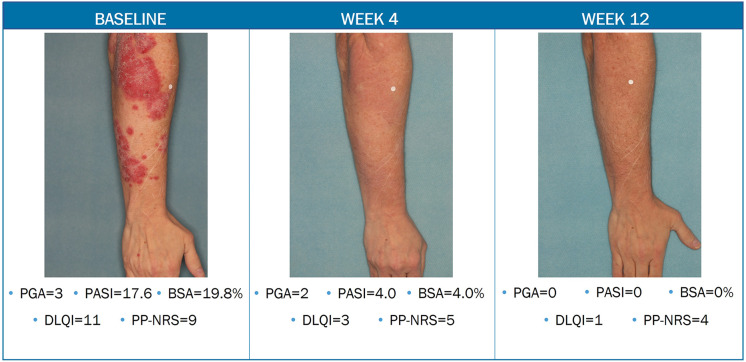
Fig. 1
Fig. 1
Clinical response of a patient with moderate plaque psoriasis treated with tapinarof cream who achieved primary, secondary, and patient-reported endpoints in PSOARING 1. Forearm: improvement in PGA, PASI, BSA, PP-NRS, and DLQI. In addition, the secondary endpoint of a PASI75 response and the PRO of a 4-point reduction in PP-NRS were achieved as early as week 4. At baseline, well-circumscribed, erythematous plaques and patches with mild scaling are visible on the forearm. At week 4, there is complete clearing of the forearm disease, which is maintained at the 12-week endpoint. There is a notable absence of post-inflammatory hyperpigmentation at week 12 after disease resolution. Image is a representative lesion of one tapinarof-treated patient from the PSOARING 1 trial. PGA, PASI, and BSA are global efficacy assessments. Individual results may vary. BSA body surface area, DLQI Dermatology Life Quality Index, PASI Psoriasis Area and Severity Index, PASI75 a reduction of ≥ 75% in Psoriasis Area and Severity Index, PGA Physician Global Assessment, PP-NRS Peak Pruritus Numerical Rating Scale, PRO patient-reported outcome, QD once daily
Fig. 2
Fig. 2
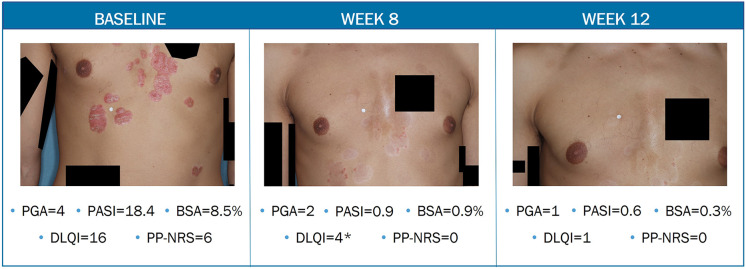
Clinical response of a patient with severe plaque psoriasis treated with tapinarof cream who achieved primary, secondary, and patient-reported endpoints in PSOARING 1. Chest: improvement in PGA, PASI, BSA, PP-NRS, and DLQI. At baseline, well-circumscribed, erythematous indurated plaques with micaceous scaling are visible on the chest. At week 8, there is marked clearing with residual mild erythema that has essentially resolved at week 12. Mild post-inflammatory hyperpigmentation at sites of resolved psoriatic plaques is visible at week 12. Image is a representative lesion of one tapinarof-treated patient from the PSOARING 1 trial. PGA, PASI, and BSA are global efficacy assessments. Individual results may vary. *DLQI was assessed at baseline, week 4 (no evaluation at week 8), and week 12. BSA body surface area, DLQI Dermatology Life Quality Index, PASI Psoriasis Area and Severity Index, PGA Physician Global Assessment, PP-NRS Peak Pruritus Numerical Rating Scale, PRO patient-reported outcome, QD once daily
Fig. 3
Fig. 3
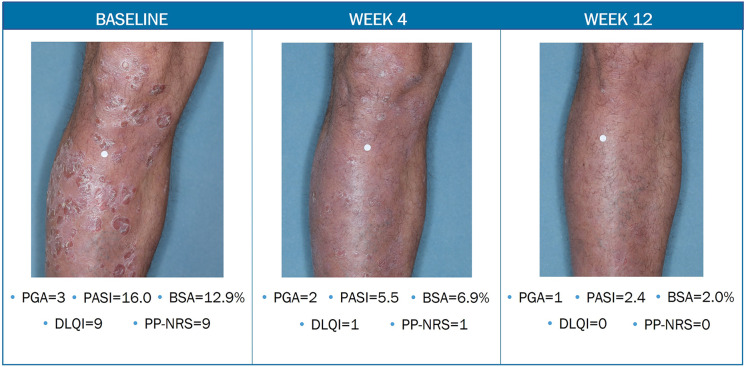
Clinical response of a patient with moderate plaque psoriasis treated with tapinarof cream who achieved primary, secondary and patient-reported endpoints in PSOARING 1. Lower leg: improvement in PGA, PASI, BSA, PP-NRS, and DLQI. At baseline, well-circumscribed, erythematous nummular macules, patches, and plaques with silvery scaling are noted on the knee and shin. At week 4, there are fewer lesions and those remaining are thinner, smaller, and have less scaling. Marked improvement is noted at week 12 with only a few, barely perceptible punctate macules. Image is a representative lesion of one tapinarof-treated patient from the PSOARING 1 trial. PGA, PASI, and BSA are global efficacy assessments. Individual results may vary. BSA body surface area, DLQI Dermatology Life Quality Index, PASI Psoriasis Area and Severity Index, PGA Physician Global Assessment, PP-NRS Peak Pruritus Numerical Rating Scale, PRO patient-reported outcomes, QD once daily
Fig. 4
Fig. 4
Clinical response of a patient with mild plaque psoriasis including thigh lesions treated with tapinarof cream who achieved primary, secondary, and patient-reported endpoints in PSOARING 1. Thigh (lateral view): improvement in PGA, PASI, BSA, PP-NRS, and DLQI. At baseline, scattered, well-circumscribed, plaques with mild scaling are present on the thighs. At week 4, there is thinning of the plaques and diminished erythema and scaling. At week 12, complete clearing is seen with faint residual post-inflammatory hyperpigmentation. Image is a representative lesion of one tapinarof-treated patient from the PSOARING 1 trial. PGA, PASI, and BSA are global efficacy assessments. Individual results may vary. BSA body surface area, DLQI Dermatology Life Quality Index, PASI Psoriasis Area and Severity Index, PGA Physician Global Assessment, PP-NRS Peak Pruritus Numerical Rating Scale, PRO patient-reported outcomes, QD once daily
Fig. 5
Fig. 5
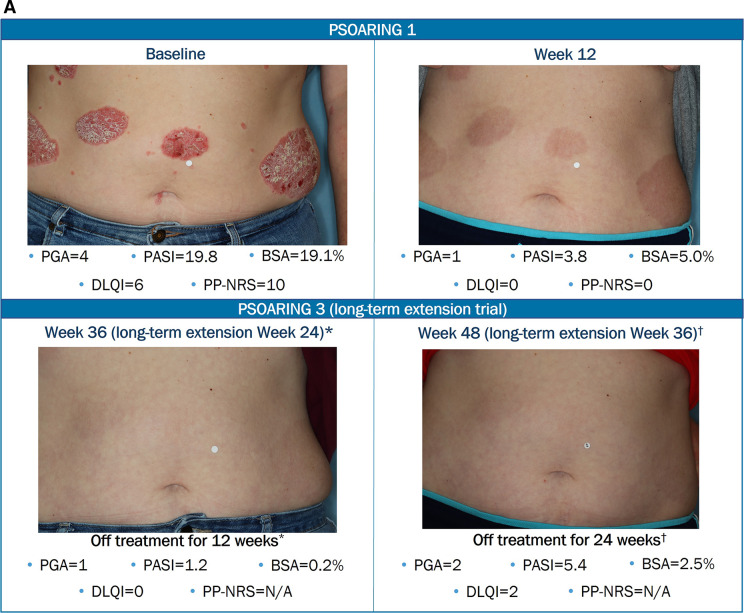
Clinical response, remittive effect off therapy, and durability of response on therapy of a patient with severe plaque psoriasis treated with tapinarof cream in PSOARING 1 and PSOARING 3. (a) Torso: at baseline, well-circumscribed, markedly indurated, erythematous scaling plaques are present. At week 12 there is significant improvement with faint erythema and post-inflammatory hyperpigmentation. At week 36 of the long-term extension trial, a 24-week remittive effect off therapy was demonstrated after this patient achieved complete disease clearance (PGA = 0) and PASI = 0, and discontinued therapy in accordance with the trial protocol at week 12 in PSOARING 3 (after 24 weeks of tapinarof treatment). In the week 36 image, the patient has been off tapinarof treatment for 12 weeks and disease control off therapy is maintained, demonstrated by the absence of psoriatic plaques on the abdomen. The week 48 image with clear abdominal skin shows that this response is maintained for an additional 12 weeks, a total of 24 weeks off tapinarof treatment. (b) Forearm and elbow: at week 36 of the long-term extension trial, a 24-week remittive effect off therapy was demonstrated after this patient achieved complete disease clearance (PGA = 0) and PASI = 0, and discontinued therapy in accordance with the trial protocol at week 12 in PSOARING 3 (after 24 weeks of tapinarof treatment). Images in (a, b) are representative lesions of one tapinarof-treated patient from the PSOARING 1 and 3 trials. PGA, PASI, and BSA are global efficacy assessments. PP-NRS was not assessed in the long-term extension trial. Individual results may vary. *Long-term extension trial week 24: Off treatment for 12 weeks (after achieving PGA = 0 at long-term extension week 12). Long-term extension trial week 36: Off treatment for 24 weeks, with re-treatment at week 36 due to disease worsening (PGA of 2 [mild]). BSA body surface area, DLQI Dermatology Life Quality Index, N/A not assessed, PASI Psoriasis Area and Severity Index, PGA Physician Global Assessment, PP-NRS Peak Pruritus Numerical Rating Scale, QD once daily
Fig. 5
Fig. 5
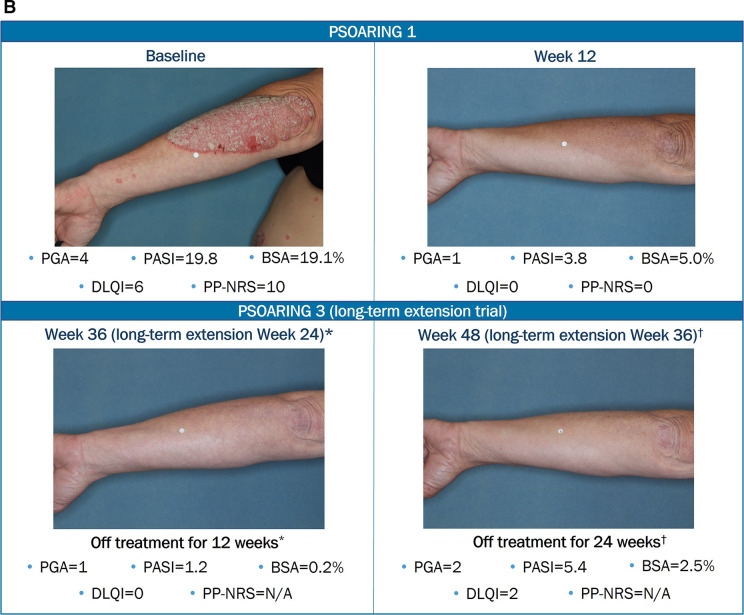
Clinical response, remittive effect off therapy, and durability of response on therapy of a patient with severe plaque psoriasis treated with tapinarof cream in PSOARING 1 and PSOARING 3. (a) Torso: at baseline, well-circumscribed, markedly indurated, erythematous scaling plaques are present. At week 12 there is significant improvement with faint erythema and post-inflammatory hyperpigmentation. At week 36 of the long-term extension trial, a 24-week remittive effect off therapy was demonstrated after this patient achieved complete disease clearance (PGA = 0) and PASI = 0, and discontinued therapy in accordance with the trial protocol at week 12 in PSOARING 3 (after 24 weeks of tapinarof treatment). In the week 36 image, the patient has been off tapinarof treatment for 12 weeks and disease control off therapy is maintained, demonstrated by the absence of psoriatic plaques on the abdomen. The week 48 image with clear abdominal skin shows that this response is maintained for an additional 12 weeks, a total of 24 weeks off tapinarof treatment. (b) Forearm and elbow: at week 36 of the long-term extension trial, a 24-week remittive effect off therapy was demonstrated after this patient achieved complete disease clearance (PGA = 0) and PASI = 0, and discontinued therapy in accordance with the trial protocol at week 12 in PSOARING 3 (after 24 weeks of tapinarof treatment). Images in (a, b) are representative lesions of one tapinarof-treated patient from the PSOARING 1 and 3 trials. PGA, PASI, and BSA are global efficacy assessments. PP-NRS was not assessed in the long-term extension trial. Individual results may vary. *Long-term extension trial week 24: Off treatment for 12 weeks (after achieving PGA = 0 at long-term extension week 12). Long-term extension trial week 36: Off treatment for 24 weeks, with re-treatment at week 36 due to disease worsening (PGA of 2 [mild]). BSA body surface area, DLQI Dermatology Life Quality Index, N/A not assessed, PASI Psoriasis Area and Severity Index, PGA Physician Global Assessment, PP-NRS Peak Pruritus Numerical Rating Scale, QD once daily
Fig. 6
Fig. 6
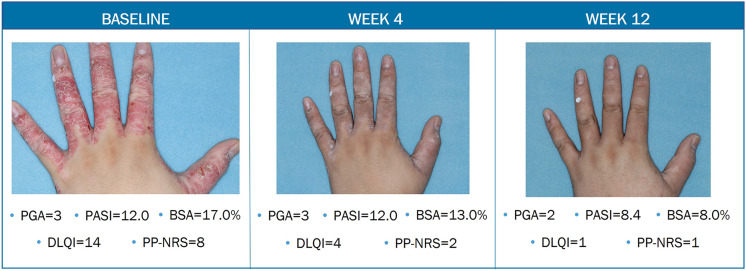
Clinical response of a patient with moderate plaque psoriasis treated with tapinarof cream who achieved improvements in PGA, PASI, BSA, and patient-reported outcomes in PSOARING 2. Hand: improvements in PGA, PASI, BSA, and PRO endpoints in a patient who failed to meet the regulatory endpoint of a PGA score of 0 or 1 with a 2-grade improvement. At baseline, markedly indurated, erythematous, scaling plaques on the dorsal digits and between the fingers are seen. Fissures and bleeding are visible, indicative of the loss of mechanical pliability of the skin and “fissuring” resulting when the digits are flexed. At week 4, the erythema and induration have significantly improved, with complete clearance of the hand at week 12. Despite the presence of residual disease elsewhere, improvements in DLQI from 14 to 1 and PP-NRS from 8 to an itch-free state (1) at week 12 indicate a favorable impact of tapinarof therapy on QoL and itch. Image is a representative lesion from one tapinarof-treated patient from the PSOARING 2 trial. PGA, PASI, and BSA are global efficacy assessments. Individual results may vary. Intertriginous skin (sites in which opposing skin surfaces are in contact when the patient is at rest) includes areas between the fingers (shown in images above). BSA body surface area, DLQI Dermatology Life Quality Index, PASI Psoriasis Area and Severity Index, PGA Physician Global Assessment, PP-NRS Peak Pruritus Numerical Rating Scale, PRO patient-reported outcome, QD once daily, QoL quality of life
Fig. 7
Fig. 7
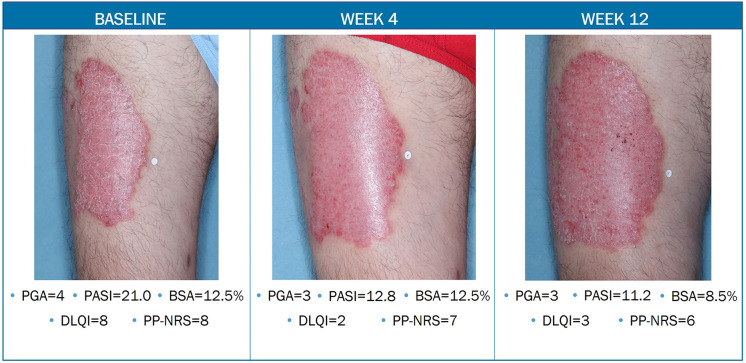
Clinical response of a patient with severe plaque psoriasis treated with vehicle cream QD in PSOARING 2. Thigh (anterior view): at baseline, a well-circumscribed erythematous plaque with scaling is present on the thigh. No significant improvement in this lesion is observed in either size or morphology during 12 weeks of vehicle treatment. Image is a representative lesion of one vehicle-treated patient from the PSOARING 2 trial. PGA, PASI, and BSA are global efficacy assessments. Individual results may vary. BSA body surface area, DLQI Dermatology Life Quality Index, PASI Psoriasis Area and Severity Index, PGA Physician Global Assessment, PP-NRS Peak Pruritus Numerical Rating Scale, QD once daily
Fig. 8
Fig. 8
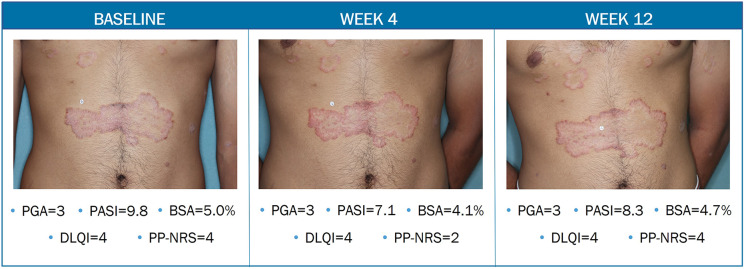
Clinical response of a patient with moderate plaque psoriasis treated with vehicle cream QD in PSOARING 2. Chest and abdomen: this patient experienced no improvement in PGA score, BSA affected, or PROs. At baseline, well-circumscribed erythematous plaques with scale are present on the chest and abdomen. No significant improvement in these lesions is observed in either size or morphology during 12 weeks of vehicle treatment. Image is a representative lesion of one vehicle-treated patient from the PSOARING 2 trial. PGA, PASI, and BSA are global efficacy assessments. Individual results may vary. BSA body surface area, DLQI Dermatology Life Quality Index, PASI Psoriasis Area and Severity Index, PGA Physician Global Assessment, PP-NRS Peak Pruritus Numerical Rating Scale, PRO patient-reported outcome, QD once daily
Fig. 9
Fig. 9
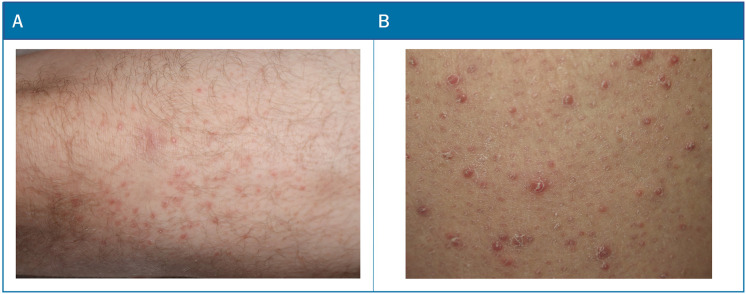
Folliculitis in two tapinarof-treated patients in PSOARING 1 and 2: (a) mild (CTCAE grade 1) and b severe (CTCAE grade 3). Punctate erythematous follicular scaling macules and papules in the morphology are reminiscent of keratosis pilaris. In the grade 3 image shown in (b), a progression of morphologies from minimal perifollicular scale to erythematous follicular scaling papules can be seen. CTCAE Common Terminology Criteria for Adverse Events
Fig. 10
Fig. 10
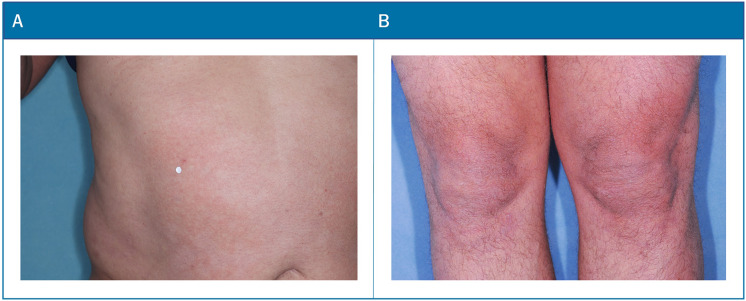
Moderate contact dermatitis (CTCAE grade 2) on the torso (a) and knees (b) of two tapinarof-treated patients in PSOARING 1 and 2. Ill-defined erythema of the abdomen, reminiscent of an atopic phenotype, is observed on the torso (a); whereas a more discrete-bordered erythema is present perilesionally to cleared psoriasis plaques affecting the knees (b). CTCAE Common Terminology Criteria for Adverse Events

References

    1. Armstrong AW, Mehta MD, Schupp CW, Gondo GC, Bell SJ, Griffiths CE. Psoriasis prevalence in adults in the United States. JAMA Dermatol. 2021;157(8):940–946. doi: 10.1001/jamadermatol.2021.2007. - DOI - PMC - PubMed
    1. Walter K. Psoriasis. JAMA. 2022;327(19):1936–1936. doi: 10.1001/jama.2022.5270. - DOI - PubMed
    1. Stein GL. Topical therapies for psoriasis: improving management strategies and patient adherence. Semin Cutan Med Surg. 2016;35(2 Suppl 2):S36–S44. - PubMed
    1. Elmets CA, Korman NJ, Prater EF, et al. Joint AAD–NPF guidelines of care for the management and treatment of psoriasis with topical therapy and alternative medicine modalities for psoriasis severity measures. J Am Acad Dermatol. 2021;84(2):432–470. doi: 10.1016/j.jaad.2020.07.087. - DOI - PubMed
    1. Tian D, Lai Y. The relapse of psoriasis: what’s the veil of mystery? JID Innov. 2022;2:100116. doi: 10.1016/j.xjidi.2022.100116. - DOI - PMC - PubMed

Associated data

LinkOut - more resources