


Short- to Long-Term Effects of Virtual Reality on Motor Skill Learning in Children With Cerebral Palsy: Systematic Review and Meta-Analysis
- PMID: 37698895
- PMCID: PMC10523212
- DOI: 10.2196/42067
Short- to Long-Term Effects of Virtual Reality on Motor Skill Learning in Children With Cerebral Palsy: Systematic Review and Meta-Analysis
Abstract
Background: Many studies have started integrating virtual reality (VR) into neurorehabilitation for children with cerebral palsy (CP). The results of the effects of VR on motor skill learning, including the short- to long-term results of relevant studies, must be pooled in a generic framework.
Objective: This systematic review and meta-analysis aimed to investigate the short- to long-term effects of therapies including VR on motor skill learning in children with CP.
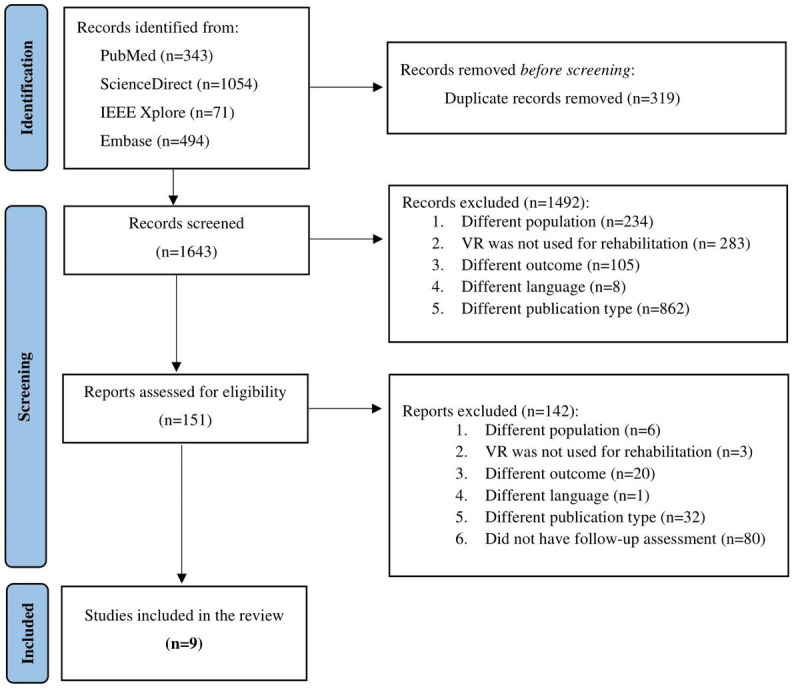
Methods: Two examiners followed the inclusion and exclusion criteria of the "Participant, Intervention, Control, and Outcome" framework. Randomized controlled trials (RCTs) and non-RCTs were considered if they compared VR-included interventions with control groups on motor functions and daily life activities in children with CP. PubMed, ScienceDirect, Embase, and IEEE Xplore databases were searched. The modified Downs and Black assessment was used to assess the methodological quality of the included studies. Meta-analyses and subgroup analyses for RCTs were conducted whenever possible.
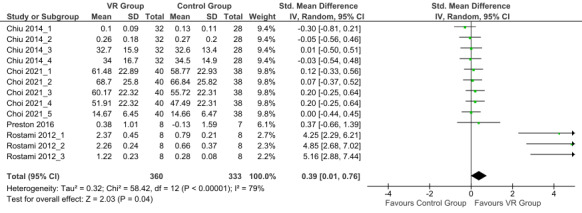
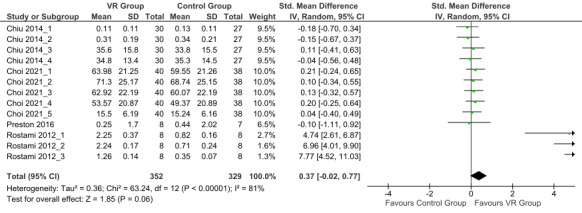
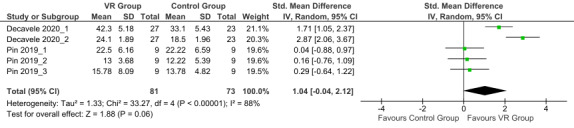
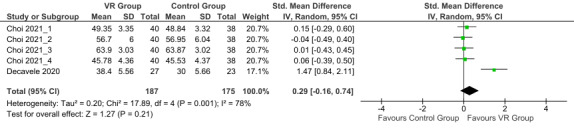
Results: A total of 7 RCTs, 2 non-RCTs, and 258 children with CP were included. The priority focus of 78% (7/9) of the studies was upper limb functions. There was a significant short-term effect of adding VR to conventional therapies on upper limb functions when compared with conventional therapies (P=.04; standardized mean difference [SMD]=0.39, 95% CI 0.01-0.76). The overall medium- to long-term effects showed a trend toward favoring the VR group, although the difference was not statistically significant (P=.06; SMD=0.37, 95% CI -0.02 to 0.77). For balance (P=.06; SMD=1.04, 95% CI -0.04 to 2.12), gross motor functions (P=.30; SMD=2.85, 95% CI -2.57 to 8.28), and daily life activities outcomes (P=.21; SMD=0.29, 95% CI -0.16 to 0.74), the overall effect in the short term also showed a trend toward favoring the VR group, but these results were not statistically significant.
Conclusions: VR seems to have additional benefits for motor skill learning in children with CP. Studies with follow-up outcomes of VR training focusing on balance and gross motor functions in patients with CP were quite limited. Future research on balance and gross motor function outcomes should target particularly long-term results of therapies including VR on motor skill learning.
Trial registration: PROSPERO International Prospective Register of Systematic Reviews CRD42021227734; https://www.crd.york.ac.uk/prospero/display_record.php?ID=CRD42021227734.
Keywords: cerebral palsy; daily life activities; long-term effect; motor functions; motor skill learning; virtual reality.
©Seyma Kilcioglu, Benoît Schiltz, Rodrigo Araneda, Yannick Bleyenheuft. Originally published in JMIR Serious Games (https://games.jmir.org), 12.09.2023.
Conflict of interest statement
Conflicts of Interest: None declared.
Figures

References
-
- Graham HK, Rosenbaum P, Paneth N, Dan B, Lin J-P, Damiano DL, Becher JG, Gaebler-Spira D, Colver A, Reddihough DS, Crompton KE, Lieber RL. Cerebral palsy. Nat Rev Dis Primers. 2016 Jan 07;2:15082. doi: 10.1038/nrdp.2015.82. https://europepmc.org/abstract/MED/27188686 nrdp201582 - DOI - PMC - PubMed
-
- Novak I, Morgan C, Fahey M, Finch-Edmondson M, Galea C, Hines A, Langdon K, Namara MM, Paton MC, Popat H, Shore B, Khamis A, Stanton E, Finemore OP, Tricks A, Te Velde A, Dark L, Morton N, Badawi N. State of the evidence traffic lights 2019: systematic review of interventions for preventing and treating children with cerebral palsy. Curr Neurol Neurosci Rep. 2020 Feb 21;20(2):3. doi: 10.1007/s11910-020-1022-z. https://europepmc.org/abstract/MED/32086598 10.1007/s11910-020-1022-z - DOI - PMC - PubMed
-
- Muratori LM, Lamberg EM, Quinn L, Duff SV. Applying principles of motor learning and control to upper extremity rehabilitation. J Hand Ther. 2013 Apr;26(2):94–102; quiz 103. doi: 10.1016/j.jht.2012.12.007. https://europepmc.org/abstract/MED/23598082 S0894-1130(13)00006-9 - DOI - PMC - PubMed
-
- Dayan E, Cohen LG. Neuroplasticity subserving motor skill learning. Neuron. 2011 Nov 03;72(3):443–54. doi: 10.1016/j.neuron.2011.10.008. https://linkinghub.elsevier.com/retrieve/pii/S0896-6273(11)00918-4 S0896-6273(11)00918-4 - DOI - PMC - PubMed
Publication types
LinkOut - more resources
Full Text Sources
Miscellaneous
