


Predictors of the Use of a Mental Health-Focused eHealth System in Patients With Breast and Prostate Cancer: Bayesian Structural Equation Modeling Analysis of a Prospective Study
- PMID: 37698900
- PMCID: PMC10523218
- DOI: 10.2196/49775
Predictors of the Use of a Mental Health-Focused eHealth System in Patients With Breast and Prostate Cancer: Bayesian Structural Equation Modeling Analysis of a Prospective Study
Abstract
Background: eHealth systems have been increasingly used to manage depressive symptoms in patients with somatic illnesses. However, understanding the factors that drive their use, particularly among patients with breast and prostate cancer, remains a critical area of research.
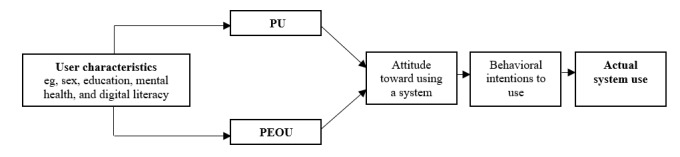
Objective: This study aimed to determine the factors influencing use of the NEVERMIND eHealth system among patients with breast and prostate cancer over 12 weeks, with a focus on the Technology Acceptance Model.
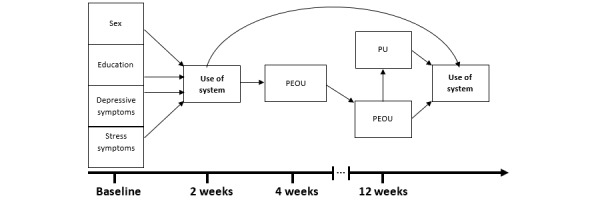
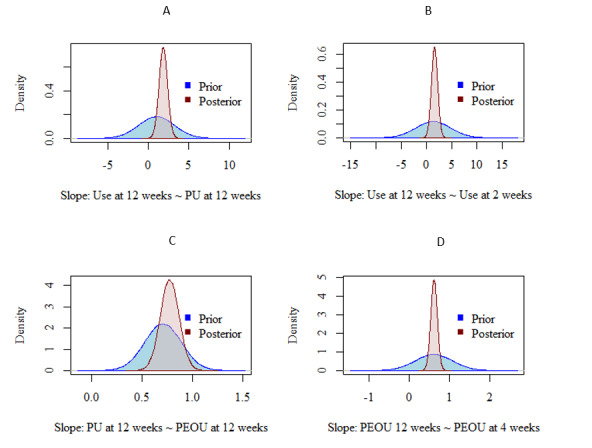
Methods: Data from the NEVERMIND trial, which included 129 patients with breast and prostate cancer, were retrieved. At baseline, participants completed questionnaires detailing demographic data and measuring depressive and stress symptoms using the Beck Depression Inventory-II and the Depression, Anxiety, and Stress Scale-21, respectively. Over a 12-week period, patients engaged with the NEVERMIND system, with follow-up questionnaires administered at 4 weeks and after 12 weeks assessing the system's perceived ease of use and usefulness. Use log data were collected at the 2- and 12-week marks. The relationships among sex, education, baseline depressive and stress symptoms, perceived ease of use, perceived usefulness (PU), and system use at various stages were examined using Bayesian structural equation modeling in a path analysis, a technique that differs from traditional frequentist methods.
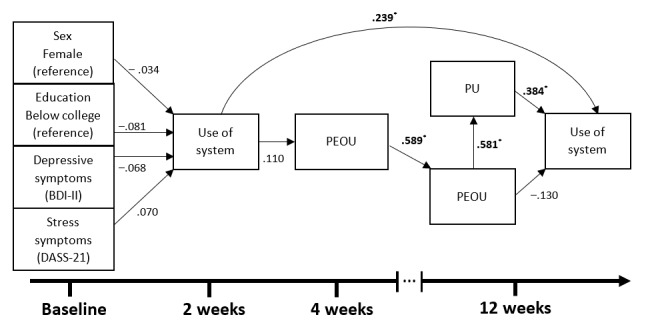
Results: The path analysis was conducted among 100 patients with breast and prostate cancer, with 66% (n=66) being female and 81% (n=81) having a college education. Patients reported good mental health scores, with low levels of depression and stress at baseline. System use was approximately 6 days in the initial 2 weeks and 45 days over the 12-week study period. The results revealed that PU was the strongest predictor of system use at 12 weeks (βuse at 12 weeks is predicted by PU at 12 weeks=.384), whereas system use at 2 weeks moderately predicted system use at 12 weeks (βuse at 12 weeks is predicted by use at 2 weeks=.239). Notably, there were uncertain associations between baseline variables (education, sex, and mental health symptoms) and system use at 2 weeks, indicating a need for better predictors for early system use.
Conclusions: This study underscores the importance of PU and early engagement in patient engagement with eHealth systems such as NEVERMIND. This suggests that, in general eHealth implementations, caregivers should educate patients about the benefits and functionalities of such systems, thus enhancing their understanding of potential health impacts. Concentrating resources on promoting early engagement is also essential given its influence on sustained use. Further research is necessary to clarify the remaining uncertainties, enabling us to refine our strategies and maximize the benefits of eHealth systems in health care settings.
Keywords: NEVERMIND system; Technology Acceptance Model; cancer; digital health; eHealth system; mental health; perceived usefulness; structural equation modeling; usability.
©Nuhamin Gebrewold Petros, Jesper Alvarsson-Hjort, Gergö Hadlaczky, Danuta Wasserman, Manuel Ottaviano, Sergio Gonzalez-Martinez, Sara Carletto, Enzo Pasquale Scilingo, Gaetano Valenza, Vladimir Carli. Originally published in JMIR Cancer (https://cancer.jmir.org), 12.09.2023.
Conflict of interest statement
Conflicts of Interest: None declared.
Figures

References
-
- Barello S, Graffigna G, Savarese M, Bosio A. Engaging patients in health management: towards a preliminary theoretical conceptualization. Psicologia della Salute. 2014 Mar;:11–33. doi: 10.3280/pds2014-003002. https://www.torrossa.com/en/resources/an/3009406?digital=true ISSN: 1972-5167 - DOI
-
- Barello S, Triberti S, Graffigna G, Libreri C, Serino S, Hibbard J, Riva G. eHealth for patient engagement: a systematic review. Front Psychol. 2016 Jan 08;6:2013. doi: 10.3389/fpsyg.2015.02013. https://air.unimi.it/handle/2434/696411 - DOI - PMC - PubMed
-
- Chhatre S, Gallo JJ, Guzzo T, Morales KH, Newman DK, Vapiwala N, Van Arsdalen K, Wein AJ, Malkowicz SB, Jayadevappa R. Trajectory of depression among prostate cancer patients: a secondary analysis of a randomized controlled trial. Cancers (Basel) 2023 Apr 02;15(7):2124. doi: 10.3390/cancers15072124. https://www.mdpi.com/resolver?pii=cancers15072124 cancers15072124 - DOI - PMC - PubMed
-
- Pilevarzadeh M, Amirshahi M, Afsargharehbagh R, Rafiemanesh H, Hashemi SM, Balouchi A. Global prevalence of depression among breast cancer patients: a systematic review and meta-analysis. Breast Cancer Res Treat. 2019 Aug 13;176(3):519–33. doi: 10.1007/s10549-019-05271-3.10.1007/s10549-019-05271-3 - DOI - PubMed
-
- Niedzwiedz CL, Knifton L, Robb KA, Katikireddi SV, Smith DJ. Depression and anxiety among people living with and beyond cancer: a growing clinical and research priority. BMC Cancer. 2019 Oct 11;19(1):943. doi: 10.1186/s12885-019-6181-4. https://bmccancer.biomedcentral.com/articles/10.1186/s12885-019-6181-4 10.1186/s12885-019-6181-4 - DOI - PMC - PubMed
