


Sugar-sweetened beverage intake and convenience store shopping as mediators of the food insecurity-Tooth decay relationship among low-income children in Washington state
- PMID: 37699013
- PMCID: PMC10497152
- DOI: 10.1371/journal.pone.0290287
Sugar-sweetened beverage intake and convenience store shopping as mediators of the food insecurity-Tooth decay relationship among low-income children in Washington state
Abstract
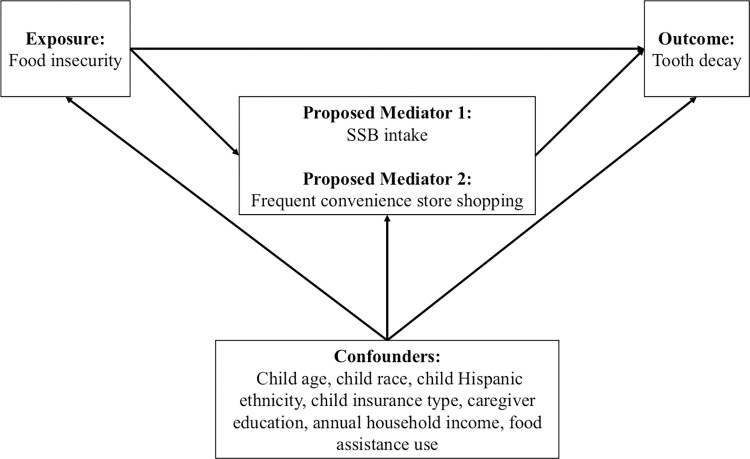
Introduction: There are oral health disparities in the U.S. and children in food-insecure households have a higher burden of tooth decay. Identifying the mechanisms underlying the food insecurity-tooth decay relationship could inform public health interventions. This study examined how sugar-sweetened beverage (SSB) intake and frequent convenience store shopping mediated the food insecurity-tooth decay relationship for lower-income children.
Materials and methods: Cross-sectional study data included a household survey, beverage questionnaire, and dental examination. The sample included 452 lower-income, racially-diverse, child-caregiver dyads in 2018 from King County in Washington state. The exposure was household food insecurity, the outcome was untreated decayed tooth surfaces, and the proposed mediators were SSB intake and frequent convenience store shopping (≥2 times/week). Causal mediation analyses via the potential outcomes framework was used to estimate natural indirect and direct effects.
Results: Fifty-five percent of participants were in food-insecure households, the mean number of decayed tooth surfaces among children was 0.87 (standard deviation [SD] = 1.99), the mean SSB intake was 17 fluid ounces (fl/oz)/day (SD = 35), and 18% of households frequently shopped at a convenience store. After adjusting for confounders, household food insecurity and log-transformed SSB intake (fluid ounces/day) were positively associated with decayed tooth surfaces, but not at the a α = 0.05 level (mean ratio [MR] 1.60; 95% confidence interval [CI] 0.89, 2.88; p = .12 and MR 1.16; 95% CI 0.93, 1.46; p = .19, respectively). Frequent convenience store shopping was associated with 2.75 times more decayed tooth surfaces (95% CI 1.61, 4.67; p < .001). SSB intake mediated 10% of the food insecurity-tooth decay relationship (p = .35) and frequent convenience store shopping mediated 22% (p = .33).
Conclusions: Interventions aimed at addressing oral health disparities in children in food-insecure households could potentially focus on reducing intake of SSBs and improving access to healthful foods in lower-income communities.
Copyright: This is an open access article, free of all copyright, and may be freely reproduced, distributed, transmitted, modified, built upon, or otherwise used by anyone for any lawful purpose. The work is made available under the Creative Commons CC0 public domain dedication.
Conflict of interest statement
The authors have declared that no competing interests exist.
Figures
References
-
- Kassebaum NJ, Smith AGC, Bernabé E, Fleming TD, Reynolds AE, Vos T, et al. Global, Regional, and National Prevalence, Incidence, and Disability-Adjusted Life Years for Oral Conditions for 195 Countries, 1990–2015: A Systematic Analysis for the Global Burden of Diseases, Injuries, and Risk Factors. J Dent Res 2017;96:380–7. doi: 10.1177/0022034517693566 - DOI - PMC - PubMed
-
- Centers for Disease Control and Prevention. Oral Health Surveillance Report: Trends in Dental Caries and Sealants, Tooth Retention, and Edentulism, United States, 1999–2004 to 2011–2016. Atlanta, GA: 2019.
Publication types
MeSH terms
LinkOut - more resources
Full Text Sources
