


Sixty years of conjecture over a urinary biomarker: a step closer to understanding the proposed link between anxiety and urinary pyrroles
- PMID: 37699019
- PMCID: PMC11064097
- DOI: 10.1093/labmed/lmad086
Sixty years of conjecture over a urinary biomarker: a step closer to understanding the proposed link between anxiety and urinary pyrroles
Abstract
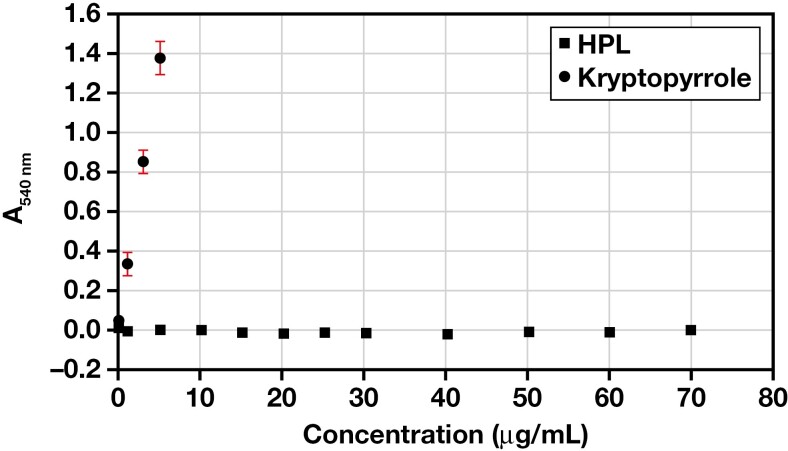
Objective: For over 60 years there has been conjecture about the identity of an Ehrlich's test positive pyrrole (Mauve Factor) reputed to be a biomarker for psychological disorders, including anxiety. We reviewed studies that attempt to identify Mauve Factor and subjected authentic standards of the 2 main candidates, kryptopyrrole and hydroxypyrrole, to the Ehrlich's reaction.
Methods: Modified Ehrlich's test for kryptopyrrole and hydroxypyrrole were applied to urine samples from 10 volunteers, anxious and nonanxious.
Results: Based on the mechanistic chemistry of Ehrlich's reaction and reactions of the 2 compounds, Mauve Factor cannot be hydroxypyrrole. Analyses of urine samples from volunteers, identified by the Generalized Anxiety Disorder - 7 item scale (GAD-7 ≥10; n = 5) and control urine samples (GAD-7 <10; n = 5) using a kryptopyrrole calibration graph, show that concentrations are similar in both groups.
Conclusion: Kryptopyrrole may be the elusive Mauve Factor. Its possible origin from stercobilin via gut microbiome-mediated metabolism, its link to gut-mediated neurological effects via γ-aminobutyric acid (GABA) receptors, and its predicted interaction with Zn2+ and consequent impact on zinc homeostasis are discussed. The GAD-7 scale does not differentiate between state and trait anxiety and as such, the minimal difference in pyrrole levels between volunteer groups requires further study.
Keywords: Mauve Factor; biomarker for anxiety; generalized anxiety disorder; hydroxypyrrole; kryptopyrrole; urinary biomarker.
© The Author(s) 2023. Published by Oxford University Press on behalf of American Society for Clinical Pathology.
Conflict of interest statement
The authors have nothing to disclose.
Figures




References
-
- Irvine DG. Apparently non-indolic Ehrlich-positive substances related to mental illnesses. J Neuropsychiatry Clin Neurosci. 1961;2:292-305. - PubMed
