


Analysis of 12 cases of antineoplastic agents-induced interstitial lung disease
- PMID: 37701034
- PMCID: PMC10493388
- DOI: 10.3389/fphar.2023.1218480
Analysis of 12 cases of antineoplastic agents-induced interstitial lung disease
Abstract
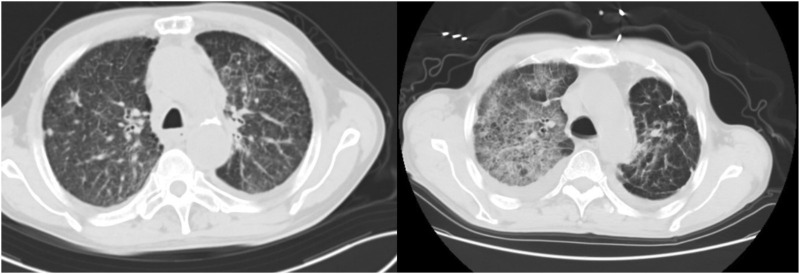
Objective: To summarize the situation of antineoplastic agents-induced interstitial lung diseases (ILD), provide reference for strengthening clinical management of druginduced interstitial lung diseases (DILD). Methods: We retrospectively investigated the medical records of 12 patients with antineoplastic agents-induced ILD in a hospital between January and December 2020. Data collected included patients' characteristic (gender, age, ECOG PS score, smoking history, primary tumor, concurrent diseases or complications.) and treatment conditions (DILD-causing drugs, clinical symptoms, chest CT, DILD treatment drugs, onset cycle, onset time, severity of DILD, DILD course and prognosis.). Results: The median age of 12 DILD cases was 68%, 66.67% of the patients were male, lung cancer accounted for 58.33% (7/12). DILD was induced by cytotoxicity drugs, targeted drugs and immune checkpoint inhibitors (ICIs), of which ICIs accounted for 66.67% (8/12). Scattered patchy, cord-like, grid-like or flocculent shadows were observed on chest CT, mainly under the pleura of lungs. Once DILD occurs, the suspected antineoplastic agents were stopped and glucocorticoid was given, among which 83.33% (10/12) patients were treated with antibiotics. Finally, 16.67% (2/12) were cured, 33.33% (4/12) were improved, 16.67% (2/12) were not cured and 33.33% (4/12) were dead. Conclusion: Antineoplastic agents-induced ILD is mostly found in elderly male lung cancer patients with smoking history. The clinical symptoms of DILD are diverse and lack of specificity. ICIs-ILD has the characteristic of high incidence and poor prognosis compared with other antineoplastic agents. Comprehensive evaluation before medication, regular review, early and adequate glucocorticoid shock therapy after onset can improve the prognosis of DILD patients.
Keywords: antineoplastic agents; drug-induced interstitial lung diseases; glucocorticoid; immune checkpoint inhibitors; targeted drugs.
Copyright © 2023 Li, Gu, Liu, Sun and Sun.
Conflict of interest statement
The authors declare that the research was conducted in the absence of any commercial or financial relationships that could be construed as a potential conflict of interest.
References
-
- Chinese Society of Clinical Oncology (2022). CSCO Guidelines Management of immune checkpoint inhibitor-related toxicity. Available at: http://www.csco.org.cn (Accessed March 20, 2023).
LinkOut - more resources
Full Text Sources
