Review
. 2023 Jun 6:7:28.
doi: 10.21037/med-22-58. eCollection 2023.

Imaging evaluation of thymic tumors

Affiliations
Review

Imaging evaluation of thymic tumors

Chad D Strange et al. Mediastinum. .

Abstract

An integral part of managing patients with thymoma and thymic carcinoma is imaging. At diagnosis and staging, imaging helps demonstrate the extent of local invasion and distant metastases which allows the proper stratification of patients for therapy. For decades, the predominant staging system for thymic tumors was the Masaoka-Koga staging system. More recently, however, the International Association for the Study of Lung Cancer, the International Thymic Malignancies Interest Group (ITMIG), the European Society of Thoracic Surgeons, the Chinese Alliance for Research on Thymomas, and the Japanese Association of Research on Thymus partnered together to develop a tumor-node-metastasis (TNM) staging system specifically for thymic tumors based on a retrospective database of nearly 10,000 patients. The TNM 8th edition defines specific criteria for thymic tumors. Imaging also serves to assess treatment response and detect recurrent disease after various treatment modalities. The Response Evaluation Criteria in Solid Tumors (RECIST) version 1.1 is currently used to assess response to treatment. ITMIG recommends certain modifications to RECIST version 1.1, however, in thymic tumors due to unique patterns of spread. While there is often overlap, computed tomography (CT), magnetic resonance imaging (MRI), and positron emission tomography/computed tomography (PET/CT) characteristics can help differentiate thymoma and thymic carcinoma, with newer CT and MRI techniques under evaluation showing encouraging potential.

Keywords: Thymoma; computed tomography (CT); magnetic resonance imaging (MRI); positron emission tomography/computed tomography (PET/CT); thymic carcinoma.


Conflict of interest statement

Conflicts of Interest: All authors have completed the ICMJE uniform disclosure form (available at https://med.amegroups.com/article/view/10.21037/med-22-58/coif). EMM reports an honorarium for a lecture from each of the following companies: Boehringer Ingelheim, AstraZeneca, Merck Sharp and Dohme. The other authors have no conflicts of interest to declare.

Figures

Figure 1
Figure 1
Thymoma. Frontal chest radiograph shows right mediastinal contour abnormality (arrow) that results in loss of the silhouette of the upper right heart border.
Figure 2
Figure 2
Adenosquamous thymic carcinoma. (A) Contrast-enhanced CT shows a right prevascular mediastinal tumor (arrow) invading the pericardium between the RA, ascending aorta (A) and RV. (B) PET/CT shows the tumor is markedly FDG avid (arrow). RA, right atrium; RV, right ventricle; CT, computed tomography; PET/CT, positron emission tomography/computed tomography; FDG, fluorodeoxyglucose.
Figure 3
Figure 3
Thymoma. (A) CT shows the left prevascular mediastinal mass (arrow) is mostly homogeneous, with low attenuation measuring 10 HU suggesting a cystic component yet has a denser component of 48 HU along the medial peripheral aspect suggesting some solid component. (B) PET/CT shows FDG uptake with SUVmax of 3.4 along the medial peripheral aspect of the mass (arrow). At resection, pathology showed thymoma with cystic component and no invasion of the pericardium or lung. CT, computed tomography; HU, Hounsfield units; PET/CT, positron emission tomography/computed tomography; FDG, fluorodeoxyglucose; SUVmax, maximum standard uptake value.
Figure 4
Figure 4
Thymic cyst. (A) Contrast-enhanced CT shows a right prevascular mediastinal 2.2 cm lesion (arrow) measuring 34 HU, which can represent solid or cystic lesion with proteinaceous material or hemorrhage. (B-D) MRI is useful to determine that this is a simple thymic cyst (arrows) with high signal intensity on T2 weighted (B) and STIR (C) and no enhancement on the post contrast image (D). CT, computed tomography; HU, Hounsfield units; MRI, magnetic resonance imaging; STIR, short tau inversion recovery.
Figure 5
Figure 5
Thymic hyperplasia. Chondroblastic osteosarcoma of the femur, treated with methotrexate, doxorubicin, cisplatin. (A) CT shows the normal thymus for age (arrow) at baseline. (B) CT 4 months later shows increase in size of the thymus consistent with rebound hyperplasia (arrow). Enlargement of the thymus gland due to hyperplasia during the recovery phase from physical stress such as after chemotherapy or recovering from burns, does not displace or change the contour of vessels surrounding it. In the appropriate clinical context of thymic hyperplasia, CT is adequate for diagnosis and MRI is not needed for confirmation. CT, computed tomography; MRI, magnetic resonance imaging.
Figure 6
Figure 6
Lymphoid thymic hyperplasia with Grave’s disease. (A) Contrast-enhanced CT shows mass-like thymic enlargement (arrow). With such an appearance, thymic hyperplasia, a thymic epithelial neoplasm or lymphoma involvement of the thymus are all considerations. (B,C) MRI with IP and OP imaging shows drop in signal intensity consistent with thymic hyperplasia (arrows), obviating the need for further investigation or biopsy. IP, in-phase; OP, out-of-phase; CT, computed tomography; MRI, magnetic resonance imaging.
Figure 7
Figure 7
Thymolipoma. (A,B) Axial and coronal contrast-enhanced CT shows large left prevascular mediastinal lesion with fat attenuation (arrows). CT, computed tomography.
Figure 8
Figure 8
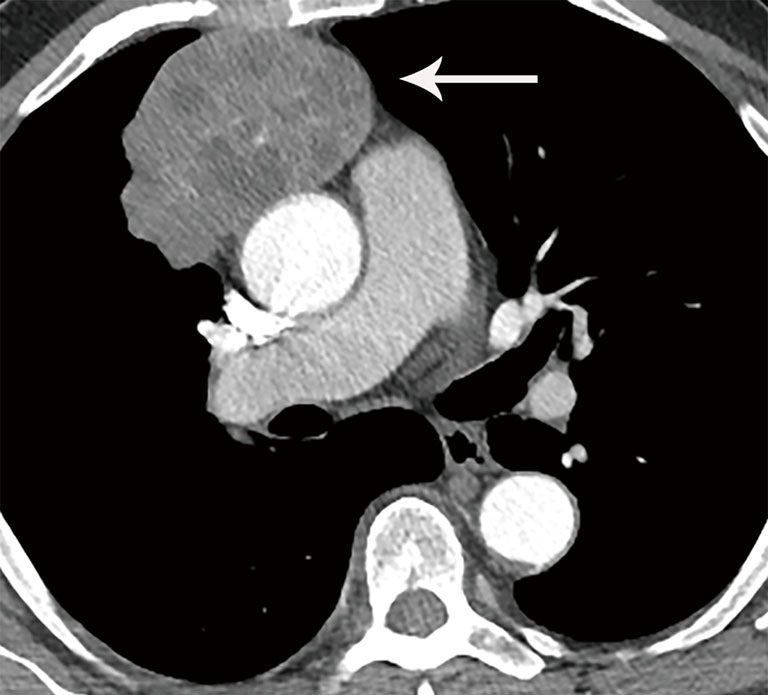
Thymoma and myasthenia gravis. Contrast-enhanced CT shows right prevascular mediastinal mass (arrow). CT, computed tomography.
Figure 9
Figure 9
Thymoma. (A) Contrast-enhanced CT shows right prevascular lobular mediastinal mass (arrow). (B) FDG PET/CT shows FDG avid thymoma (arrow) with SUV of 16. Presence of intense FDG uptake suggests more aggressive type thymoma or thymic carcinoma. CT, computed tomography; FDG, fluorodeoxyglucose; PET/CT, positron emission tomography/computed tomography; SUV, standard uptake value.
Figure 10
Figure 10
WHO type B3 thymoma. Contrast-enhanced CT shows right prevascular mediastinal mass with heterogeneous attenuation, lobular contours and areas of necrosis (arrow), consistent with more aggressive WHO subtype identified pathologically. WHO, World Health Organization; CT, computed tomography.
Figure 11
Figure 11
Thymic carcinoma. Contrast-enhanced CT shows left prevascular mediastinal mass (arrow) with small calcific focus. CT, computed tomography.
Figure 12
Figure 12
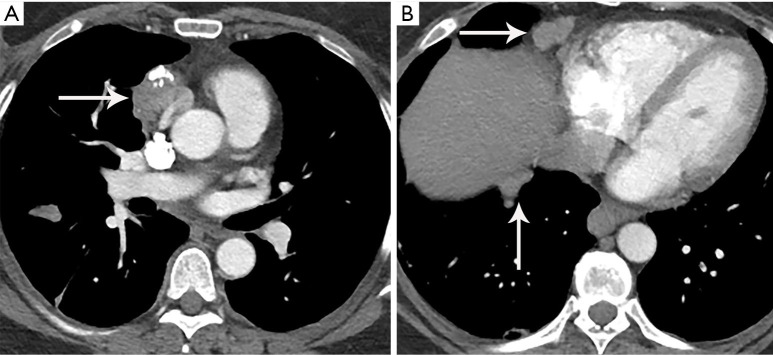
Thymic carcinoma with pleural metastases. (A) Contrast-enhanced CT shows a right prevascular lobular mediastinal mass with heterogeneous attenuation and calcifications (arrow). (B) CT shows nodular right diaphragmatic pleural metastases (vertical arrows) and right anterior diaphragmatic nodal metastasis (horizontal arrow). CT, computed tomography.

References

    1. Benveniste MF, Rosado-de-Christenson ML, Sabloff BS, et al. Role of imaging in the diagnosis, staging, and treatment of thymoma. Radiographics 2011;31:1847-61; discussion 1861-3. 10.1148/rg.317115505 - DOI - PubMed
    1. Regnard JF, Zinzindohoue F, Magdeleinat P, et al. Results of re-resection for recurrent thymomas. Ann Thorac Surg 1997;64:1593-8. 10.1016/S0003-4975(97)01175-2 - DOI - PubMed
    1. Ströbel P, Bauer A, Puppe B, et al. Tumor recurrence and survival in patients treated for thymomas and thymic squamous cell carcinomas: a retrospective analysis. J Clin Oncol 2004;22:1501-9. 10.1200/JCO.2004.10.113 - DOI - PubMed
    1. Carter BW, Okumura M, Detterbeck FC, et al. Approaching the patient with an anterior mediastinal mass: a guide for radiologists. J Thorac Oncol 2014;9:S110-8. 10.1097/JTO.0000000000000295 - DOI - PubMed
    1. Tomiyama N, Honda O, Tsubamoto M, et al. Anterior mediastinal tumors: diagnostic accuracy of CT and MRI. Eur J Radiol 2009;69:280-8. 10.1016/j.ejrad.2007.10.002 - DOI - PubMed