


Primate richness and abundance is driven by both forest structure and conservation scenario in Costa Rica
- PMID: 37703237
- PMCID: PMC10499215
- DOI: 10.1371/journal.pone.0290742
Primate richness and abundance is driven by both forest structure and conservation scenario in Costa Rica
Abstract
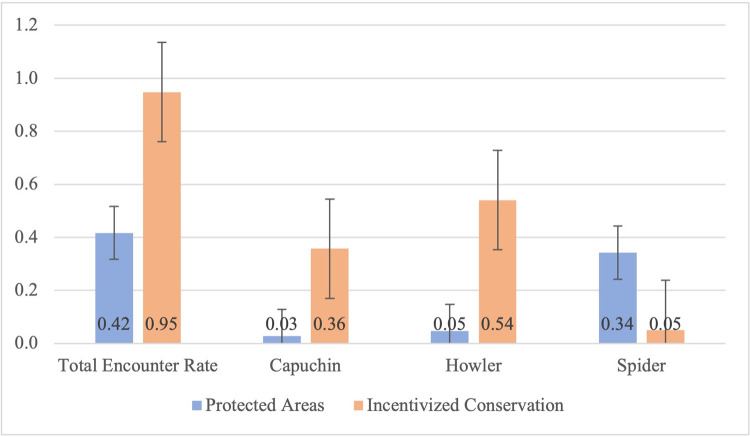
Variation in tropical forest management directly affects biodiversity and provisioning of ecosystem services on a global scale, thus it is necessary to compare forests under different conservation approaches such as protected areas, payments for ecosystem services programs (PES), and ecotourism, as well as forests lacking any formal conservation plan. To examine the effectiveness of specific conservation approaches, we examined differences in forest structure and tree recruitment, including canopy cover; canopy height; seedling, sapling, and adult tree density; and average and total diameter at breast height (DBH) across 78 plots in 18 forests across Costa Rica representing protected areas, private forests utilizing PES and/or ecotourism, and private forests not utilizing these economic incentives. The effectiveness of conservation approaches in providing suitable primate habitat was assessed by conducting broad primate census surveys across a subset of eight forests to determine species richness and group encounter rate of three primate species: mantled howler monkey (Alouatta palliata), Central American spider monkey (Ateles geoffroyi), and the white-faced capuchin monkey (Cebus imitator). Only canopy height was significantly different across the three approaches, with protected areas conserving the tallest and likely oldest forests. Canopy height was also significantly associated with the group encounter rate for both mantled howler and spider monkeys, but not for capuchins. Total group encounter rate for all three monkey species combined was higher in incentivized forests than in protected areas, with capuchin and howler monkey group encounter rates driving the trend. Group encounter rate for spider monkeys was higher in protected areas than in incentivized forests. Incentivized conservation (PES and ecotourism) and protected areas are paragons of land management practices that can lead to variation in forest structure across a landscape, which not only protect primate communities, but support the dietary ecologies of sympatric primate species.
Copyright: © 2023 Johnson et al. This is an open access article distributed under the terms of the Creative Commons Attribution License, which permits unrestricted use, distribution, and reproduction in any medium, provided the original author and source are credited.
Conflict of interest statement
The authors have declared that no competing interests exist.
Figures

References
-
- McDowell NG, Allen CD, Anderson-Teixeira K, Aukema BH, Bond-Lamberty B, Chini L, et al.. Pervasive shifts in forest dynamics in a changing world. Science. 2020; 368: 964–976. - PubMed
-
- Broadbent E, Zambrano A, Dirzo R, Durham WH, Driscoll L, Gallagher P, et al.. The effect of land use change and ecotourism on biodiversity: a case study of Manuel Antonio, Costa Rica, from 1985 to 2008. Landscape Ecol. 2012; 27: 731–744.
Publication types
MeSH terms
Supplementary concepts
Associated data
LinkOut - more resources
Full Text Sources
Miscellaneous
