


Migratory destinations and spatial structuring of humpback whales (Megaptera novaeangliae) wintering off Nicaragua
- PMID: 37704666
- PMCID: PMC10500005
- DOI: 10.1038/s41598-023-41923-7
Migratory destinations and spatial structuring of humpback whales (Megaptera novaeangliae) wintering off Nicaragua
Abstract
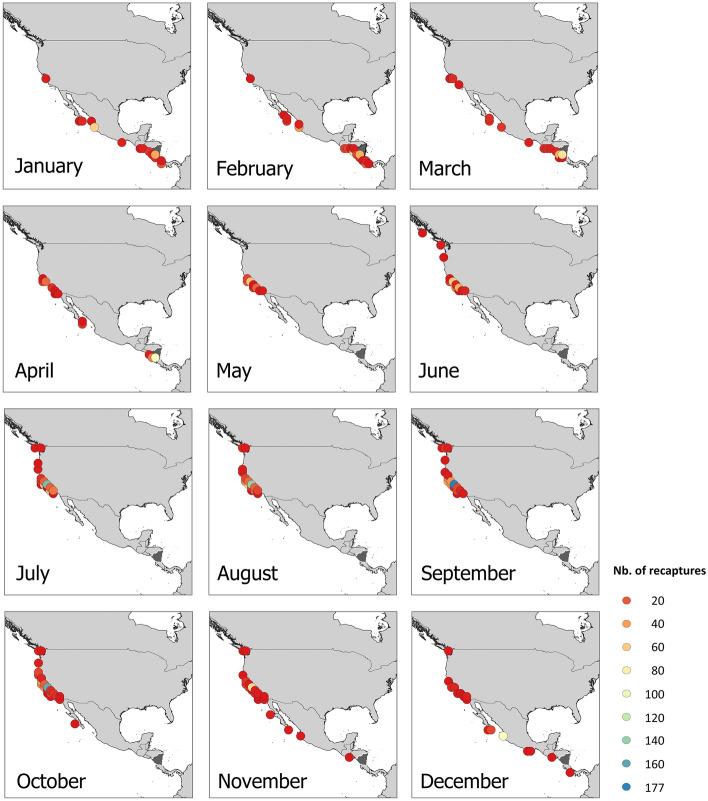
Understanding the migratory patterns of large whales is of conservation importance, especially in identifying threats to specific populations. Migration ecology, including migratory destinations, movements and site fidelity for humpback whales (Megaptera novaeangliae) remain poorly studied in parts of the range of the Central America population, considered endangered under the United States Endangered Species Act. This study aimed to investigate the migratory destinations of humpback whales sighted at two study sites in Nicaragua, which are part of the Central America population. A ten-year photographic database of humpback whales observed off Nicaragua was combined with citizen science contributions and sightings from dedicated research programs. The resulting image collection was compared with available historical photo identifications and databases using an automated image recognition algorithm. This approach yielded 36 years of photographic identification totaling 431 recaptures in Nicaragua (2006-2008 and 2016-2021) and 2539 recaptures (1986-2020) in both feeding and breeding grounds of 176 unique individuals sighted in Nicaragua. Our results showed that photo-identified whales were recaptured between October and April in breeding grounds and year-round in feeding grounds between British Columbia and California, with peak recaptures between June and October. Our study provided first-time evidence on fine-scale site affinity of individual humpback whales within Nicaraguan waters and to other breeding and feeding grounds.
© 2023. Springer Nature Limited.
Conflict of interest statement
The authors declare no competing interests.
Figures



References
-
- Dingle H, Drake VA. What is migration? Bioscience. 2007;57:113–121.
-
- Bettridge, S. et al. Status review of the humpback whale (Megaptera novaeangliae) under the endangered species act.https://repository.library.noaa.gov/view/noaa/4883 (2015).
-
- Rizzo LY, Schulte D. A review of humpback whales’ migration patterns worldwide and their consequences to gene flow. J. Mar. Biol. Assoc. U. K. 2009;89:995–1002.
-
- Robinson R, et al. Travelling through a warming world: Climate change and migratory species. Endanger. Species Res. 2009;7:87–99.
-
- Dawbin W. The seasonal migratory cycle of humpback whales. Whales, dolphins porpoises. Univ. Calif. Press. Berkeley. 1966;1996:145–170.
Publication types
MeSH terms
LinkOut - more resources
Full Text Sources
Miscellaneous
