


Spinal manipulation characteristics: a scoping literature review of force-time characteristics
- PMID: 37705030
- PMCID: PMC10500795
- DOI: 10.1186/s12998-023-00512-1
Spinal manipulation characteristics: a scoping literature review of force-time characteristics
Abstract
Background: Spinal manipulation (SM) is a recommended and effective treatment for musculoskeletal disorders. Biomechanical (kinetic) parameters (e.g. preload/peak force, rate of force application and thrust duration) can be measured during SM, quantifying the intervention. Understanding these force-time characteristics is the first step towards identifying possible active ingredient/s responsible for the clinical effectiveness of SM. Few studies have quantified SM force-time characteristics and with considerable heterogeneity evident, interpretation of findings is difficult. The aim of this study was to synthesise the literature describing force-time characteristics of manual SM.
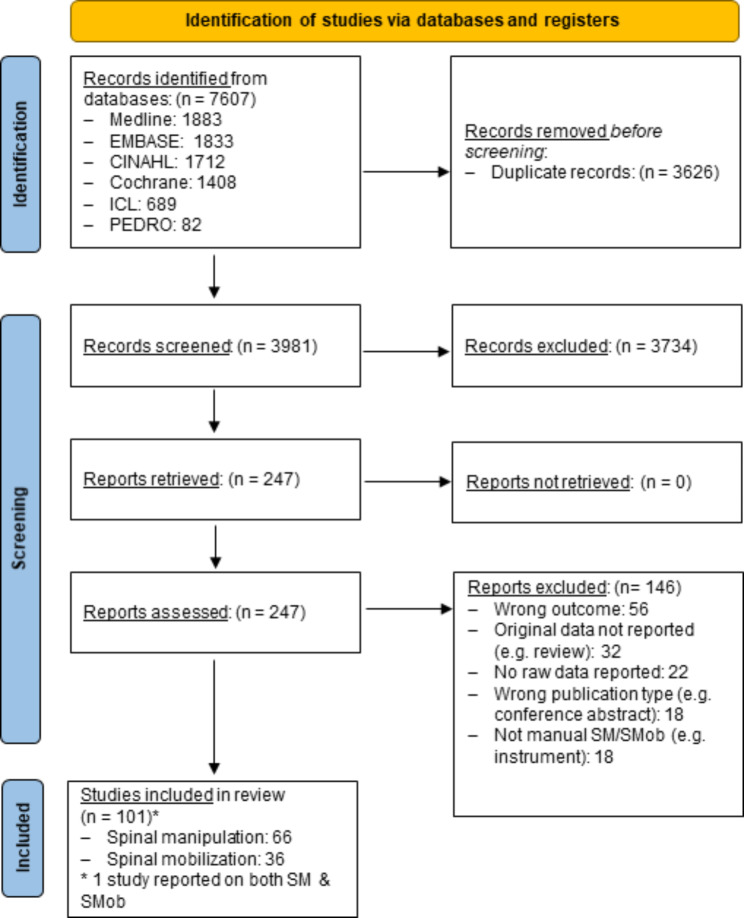
Methods: This scoping literature review is reported following the Preferred Reporting Items for Scoping Reviews (PRISMA-ScR) statement. Databases were searched from inception to October 2022: MEDLINE (Ovid), Embase, CINAHL, ICL, PEDro and Cochrane Library. The following search terms and their derivatives were adapted for each platform: spine, spinal, manipulation, mobilization or mobilisation, musculoskeletal, chiropractic, osteopathy, physiotherapy, naprapathy, force, motor skill, biomechanics, dosage, dose-response, education, performance, psychomotor, back, neck, spine, thoracic, lumbar, pelvic, cervical and sacral. Data were extracted and reported descriptively for the following domains: general study characteristics, number of and characteristics of individuals who delivered/received SM, region treated, equipment used and force-time characteristics of SM.
Results: Of 7,607 records identified, 66 (0.9%) fulfilled the eligibility criteria and were included in the analysis. Of these, SM was delivered to the cervical spine in 12 (18.2%), the thoracic spine in 40 (60.6%) and the lumbopelvic spine in 19 (28.8%) studies. In 6 (9.1%) studies, the spinal region was not specified. For SM applied to all spinal regions, force-time characteristics were: preload force (range: 0-671N); peak force (17-1213N); rate of force application (202-8700N/s); time to peak thrust force (12-938ms); and thrust duration (36-2876ms).
Conclusions: Considerable variability in the reported kinetic force-time characteristics of SM exists. Some of this variability is likely due to differences in SM delivery (e.g. different clinicians) and the measurement equipment used to quantify force-time characteristics. However, improved reporting in certain key areas could facilitate more sophisticated syntheses of force-time characteristics data in the future. Such syntheses could provide the foundation upon which dose-response estimates regarding the clinical effectiveness of SM are made.
Keywords: Biomechanics; Force-time characteristics; Kinematics; Kinetics; Spinal manipulation; Spine Pain.
© 2023. Chiropractic and Osteopathic College of Australasia, European Academy of Chiropractic, The Royal College of Chiropractors, Nordic Institute of Chiropractic and Clinical Biomechanics and BioMed Central Ltd.
Conflict of interest statement
The authors declare that they have no competing interests.
References
-
- Vos T, Lim SS, Abbafati C, Abbas KM, Abbasi M, Abbasifard M, et al. Global burden of 369 diseases and injuries in 204 countries and territories, 1990–2019: a systematic analysis for the global burden of Disease Study 2019. The Lancet. 2020;396(10258):1204–22. doi: 10.1016/S0140-6736(20)30925-9. - DOI - PMC - PubMed
-
- Ferreira ML, de Luca K, Haile LM, Steinmetz JD, Culbreth GT, Cross M, et al. Global, regional, and national burden of low back pain, 1990–2020, its attributable risk factors, and projections to 2050: a systematic analysis of the global burden of Disease Study 2021. Lancet Rheumatol. 2023;5(6):e316–29. doi: 10.1016/S2665-9913(23)00098-X. - DOI - PMC - PubMed
Publication types
MeSH terms
LinkOut - more resources
Full Text Sources
Medical
