


Wastewater Surveillance Data as a Complement to Emergency Department Visit Data for Tracking Incidence of Influenza A and Respiratory Syncytial Virus - Wisconsin, August 2022-March 2023
- PMID: 37708080
- PMCID: PMC10511267
- DOI: 10.15585/mmwr.mm7237a2
Wastewater Surveillance Data as a Complement to Emergency Department Visit Data for Tracking Incidence of Influenza A and Respiratory Syncytial Virus - Wisconsin, August 2022-March 2023
Abstract
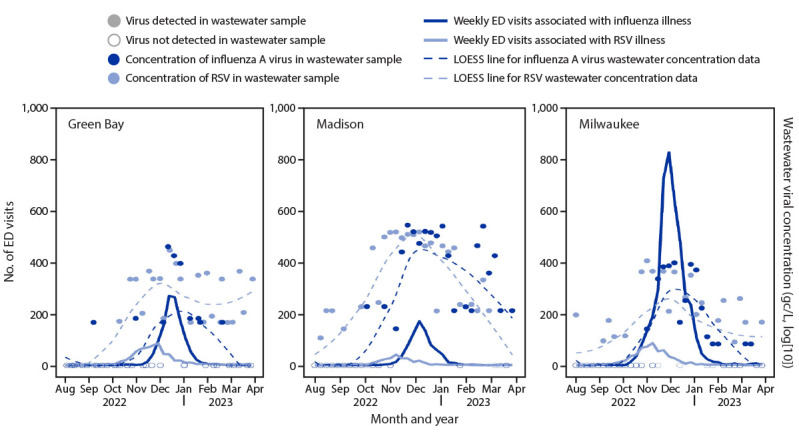
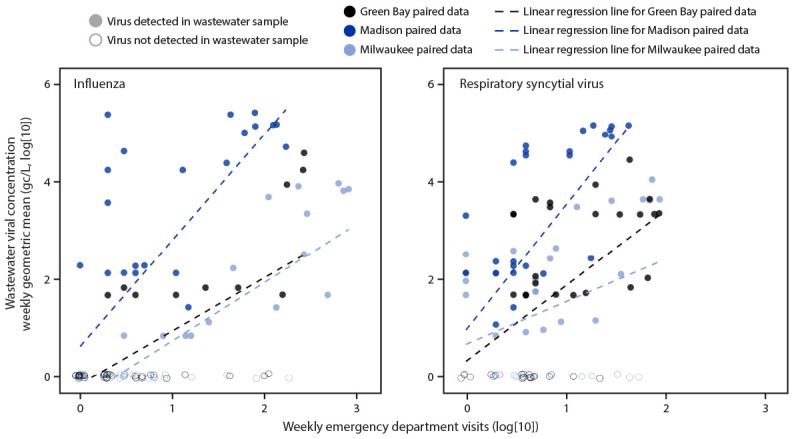
Wastewater surveillance has been used to assist public health authorities in tracking local transmission of SARS-CoV-2. The usefulness of wastewater surveillance to track community spread of other respiratory pathogens, including influenza virus and respiratory syncytial virus (RSV), is less clear. During the 2022-23 respiratory diseases season, concentrations of influenza A virus and RSV in wastewater samples in three major Wisconsin cities were compared with emergency department (ED) visits associated with these pathogens. In all three cities, higher concentrations of influenza A virus and RSV in wastewater were associated with higher numbers of associated ED visits (Kendall's tau range = 0.50-0.63 for influenza-associated illness and 0.30-0.49 for RSV-associated illness). Detections of both influenza A virus and RSV in wastewater often preceded a rise in associated ED visits for each pathogen, and virus material remained detectable in wastewater for up to 3 months after pathogen-specific ED visits declined. These results demonstrate that wastewater surveillance has the potential to complement conventional methods of influenza and RSV surveillance, detecting viral signals earlier and for a longer duration than do clinical data. Continued use of wastewater surveillance as a supplement to established surveillance systems such as ED visits might improve local understanding and response to seasonal respiratory virus outbreaks.
Conflict of interest statement
All authors have completed and submitted the International Committee of Medical Journal Editors form for disclosure of potential conflicts of interest. Martin Shafer reports serving on several Association of Public Health Laboratories advisory boards that support wastewater surveillance practices. Melissa K. Schussman reports institutional support from the University of Wisconsin Milwaukee Foundation. Rebecca B. Fahney reports institutional support from Wisconsin Alumni Research Foundation (WARF) COVID-19 Challenge and unpaid membership on the Midwest Society of Environmental Toxicology and Chemistry board. Dagmara S. Antkiewicz reports institutional support from WARF COVID-19 Challenge and unpaid membership on the Midwest Society of Environmental Toxicology and Chemistry board. No other potential conflicts of interest were disclosed.
Figures
References
-
- Boehm AB, Hughes B, Duong D, et al. Wastewater concentrations of human influenza, metapneumovirus, parainfluenza, respiratory syncytial virus, rhinovirus, and seasonal coronavirus nucleic-acids during the COVID-19 pandemic: a surveillance study. Lancet Microbe 2023;4:e340–8. 10.1016/S2666-5247(22)00386-X - DOI - PMC - PubMed
-
- Hughes B, Duong D, White BJ, et al. Respiratory syncytial virus (RSV) RNA in wastewater settled solids reflects RSV clinical positivity rates. Environ Sci Technol Lett 2022;9:173–8. 10.1021/acs.estlett.1c00963 - DOI
MeSH terms
Substances
LinkOut - more resources
Full Text Sources
Medical
Miscellaneous
