. 2023 Sep 14;13(1):15189.
doi: 10.1038/s41598-023-42154-6.

Pipeline validation for the identification of antimicrobial-resistant genes in carbapenem-resistant Klebsiella pneumoniae

Affiliations

Pipeline validation for the identification of antimicrobial-resistant genes in carbapenem-resistant Klebsiella pneumoniae

Andressa de Almeida Vieira et al. Sci Rep. .

Abstract

Antimicrobial-resistant Klebsiella pneumoniae is a global threat to healthcare and an important cause of nosocomial infections. Antimicrobial resistance causes prolonged treatment periods, high mortality rates, and economic impacts. Whole Genome Sequencing (WGS) has been used in laboratory diagnosis, but there is limited evidence about pipeline validation to parse generated data. Thus, the present study aimed to validate a bioinformatics pipeline for the identification of antimicrobial resistance genes from carbapenem-resistant K. pneumoniae WGS. Sequences were obtained from a publicly available database, trimmed, de novo assembled, mapped to the K. pneumoniae reference genome, and annotated. Contigs were submitted to different tools for bacterial (Kraken2 and SpeciesFinder) and antimicrobial resistance gene identification (ResFinder and ABRicate). We analyzed 201 K. pneumoniae genomes. In the bacterial identification by Kraken2, all samples were correctly identified, and in SpeciesFinder, 92.54% were correctly identified as K. pneumoniae, 6.96% erroneously as Pseudomonas aeruginosa, and 0.5% erroneously as Citrobacter freundii. ResFinder found a greater number of antimicrobial resistance genes than ABRicate; however, many were identified more than once in the same sample. All tools presented 100% repeatability and reproducibility and > 75% performance in other metrics. Kraken2 was more assertive in recognizing bacterial species, and SpeciesFinder may need improvements.


Conflict of interest statement

The authors declare no competing interests.

Figures
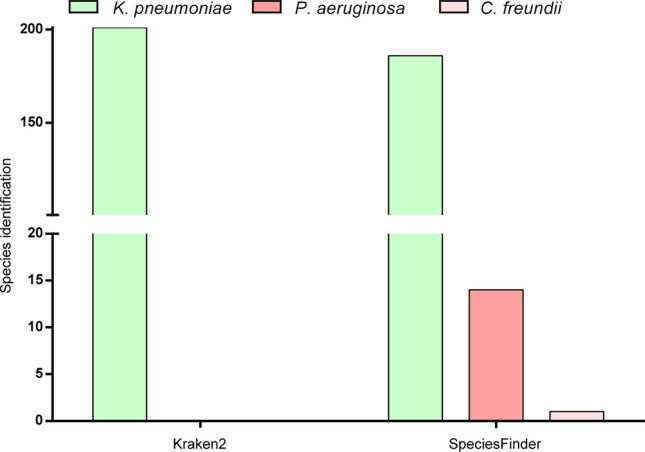
Figure 1
Figure 1
Bacteria identified by Kraken and SpeciesFinder databases.
Figure 2
Figure 2
Resistance genes found by ResFinder and ABRicate databases in 201 SRAs (A). Same gene was indicated more than once in each sample (B). Results were presented as mean ± SEM and analyzed by Student's t test. * means statistical difference from the ResFinder group (p ≤ 0.05).
Figure 3
Figure 3
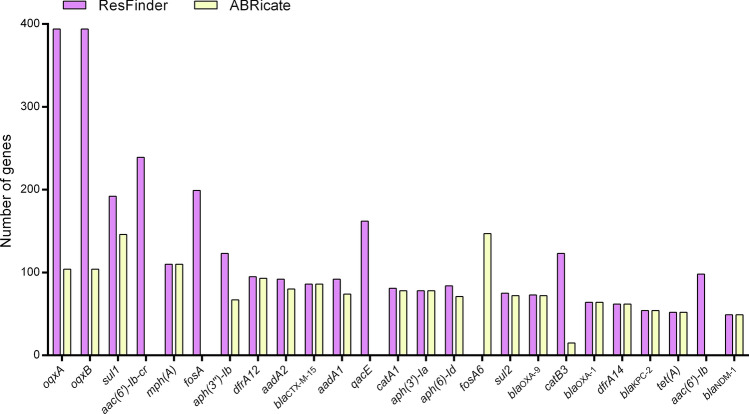
Twenty-five genes most frequently identified by ResFinder and ABRicate databases.
Figure 4
Figure 4
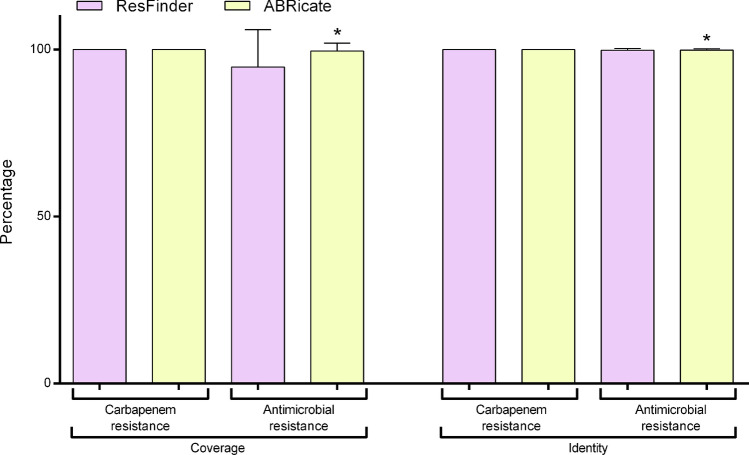
Percent coverage and identity of antimicrobial resistance genes found by ResFinder and ABRicate databases. Results were presented as mean ± SEM and analyzed by Student's t test. * means statistical difference from the ResFinder group (p ≤ 0.05).
Figure 5
Figure 5
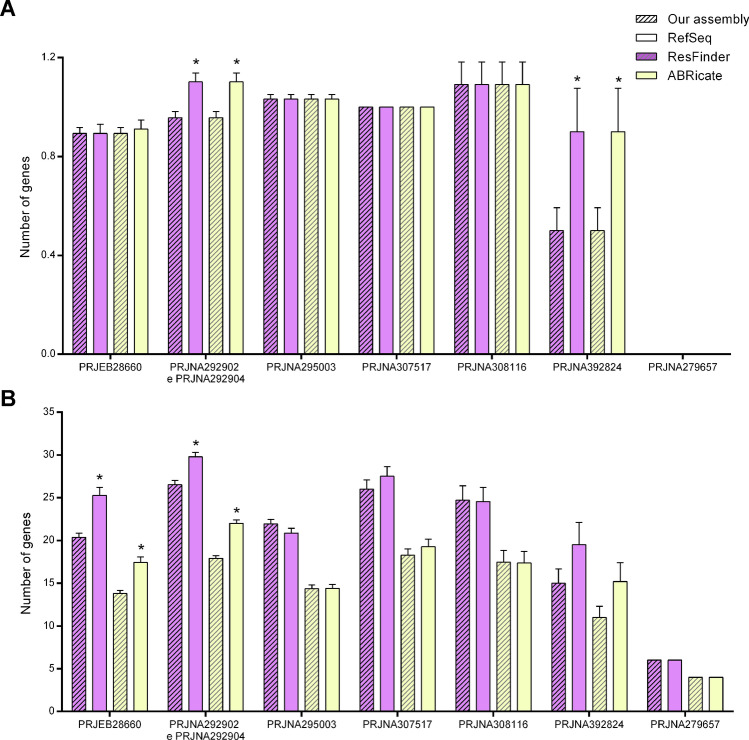
Resistance genes identified by ResFinder and ABRicate databases using the samples assembled using the pipeline described in this study and their RefSeq. Carbapenem resistance genes (A) and all antimicrobial resistance genes identified (B) by the databases in each bioproject. Results were presented as mean ± SEM and analyzed by Student's t test. * means statistical difference from our assembly (p ≤ 0.05).
Figure 6
Figure 6
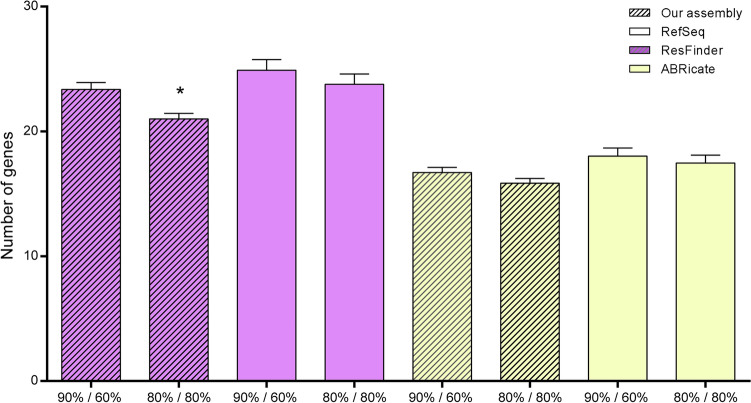
Resistance genes identified by ResFinder with BLAST parameters set at 80% identity and coverage (default parameters of ABRicate) and ABRicate with BLAST parameters set at 90% identity and 60% coverage (default parameters of ResFinder), using the samples assembled using the pipeline described in this study and their RefSeq. Results were presented as mean ± SEM and analyzed by Student's t test. * means statistical difference from 90% identity and 60% coverage (p ≤ 0.05).
Figure 7
Figure 7
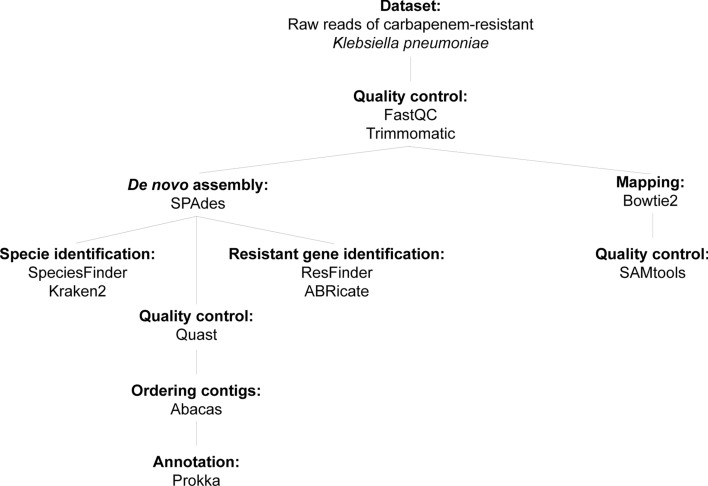
Bioinformatics pipeline used in the work.

References

    1. Schürch AC, Van Schaik W. Challenges and opportunities for whole-genome sequencing–based surveillance of antibiotic resistance. Ann. N.Y. Acad. Sci. 2017;1388(1):108–120. doi: 10.1111/nyas.13310. - DOI - PubMed
    1. van Camp PJ, Haslam DB, Porollo A. Prediction of antimicrobial resistance in gram-negative bacteria from whole-genome sequencing data. Front. Microbiol. 2020;11:1–13. doi: 10.3389/fmicb.2020.01013. - DOI - PMC - PubMed
    1. Magiorakos AP, et al. Multidrug-resistant, extensively drug-resistant and pandrug-resistant bacteria: An international expert proposal for interim standard definitions for acquired resistance. Clin. Microbiol. Infect. 2012;18(3):268–281. doi: 10.1111/j.1469-0691.2011.03570.x. - DOI - PubMed
    1. Merla C, et al. Description of Klebsiella spallanzanii sp. nov. and of Klebsiella pasteurii. Front. Microbiol. 2019;10:1–9. doi: 10.3389/fmicb.2019.02360. - DOI - PMC - PubMed
    1. Patro LPP, Rathinavelan T. Targeting the sugary armor of Klebsiella species. Front. Cell. Infect. Microbiol. 2019;9:1–23. doi: 10.3389/fcimb.2019.00367. - DOI - PMC - PubMed

Publication types

MeSH terms