


Multidrug-resistant Gram-negative bacterial infections and associated factors in a Kenyan intensive care unit: a cross-sectional study
- PMID: 37710247
- PMCID: PMC10500940
- DOI: 10.1186/s12941-023-00636-5
Multidrug-resistant Gram-negative bacterial infections and associated factors in a Kenyan intensive care unit: a cross-sectional study
Abstract
Background: Patients admitted to intensive care units (ICU) are at risk of Gram-negative bacteria (GNB) infections, especially those caused by multidrug-resistant (MDR) isolates, increasing morbidity, mortality, and healthcare costs. However, epidemiological surveillance data on MDR bacteria to inform infection prevention and control (IPCs) interventions is limited in our study setting. Here we assessed the prevalence and factors associated with GNB infections in ICU- patients admitted in our study setting.
Methods: This was a hospital-based cross-sectional study among patients admitted to ICU at the Nairobi West Hospital, Kenya, between January and October 2022. Altogether, we recruited 162 patients, excluding those hospitalized for less than 48 h and declining consent, and collected demographics and clinical data by case report form. Blood, wound and throat swab, ascetic tap, stool, urine, tracheal aspirate, and sputum samples were collected cultured. Isolates identity and antimicrobial susceptibility were elucidated using the BD Phoenix system.
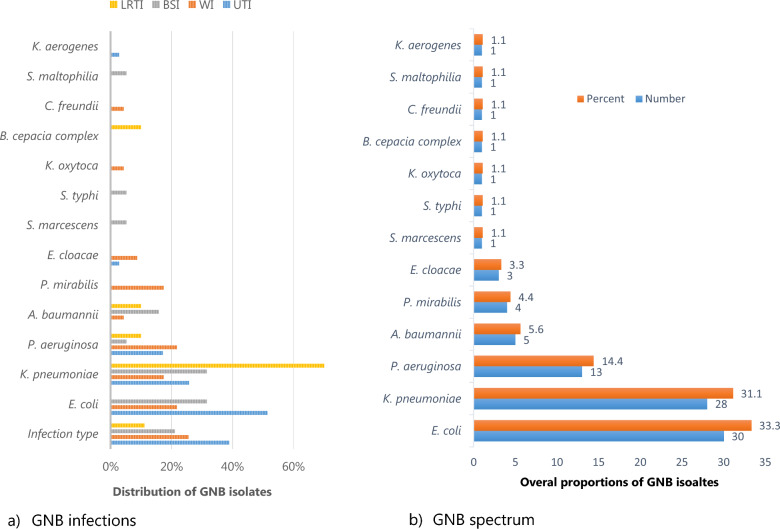
Results: The prevalence of GNB infections was 55.6%, predominated by urinary tract infections (UTIs). We recovered 13 GNB types, with Escherichia coli (33.3%) and Klebsiella pneumoniae (31.1%) as the most common isolates. Factors associated with GNB infections were a history of antibiotic use (aOR = 4.23, p = 0.001), nasogastric tube use (NGT, aOR = 3.04, p = 0.013), respiratory tract (RT, aOR = 5.3, p = 0.005) and cardiovascular (CV, aOR = 5.7, p = 0.024) conditions. 92% of the isolates were MDR,predominantly Escherichia coli, Klebsiella pneumoniae, and Pseudomonas aeruginosa.
Conclusion: We report a high prevalence of MDR-GNB infections, predominated by UTI, in ICU, whereby patients with a history of antibiotic use, using the NGT, and having RT and CV conditions were at increased risk. To improve the management of ICU-admitted patients, continuous education, training, monitoring, evaluation and feedback on infection prevention and control are warranted in our study setting.
Keywords: Gram-negative bacteria; Infections; Multidrug-resistance; Risk factors.
© 2023. BioMed Central Ltd., part of Springer Nature.
Conflict of interest statement
The authors declare that they have no competing interest.
Figures
References
-
- Abraham EP. The antibiotics. Compr Biochem. 1963;11(4):181–224. doi: 10.1016/B978-1-4831-9711-1.50022-3. - DOI
-
- Sengupta S, Barman P, Lo J. Opportunities to overcome implementation challenges of infection prevention and control in low-middle income countries. Curr Treat Options Infect Dis. 2019;11(3):267–280. doi: 10.1007/s40506-019-00200-w. - DOI
MeSH terms
Substances
LinkOut - more resources
Full Text Sources
Medical
Molecular Biology Databases
Miscellaneous
