


Frequency of urinary pesticides in children: a scoping review
- PMID: 37711246
- PMCID: PMC10497881
- DOI: 10.3389/fpubh.2023.1227337
Frequency of urinary pesticides in children: a scoping review
Abstract
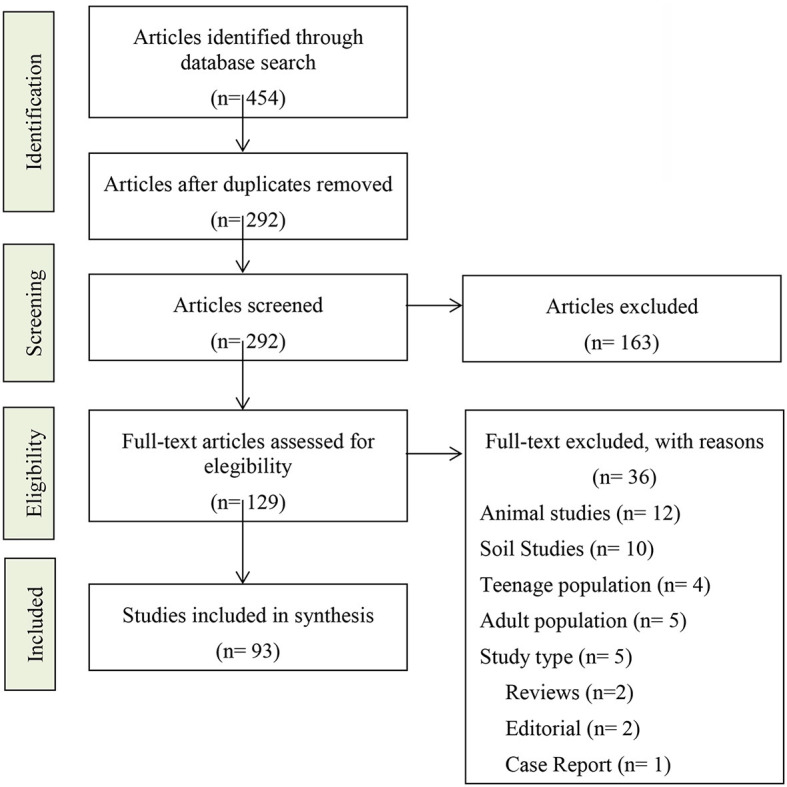
Pesticides are any mix of ingredients and substances used to eliminate or control unwanted vegetable or animal species recognized as plagues. Its use has been discussed in research due to the scarcity of strong scientific evidence about its health effects. International literature is still insufficient to establish a global recommendation through public policy. This study aims to explore international evidence of the presence of pesticides in urine samples from children and their effects on health through a scoping review based on the methodology described by Arksey and O'Malley. The number of articles resulting from the keyword combination was 454, and a total of 93 manuscripts were included in the results and 22 were complementary. Keywords included in the search were: urinary, pesticide, children, and childhood. Children are exposed to pesticide residues through a fruit and vegetable intake environment and household insecticide use. Behavioral effects of neural damage, diabetes, obesity, and pulmonary function are health outcomes for children that are commonly studied. Gas and liquid chromatography-tandem mass spectrometry methods are used predominantly for metabolite-pesticide detection in urine samples. Dialkylphosphates (DAP) are common in organophosphate (OP) metabolite studies. First-morning spot samples are recommended to most accurately characterize OP dose in children. International evidence in PubMed supports that organic diets in children are successful interventions that decrease the urinary levels of pesticides. Several urinary pesticide studies were found throughout the world's population. However, there is a knowledge gap that is important to address (public policy), due to farming activities that are predominant in these territories.
Keywords: children; exposure; glyphosate; levels; organic diet; urinary pesticide.
Copyright © 2023 Guzman-Torres, Sandoval-Pinto, Cremades, Ramírez-de-Arellano, García-Gutiérrez, Lozano-Kasten and Sierra-Díaz.
Conflict of interest statement
The authors declare that the research was conducted in the absence of any commercial or financial relationships that could be construed as a potential conflict of interest.
References
-
- Pulido N. Yuval Noah Harari. De animales a dioses. Una breve historia de la humanidad. Barcelona, 2014. Debate. Trad. de Joandomènec Ros. Revista Geográfica Venezolana, Vol. 58. (2017). p. 514–9.
-
- National Institute of Environmental Health Sciences. Pesticides. Pesticides. (2021). Available online at: https://www.niehs.nih.gov/health/topics/agents/pesticides/index.cfm (accessed November 11, 2021).
Publication types
MeSH terms
Substances
LinkOut - more resources
Full Text Sources
Medical
Miscellaneous
