


Association between retinol binding protein-4 and psoriasis vulgaris: a systematic review and meta-analysis
- PMID: 37711744
- PMCID: PMC10498455
- DOI: 10.3389/fmed.2023.1208969
Association between retinol binding protein-4 and psoriasis vulgaris: a systematic review and meta-analysis
Abstract
Background: Psoriasis vulgaris is a chronic skin disease which is related to cardiovascular and metabolic diseases. In the pathogenesis of these diseases, adipokines, including retinol binding protein-4 (RBP-4), play crucial roles. Studies have also shown that RBP-4 might be a meaningful factor in psoriasis however, relying on the analysis of a single study have some drawbacks.
Objective: To evaluate the association between RBP-4 and psoriasis vulgaris more comprehensively.
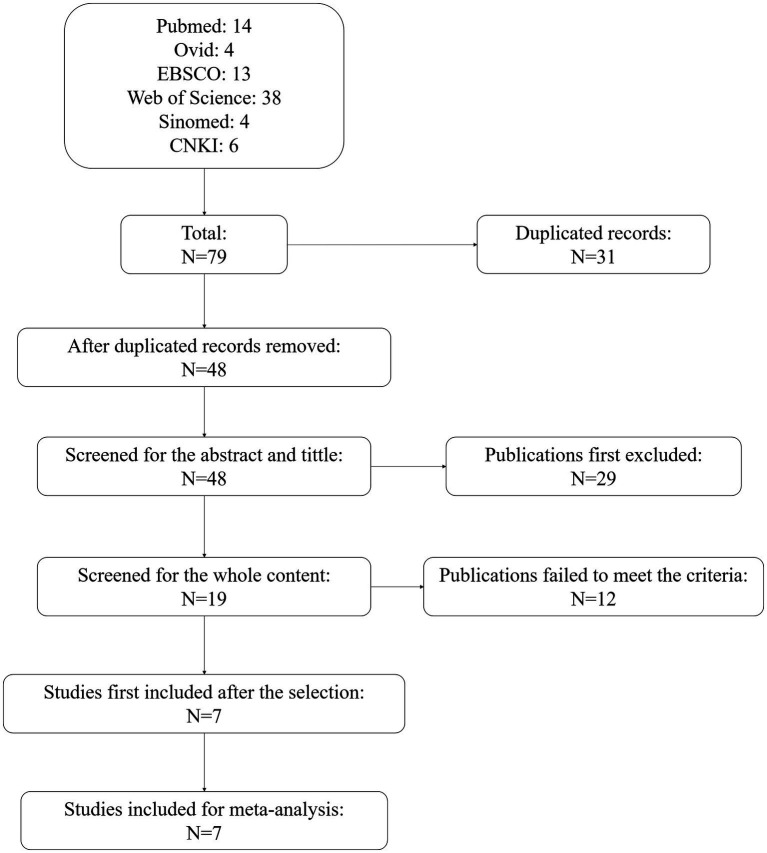
Methods: Six databases were searched to obtain relevant publications. The selection of the included studies was based on a criteria. The standardized mean difference (SMD) was used for analysis. A value of p < 0.05 was defined as significance.
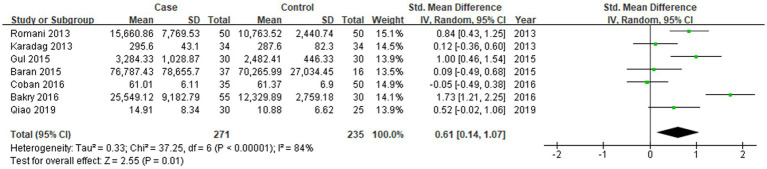
Results: Seven studies were included, with 271 cases and 235 controls. In the comparison between patients and controls, the merged data suggested that levels of RBP-4 were significantly higher in patients (SMD = 0.61, 95%CI: 0.14, 1.07, p < 0.05). In five studies containing the data of RBP-4 levels before and after treatment, no significance was found, either for RBP-4 levels in the after-treatment group and control group in these five studies (p > 0.05). Subgroup analysis was conducted based on the therapy method. Patients with systematic treatment showed a significant decrease of BRP-4 level after the treatment (SMD = -0.64, 95%CI: -1.26, -0.03, p < 0.05).
Conclusion: For patients with psoriasis vulgaris, RBP-4 levels are elevated, and systematic treatment can lower these levels. RBP-4 might act as a key indicator for the diagnosis, efficacy assessment, and comorbidity monitoring of the patients. Further studies with well-designed protocols and enlarged populations are still needed.
Keywords: comorbidity; dermatology; meta-analysis; psoriasis; retinol binding protein.
Copyright © 2023 Gao, Cui and Cheng.
Conflict of interest statement
The authors declare that the research was conducted in the absence of any commercial or financial relationships that could be construed as a potential conflict of interest.
Figures


References
-
- Lerman JB, Joshi AA, Chaturvedi A, Aberra TM, Dey AK, Rodante JA, et al. . Coronary plaque characterization in psoriasis reveals high-risk features that improve after treatment in a prospective observational study. Circulation. (2017) 136:263–76. doi: 10.1161/CIRCULATIONAHA.116.026859, PMID: - DOI - PMC - PubMed
Publication types
LinkOut - more resources
Full Text Sources
Miscellaneous
