Review
. 2023 Aug 30:13:1237164.
doi: 10.3389/fcimb.2023.1237164. eCollection 2023.

Bacterial biofilms in the human body: prevalence and impacts on health and disease

Affiliations
Review

Bacterial biofilms in the human body: prevalence and impacts on health and disease

Elena K Perry et al. Front Cell Infect Microbiol. .

Abstract

Bacterial biofilms can be found in most environments on our planet, and the human body is no exception. Consisting of microbial cells encased in a matrix of extracellular polymers, biofilms enable bacteria to sequester themselves in favorable niches, while also increasing their ability to resist numerous stresses and survive under hostile circumstances. In recent decades, biofilms have increasingly been recognized as a major contributor to the pathogenesis of chronic infections. However, biofilms also occur in or on certain tissues in healthy individuals, and their constituent species are not restricted to canonical pathogens. In this review, we discuss the evidence for where, when, and what types of biofilms occur in the human body, as well as the diverse ways in which they can impact host health under homeostatic and dysbiotic states.

Keywords: adhesin; aggregate; antibiotic tolerance; biofilm; carcinogenesis; chronic infection; extracellular matrix; microbiome.


Conflict of interest statement

Author EP and M-WT were employed by Genentech, Inc. This study received funding from Genentech, Inc. The funder had the following involvement with the study: employer of the authors.

Figures
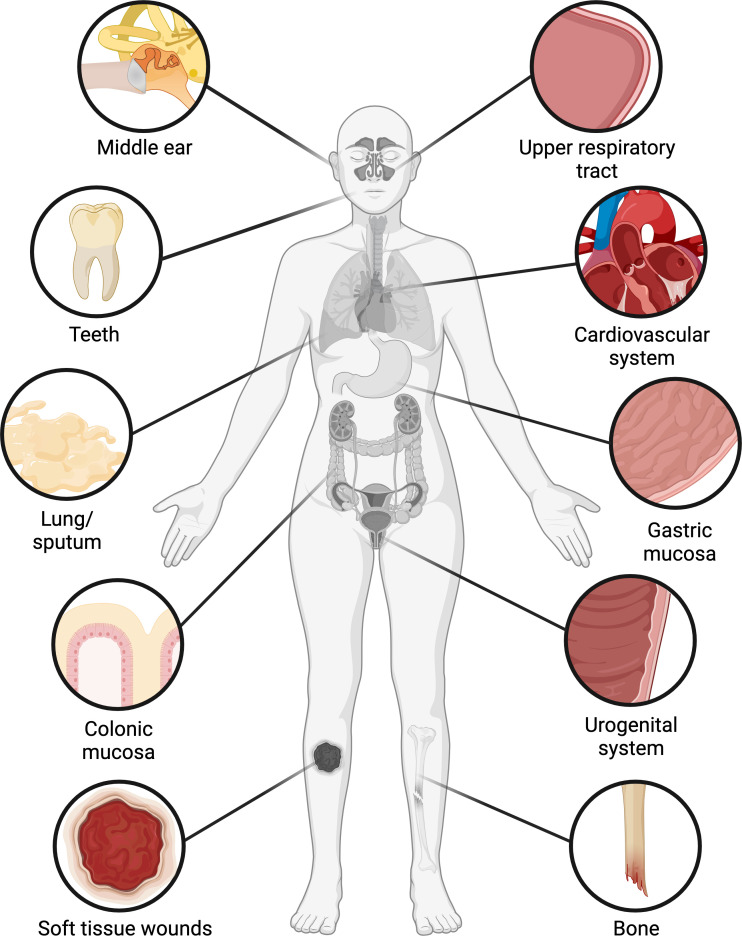
Figure 1
Figure 1
Occurrence of biofilms in the human body. Biofilms have been found in numerous organs and tissues, including the middle ear and upper respiratory tract, oral cavity, cardiovascular system, lung, stomach, colon, urogenital system, bone, and soft tissue wounds. In the oral cavity, colon, and female reproductive tract, biofilms occur with varying frequencies in clinically healthy patients as well as those with infections or underlying conditions, while in other tissues biofilms are generally associated with infections. Figure created with BioRender.com.
Figure 2
Figure 2
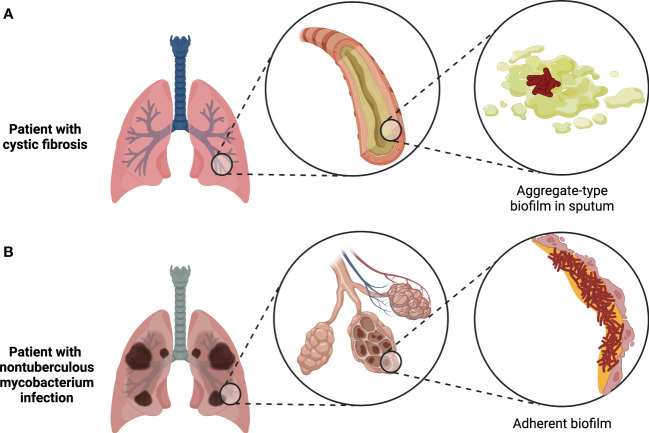
Two major types of biofilms found in the human body. Tissue-associated biofilms generally either take the form of bacterial aggregates suspended in mucus or other host secretions, as in the case of biofilms found in cystic fibrosis patient sputum (A), or adherent biofilms attached to the surface of the tissue, as in the case of biofilms formed by nontuberculous mycobacteria during chronic infections (B). Figure created with BioRender.com.
Figure 3
Figure 3
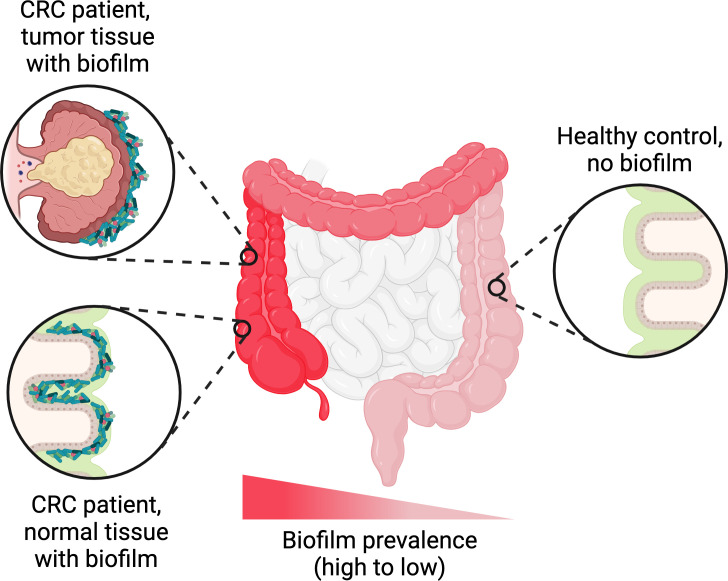
Trends in biofilm occurrence in the distal gastrointestinal tract. Adherent biofilms on the colonic epithelium are found in a higher proportion of patients with conditions such as colorectal cancer (CRC), inflammatory bowel disease, or irritable bowel syndrome compared to healthy controls. In biofilm-positive CRC patients, the biofilms are generally not restricted to the tumor itself and can also be found on normal colonic tissue. Regardless of the patient’s underlying condition, the frequency of biofilm detection follows a decreasing trend along the longitudinal axis of the colon, with higher frequencies in the ascending colon compared to the transverse and descending colon. Figure created with BioRender.com.

References

    1. Abed J., Emgård J. E. M., Zamir G., Faroja M., Almogy G., Grenov A., et al. (2016). Fap2 mediates Fusobacterium nucleatum colorectal adenocarcinoma enrichment by binding to tumor-expressed gal-galNAc. Cell Host Microbe 20, 215–225. doi: 10.1016/j.chom.2016.07.006 - DOI - PMC - PubMed
    1. Ahn S.-J., Burne R. A. (2007). Effects of oxygen on biofilm formation and the atlA autolysin of Streptococcus mutans . J. Bacteriol 189, 6293–6302. doi: 10.1128/jb.00546-07 - DOI - PMC - PubMed
    1. Al-Ahmad A., Wunder A., Auschill T. M., Follo M., Braun G., Hellwig E., et al. (2007). The in vivo dynamics of Streptococcus spp., Actinomyces naeslundii, Fusobacterium nucleatum and Veillonella spp. in dental plaque biofilm as analysed by five-colour multiplex fluorescence in situ hybridization. J. Med. Microbiol. 56, 681–687. doi: 10.1099/jmm.0.47094-0 - DOI - PubMed
    1. Alhede M., Alhede M., Qvortrup K., Kragh K. N., Jensen P.Ø., Stewart P. S., et al. (2020). The origin of extracellular DNA in bacterial biofilm infections in vivo . Pathog. Dis. 78, ftaa018. doi: 10.1093/femspd/ftaa018 - DOI - PMC - PubMed
    1. Alhede M., Bjarnsholt T., Jensen P.Ø., Phipps R. K., Moser C., Christophersen L., et al. (2009). Pseudomonas aeruginosa recognizes and responds aggressively to the presence of polymorphonuclear leukocytes. Microbiology 155, 3500–3508. doi: 10.1099/mic.0.031443-0 - DOI - PubMed

Publication types

LinkOut - more resources