


Maternal breastfeeding is associated with offspring microbiome diversity; a secondary analysis of the MicrobeMom randomized control trial
- PMID: 37720155
- PMCID: PMC10502216
- DOI: 10.3389/fmicb.2023.1154114
Maternal breastfeeding is associated with offspring microbiome diversity; a secondary analysis of the MicrobeMom randomized control trial
Abstract
Background: Microbial dysbiosis in infancy can influence long-term health outcomes such as childhood obesity. The aim of this study is to explore relationships among maternal well-being during pregnancy, breastfeeding, and the infant gut microbiome.
Methods: This is a secondary analysis of healthy pregnant women from the MicrobeMom study, a double-blind randomized control trial of maternal probiotic supplementation (Bifidobacterium breve 702258) versus placebo antenatally and up to 3 months postpartum. Maternal well-being was assessed using the WHO-5 well-being index at 16 weeks' and 34 weeks' gestation. Breastfeeding practices were recorded at discharge from hospital and at 1 month postpartum. Infant stool samples were obtained at 1 month of age. Next generation shotgun sequencing determined infant microbial diversity. Independent sample t-tests and Mann-Whitney U tests informed adjusted regression analysis, which was adjusted for delivery mode, antibiotics during delivery, maternal age and body mass index (BMI), and probiotic vs. control study group.
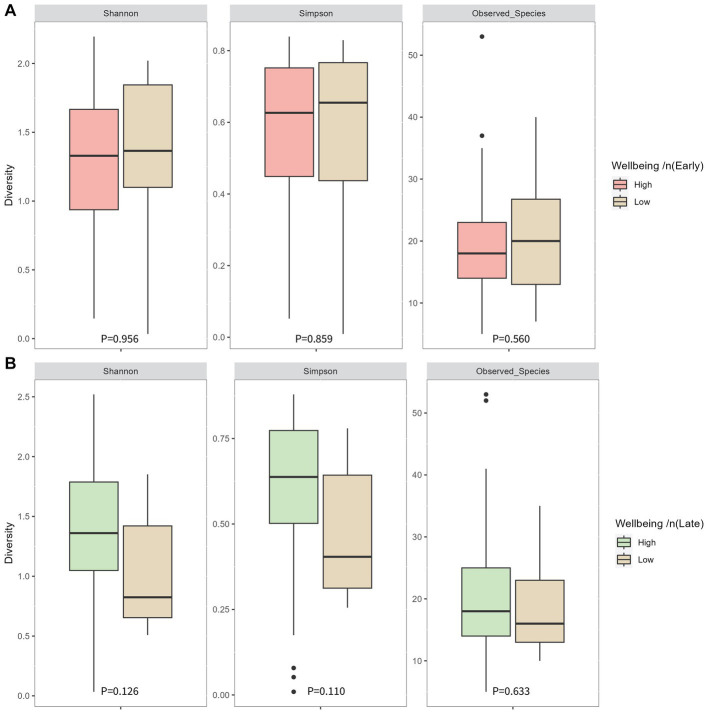
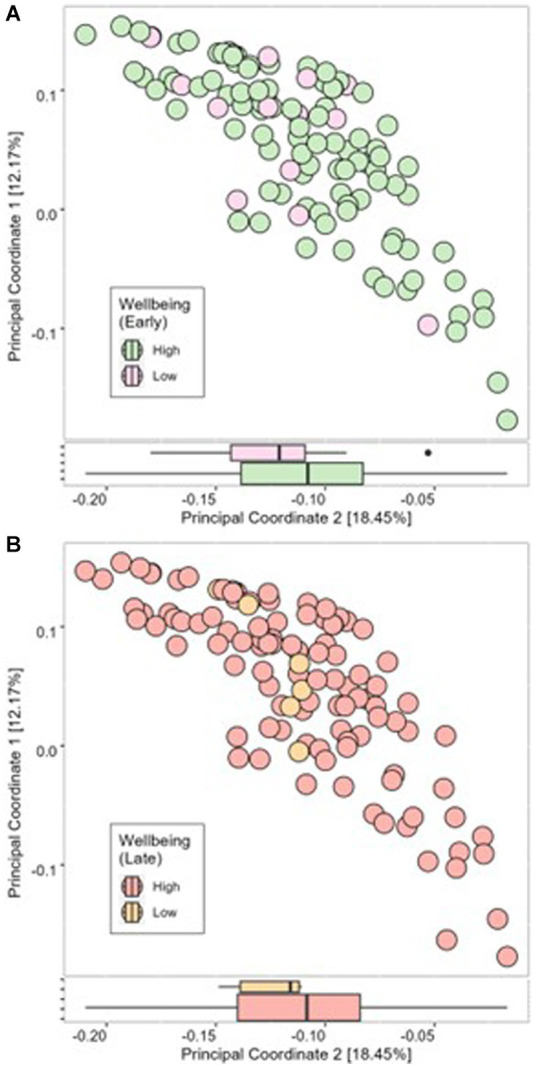
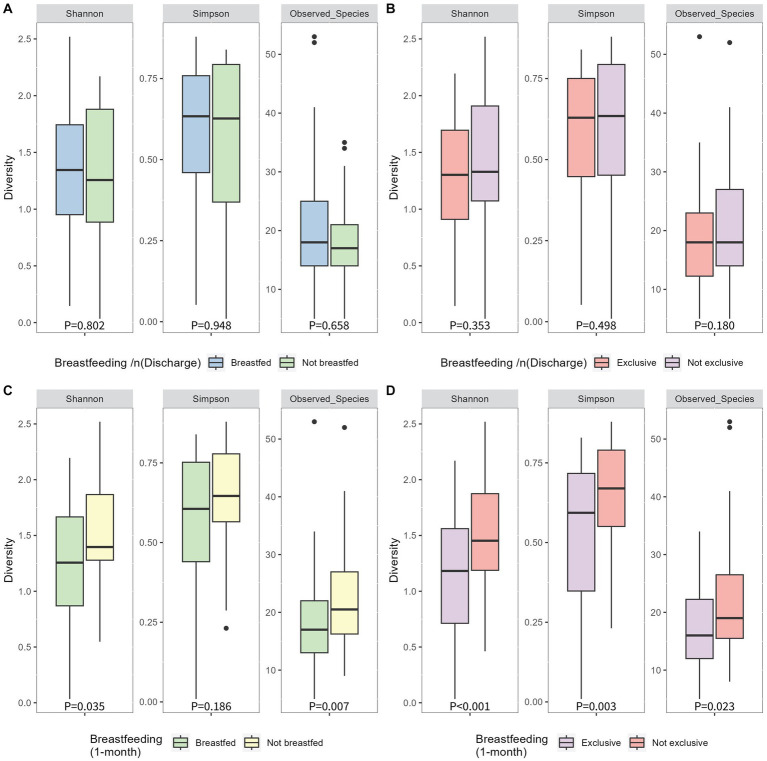
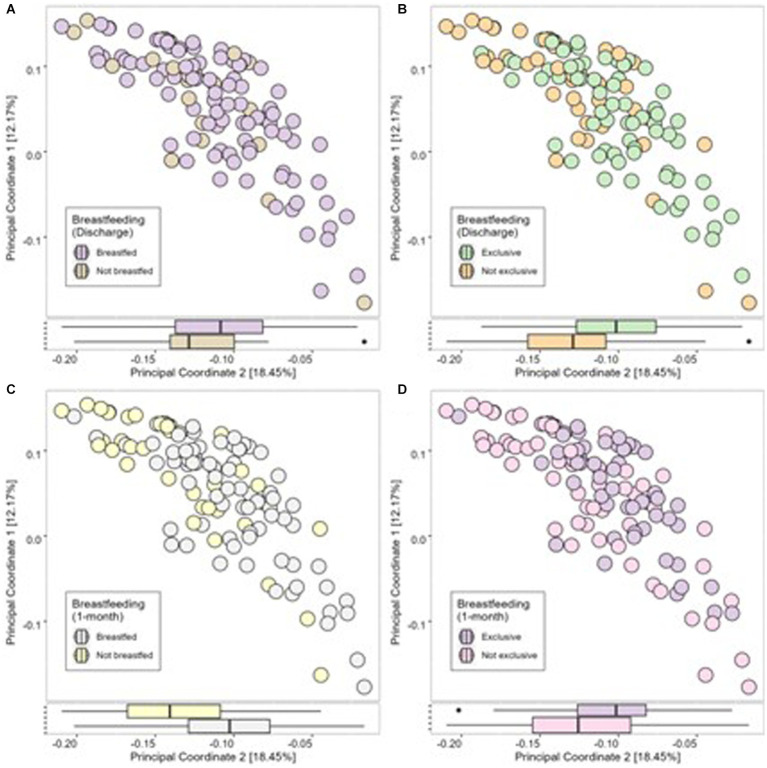
Results: Women (n = 118) with at least one measure of well-being were on average 33 years (SD 3.93) of age and 25.09 kg/m2 (SD 3.28) BMI. Exclusive breastfeeding was initiated by 65% (n = 74). Any breastfeeding was continued by 69% (n = 81) after 1 month. In early and late pregnancy, 87% (n = 97/111) and 94% (n = 107/114) had high well-being scores. Well-being was not associated with infant microbial diversity at 1 month. In adjusted analysis, exclusive breastfeeding at discharge from hospital was associated with infant microbial beta diversity (PC2; 0.254, 95% CI 0.006, 0.038). At 1 month postpartum, any breastfeeding was associated with infant microbial alpha diversity (Shannon index; -0.241, 95% CI -0.498, -0.060) and observed species; (-0.325, 95% CI -0.307, -0.060), and infant microbial beta diversity (PC2; 0.319, 95% CI 0.013, 0.045). Exclusive breastfeeding at 1 month postpartum was associated with infant alpha diversity (Shannon index -0.364, 95% CI -0.573, -0.194; Simpson index 0.339, 95% CI 0.027, 0.091), and infant's number of observed microbial species (-0.271, 95% CI -0.172, -0.037).
Conclusion: Breastfeeding practices at 1 month postpartum were associated with lower microbial diversity and observed species in infants at 1 month postpartum, which is potentially beneficial to allow greater abundance of Bifidobacterium.
Clinical trial registration: ISRCTN53023014.
Keywords: breastfeeding; infant health; microbiome; pregnancy; well-being.
Copyright © 2023 Yelverton, Killeen, Feehily, Moore, Callaghan, Geraghty, Byrne, Walsh, Lawton, Murphy, Van Sinderen, Cotter and McAuliffe.
Conflict of interest statement
The author EM was employed by PrecisionBiotics Group Ltd. The remaining authors declare that the research was conducted in the absence of any commercial or financial relationships that could be construed as a potential conflict of interest.
Figures
References
-
- Arabi S. M., Bahrami L. S., Rahnama I., Sahebkar A. (2022). Impact of synbiotic supplementation on cardiometabolic and anthropometric indices in patients with metabolic syndrome: a systematic review and meta-analysis of randomized controlled trials. Pharmacol. Res. 176:106061. doi: 10.1016/j.phrs.2022.106061, PMID: - DOI - PubMed
-
- Bech P., Olsen L. R., Kjoller M., Rasmussen N. K. (2003). Measuring well-being rather than the absence of distress symptoms: a comparison of the SF-36 mental health subscale and the WHO-five well-being scale. Int. J. Methods Psychiatr. Res. 12, 85–91. doi: 10.1002/mpr.145, PMID: - DOI - PMC - PubMed
-
- Benjamini Y., Hochberg Y. (1995). Controlling the false discovery rate: a practical and powerful approach to multiple testing. J. R. Stat. Soc. Ser. B 57, 289–300. doi: 10.1111/j.2517-6161.1995.tb02031.x - DOI
LinkOut - more resources
Full Text Sources
