


The role of dexmedetomidine in ARDS: an approach to non-intensive care sedation
- PMID: 37720511
- PMCID: PMC10502206
- DOI: 10.3389/fmed.2023.1224242
The role of dexmedetomidine in ARDS: an approach to non-intensive care sedation
Abstract
Introduction: Severe COVID-19 is a life-threatening condition characterized by complications such as interstitial pneumonia, hypoxic respiratory failure, and acute respiratory distress syndrome (ARDS). Non-pharmacological intervention with mechanical ventilation plays a key role in treating COVID-19-related ARDS but is influenced by a high risk of failure in more severe patients. Dexmedetomidine is a new generation highly selective α2-adrenergic receptor (α2-AR) agonist that provides sedative effects with preservation of respiratory function. The aim of this study is to assess how dexmedetomidine influences gas exchange during non-invasive ventilation (NIV) and high-flow nasal cannula (HFNC) in moderate to severe ARDS caused by COVID-19 in a non-intensive care setting.
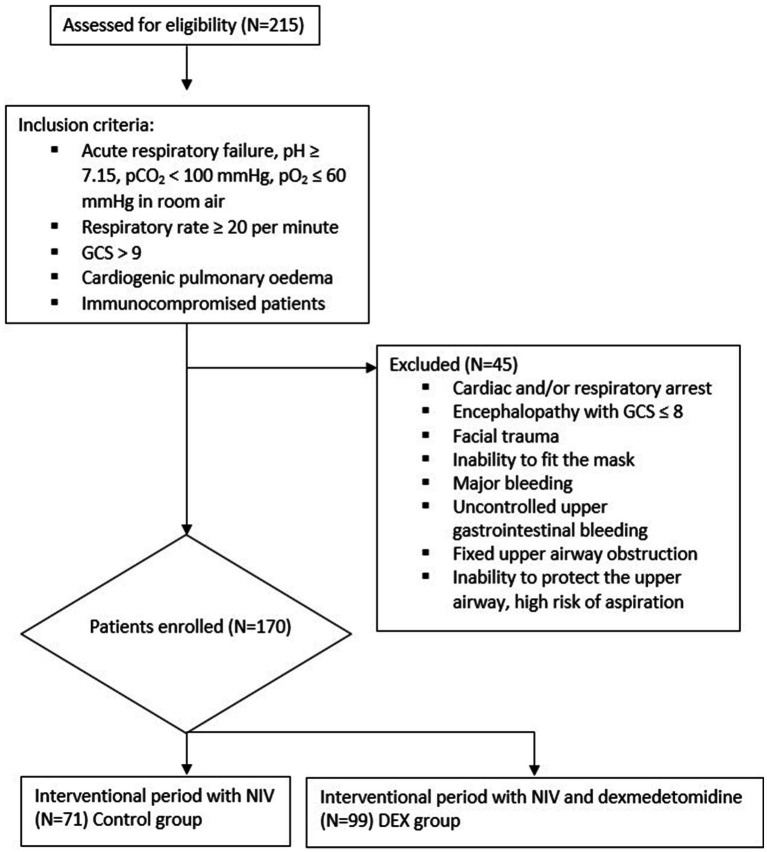
Methods: This is a single center retrospective cohort study. We included patients who showed moderate to severe respiratory distress. All included subjects had indication to NIV and were suitable for a non-intensive setting of care. A total of 170 patients were included, divided in a control group (n = 71) and a treatment group (DEX group, n = 99).
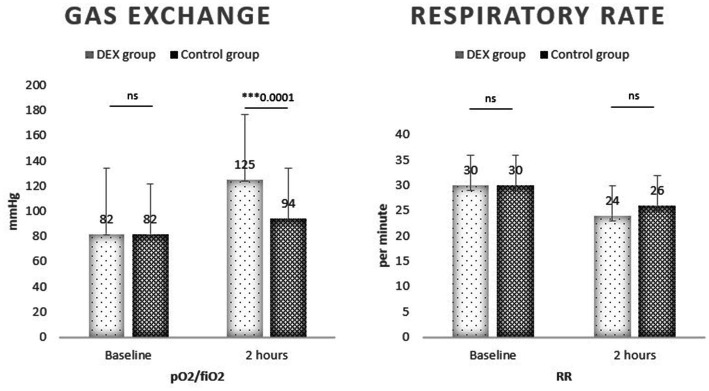
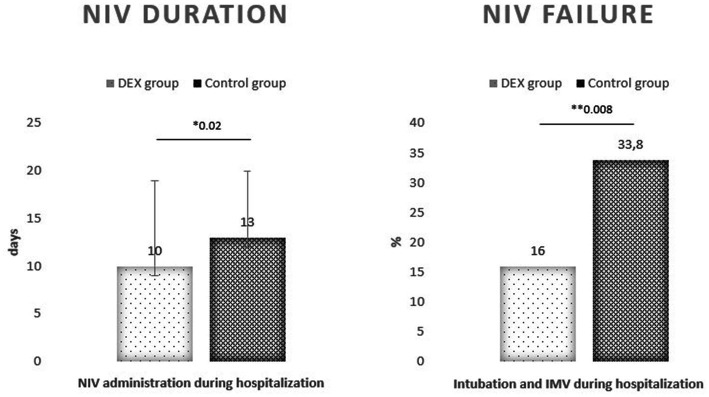
Results: A total of 170 patients were hospitalized for moderate to severe ARDS and COVID-19. The median age was 71 years, 29% females. The median Charlson comorbidity index (CCI) was 2.5. Obesity affected 21% of the study population. The median pO2/FiO2 was 82 mmHg before treatment. After treatment, the increase of pO2/FiO2 ratio was clinically and statistically significant in the DEX group compared to the controls (125 mmHg [97-152] versus 94 mmHg [75-122]; ***p < 0.0001). A significative reduction of NIV duration was observed in DEX group (10 [7-16] days vs. 13 [10-17] days; *p < 0.02). Twenty four patients required IMV in control group (n = 71) and 16 patients in DEX group (n = 99) with a reduction of endotracheal intubation of 62% (OR 0.38; **p < 0.008). A higher incidence of sinus bradycardia was observed in the DEX group.
Conclusion: Dexmedetomidine provides a "calm and arousal" status which allows spontaneous ventilation in awake patients treated with NIV and HFNC. The adjunctive therapy with dexmedetomidine is associated with a higher pO2/FiO2, lower duration of NIV, and a lower risk of NIV failure. A higher incidence of sinus bradycardia needs to be considered.
Keywords: COVID-19; acute respiratory distress syndrome; continuous positive airway pressure; high flow nasal cannula; non-invasive ventilation; pressure support ventilation; refractory hypoxemia; respiratory drive.
Copyright © 2023 Simioli, Annunziata, Coppola, Imitazione, Mirizzi, Marotta, D’Angelo and Fiorentino.
Conflict of interest statement
The authors declare that the research was conducted in the absence of any commercial or financial relationships that could be construed as a potential conflict of interest.
Figures
References
-
- Available at: https://www.worldometers.info/coronavirus/country/italy/
-
- Centers for Disease Control and Prevention . Underlying medical conditions associated with high risk for severe COVID-19: information for healthcare providers. Available at: https://www.cdc.gov/coronavirus/2019-ncov/hcp/clinical-care/underlyingco... - PubMed
LinkOut - more resources
Full Text Sources
Research Materials
